


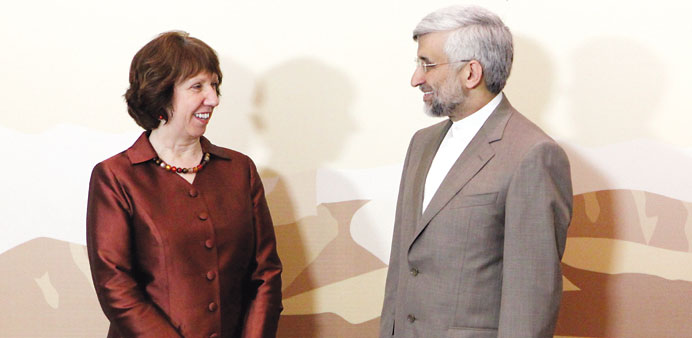
EU foreign policy chief Catherine Ashton and Iran’s top nuclear negotiator Saeed Jalili speak while meeting on the sidelines of Almaty meeting.
AFP/Almaty
World powers and Iran yesterday exchanged offers in crunch talks in Kazakhstan aimed at breaking a decade of deadlock over Tehran’s nuclear drive despite low expectations of any deal.
The two-day meeting in the Kazakh city of Almaty comes as sanctions bite against the Islamic republic and Israel still refuses to rule out air strikes to knock out Iran’s suspected nuclear weapons drive.
The first round of closed-door talks involving the United States, Russia, China, France, Britain and Germany lasted several hours. They were expected to later adjourn and resume today, Kazakh officials following the talks said.
“We have come here with a revised offer and we have come to engage with Iran in a meaningful way,” EU foreign policy chief Catherine Ashton, who negotiates with Iran on behalf of the world powers, said in a statement.
She said the ambition was that “we see progress by the end of the meeting.”
The world powers are offering Iran permission to resume its gold and precious metals trade as well as some international banking activity which are currently under sanctions, Western officials told AFP.
But in exchange, Iran will have to limit sensitive uranium enrichment operations that the world powers fear could be used to make a nuclear bomb, the sources added.
Iran would have to stop enriching uranium to 20% and shut down its controversial Fordo plant where such activity occurs, a Western official said.
An Iranian source said Tehran had come up with a counter-offer, whose final nature would be determined by terms posed by the big powers.
“Which version we present depends on what the 5 1 (world powers) put forward. Our offer will be of the same weight as their offer,” the Iranian delegation source said.
The source stressed “there was no question” of Tehran closing the Fordo plant where uranium is enriched to up to 20% — a level seen as being within technical reach of weapons-grade matter.
But Iran could envisage halting the enrichment of uranium to 20%, if all international sanctions against it were dropped, including UN Security Council measures, the source said.
Hopes are low of a breakthrough at the talks -- the first such since a meeting in Moscow in June 2012 -- and Iranian officials have doused expectations by insisting they will offer no special concessions.
“It’s clear that no one expects everyone to walk out of here in Almaty with a done deal. This is a negotiating process,” said Ashton’s spokesman Michael Mann.
Iran denies it is developing nuclear weapons and wants the world to respect its “right” to enrich uranium — something current UN sanctions say it cannot do because of its refusal to co-operate with nuclear inspectors.
“We don’t expect any breakthrough. The Iranians have made different declarations in the last days. It depends if you take the positive or the negative ones,” said one Western official who asked not to be identified.
The Iranians went into the talks by issuing a string of comments suggesting they were willing to listen to offers without softening their own position.
“We will not accept anything beyond our obligations and will not accept anything less than our rights,” Jalili declared before setting off for Kazakhstan.
The talks essentially come down to tough negotiating sessions — replete with power point presentations — between Jalili and Ashton.
Russian Deputy Foreign Minister Sergei Ryabkov said Moscow was hoping that the talks would now move into a phase of “bargaining” rather than just offering proposals.
“There needs to be a political will to move into that phase. We call on all participants not to lose any more time,” he said, quoted by Russian news agencies.
The talks come with the lingering threat of Israel launching a unilateral strike on Iran just as it had done against the Osirak nuclear reactor in Saddam Husain’s Iraq in 1981.
Kerry advocates ‘diplomatic path’
US Secretary of State John Kerry insisted yesterday there was a “diplomatic path” to be forged with Iran on its disputed nuclear programme, as world powers and Tehran held crunch talks.
“There is a diplomatic path,” said Kerry after meeting his German counterpart Guido Westerwelle in Berlin. He expressed his “hope” that “Iran itself will make its choice to move down the path of a diplomatic solution.” Kerry said it “would really be a mistake in the middle of the talks for me to try to talk at any length about what the dynamics of those talks are.”
“I want these talks to have their chance to work through before I comment,” added the secretary.
Nevertheless, he urged Tehran to accept the offer of Western powers, saying they included “reciprocal measures that encourage Iran to make concrete steps in order to begin addressing the international community’s concerns.”