


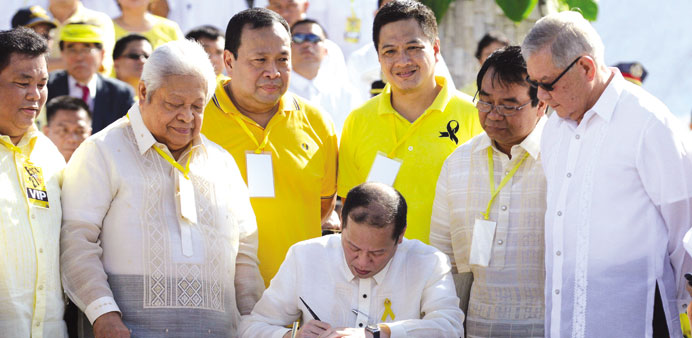
Philippine President Benigno Aquino signs the Martial Law Compensation bill.
AFP/Manila
Philippine President Benigno Aquino signed a landmark law yesterday compensating human rights victims of dictator Ferdinand Marcos, 27 years after a bloodless “People Power” revolution ended his reign.
Ten billion pesos ($244mn) will be distributed to potentially thousands of people whom Marcos’s security forces tortured, raped or detained, as well as relatives of those who were killed, during his rule.
Speaking at a ceremony in Manila to mark the anniversary of the revolution that was led by his mother, Aquino said the law was part of his government’s efforts to “right the wrongs of the past”.
“We may not bring back the time stolen from martial law victims, but we can assure them of the state’s recognition of their sufferings that will help bring them closer to the healing of their wounds,” Aquino said.
Loretta Ann Rosales, an anti-Marcos activist who was tortured by his security forces and now heads the country’s independent rights commission, said the law would finally allow all his victims to feel a sense of justice.
“The law is essential in rectifying the abuses of the Marcos dictatorship and obliges the state to give compensation to all those who suffered gross violations of their rights,” Rosales said.
Marie Hilao-Enriquez, the chairwoman of Selda, a group which represents Marcos rights victims, also welcomed the symbolic intent behind the law but said the money was too little to have a meaningful impact.
“There are so many victims that when you divide it to everyone it will not result to much,” Hilao-Enriquez said.
Hilao-Enriquez’s group represents about 10,000 documented victims but she said there were many more who had not been officially registered and may now come forward, such as Muslim communities in the remote south of the country.
Under the law, a compensation board will accept and evaluate applications for reparations over the next six months. Those victims will be from when Marcos declared martial law in 1972 to the end of his rule in 1986.
The compensation will come from about $600mn the government has recovered from Swiss bank accounts that Marcos secretly maintained while he was in power.
The government has accused Marcos and his relatives of plundering up to $10bn and has so far recovered about $4bn.
After millions of people took to the streets in a military-backed protest, US-supported Marcos fled to Hawaii where he died in 1989.
After returning from exile his relatives have made a remarkable political comeback, while always denying any wrongdoing by the family.
Marcos’s famously extravagant wife Imelda is now an 83-year-old congresswoman representing the family’s political stronghold in a northern province.
Marcos’s son and namesake, Ferdinand Marcos Jnr, is a senator with public ambitions eventually to become president.
He posted a long statement on his official Facebook page in which he said he had “no problem” with compensating people for rights abuses committed between 1972 and 1986. But Marcos said the issue of compensating the “tens of thousands” of human rights victims in the post-Marcos era had been ignored.
“That question is like an elephant in the room that some politicians, the typically glib, sanctimonious, and self-righteous, pretend not to see,” he wrote, while insisting he was focused on ways to “unify our country”.
The President said that Edsa should remind Filipinos that they should be willing to make sacrifices for the greater good.
“I sometimes think that it seems we are fond of the cycle of falling down, standing up, as if we cannot accept that we can move forward and advance without again being wounded, without again being persecuted, without again being hurt. It is hard to admit: we are experts in rising up but it seems we lack advancement and progress,” he said.
“Now that we have risen, let us move forward; let us carry one another and focus our sights on the future; let us dust off our worries and move forward to the realization of our dreams,” Aquino added.
The President thanked Senate President Juan Ponce Enrile and Speaker Feliciano Belmonte Jr., as well as the bill’s authors—Rep Lorenzo “Erin” Tañada 3rd of Quezon province and Sen. Sergio “Serge” Osmeña 3rd—for their contributions in the enactment of the measure.