


|
|
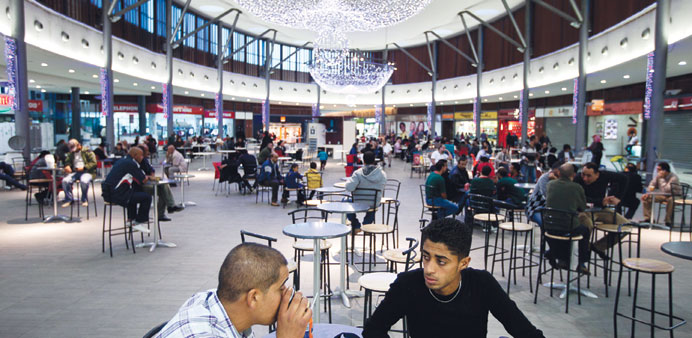
Customers sit in a cafe at the Tunis City shopping mall in Tunis, Tunisia (file). Political instability in Tunisia looks set to slow growth of its economy this year. The economy grew 3.5% from a year earlier in the third quarter of 2012, according to the most recent official data.
Reuters/Tunis
Political instability in Tunisia looks set to slow growth of its economy this year just as business was starting to recover strongly from the turmoil following the 2011 revolution.
The economy grew 3.5% from a year earlier in the third quarter of 2012, according to the most recent official data. That was a rebound from a shrinkage of 1.8% for full-year 2011, when the ouster of president Zine El Abidine Ben Ali was accompanied by a wave of labour unrest and street violence that drove away foreign tourists.
Just a few weeks ago, government officials were predicting expansion of around 4.5% for 2013 — in line with the average growth rate in the decade before the uprising.
But the killing on February 6 of human rights lawyer and opposition leader Chokri Belaid has ravaged the immediate outlook for the economy, underlining the fragility of the region’s recovery in the wake of the Arab Spring uprisings.
Former central bank governor Mustafa Kamal Nabli said Tunisia’s economy now faced a difficult year during which the government would have difficulty funding its budget deficit.
“The restoration of political stability and security is a priority because there will be no investment, and no tourism or exports, without stability,” he told the local Attounissia newspaper.
The death of Belaid, a fierce critic of Tunisia’s Islamist-led government, was the country’s first politically motivated assassination in decades, so it does not necessarily indicate a pattern of political violence.
But by upsetting a delicate truce between secular and religious groups in the country, it has raised the threat of major unrest; one policeman was killed in street protests that swept the country after the assassination, with crowds attacking offices of the Ennahda ruling party in Tunis and elsewhere.
The threat of violence already seems to have been enough to damage Tunisia’s tourism industry, a major earner of foreign exchange and source of jobs.
“The effect is disastrous for tourism...Bookings for French tourists are down by 80% compared to the same week last year,” said Khaled Allani, a hotel manager in the major eastern resort town of Hammamet.
The number of tourist visits to Tunisia last year climbed 30% to about 6mn. The industry is estimated to provide some 7% of the country’s gross domestic product and 400,000 jobs in a population of about 11mn.
Tourism is also important to pay Tunisia’s bills abroad; tourism receipts totalled 1.09bn dinars ($699mn) in the third quarter of last year, offsetting more than a third of the country’s trade deficit of 2.83bn dinars.
A second threat to the economy is that Tunisians could start waging political battles through industrial action. Belaid’s killing prompted labour union UGTT, Tunisia’s biggest, to call the country’s first general strike for 34 years on February 8.
“The general strike caused the state Treasury losses of about 280mn dinars,” estimated former finance minister Hussein Dimassi, predicting that the losses would force the government to cut economic development spending this year.
A third risk is that the political turmoil could distract the government from drafting policy reforms needed to strengthen its finances — while even if such reforms are drafted, it may be hard to win public support for them in such a politically charged atmosphere.
Tunisia has been in talks with the International Monetary Fund on obtaining a $1.78bn loan, but it is expected to have to reassure the IMF that it is shoring up its budget position with politically sensitive steps such as limiting spending on food and fuel subsidies.
Such undertakings may have become a lot more difficult to give since Belaid’s death, partly because the shape of the government that will rule until the next elections, which are expected by the end of the year, is no longer clear.
After the assassination, Prime Minister Hamadi Jebali proposed forming a non-partisan, technocratic cabinet to run the country until the elections. But senior members of his own Ennahda party rejected that proposal, prompting Jebali to resign on Tuesday.
Tunisia may soon resemble Egypt, where the expected signing of a $4.8bn loan agreement with the IMF, and reforms to the state’s subsidy system, have been held up for months by a worsening political climate.
“Once a new government is named, we will enquire about its intentions/mandate. Once the political situation is clarified, we’ll assess how best to help Tunisia,” IMF spokeswoman Wafa Amr told Reuters in an email on Tuesday.
Economic disaster is by no means inevitable. New foreign direct investment jumped to 3.00bn dinars in 2012 from 1.62bn in 2011, partly because of privatisations, according to official data. Last year’s total exceeded the 2.17bn dinars recorded in 2010, before the revolution.