


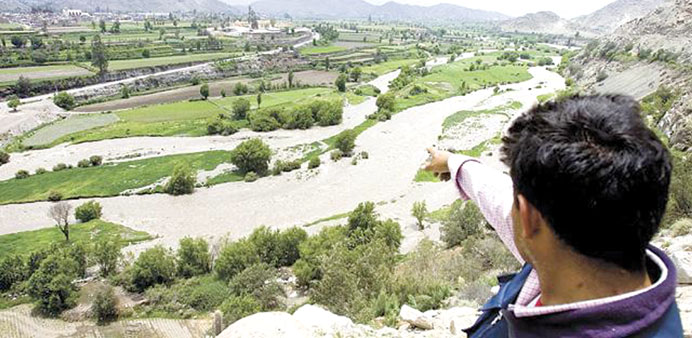
A farmer points out to overflowing rivers in the Arequipa region. Farmers in the sector of La Jara, on the bridge Congata, noted that crops of cabbage, corn and pasture were destroyed by the flooding of the River Chili.
By Steff Gaulter
Parts of Peru have flooded again. Almost every year somewhere in Peru seems to be inundated by rain, causing flash flooding and landslides. This year the flooding happened in the southern regions of Ica and Arequipa. The torrential rain caused a number of rivers to burst their banks, inundating hundreds of homes and washing away cars and roads. Nearly 50,000 people have been affected by this year’s extreme rain, and six people are known to have died.
The fact that it floods so regularly in Peru might seem strange if you consider how little rain is actually expected in the course of a year. In the west of the country, the average annual rainfall of Arequipa is only 95mm (3.7 inches), which is far drier than most other cities. Take London or Tokyo as an example, London’s average rainfall is 611mm (24 inches) and Tokyo’s is much higher at 1529 mm (60.2 inches), but neither of these cities experiences flooding on such a regular basis. What is it about Peru that makes it so prone to flooding?
The climate of Peru varies drastically depending on where you are within the country. The major change is due to the huge mountain range, the Andes, which runs north to south across the central section of the country.
The majority of the rain originates in the Amazon basin and the rain showers drift westwards towards the coast, but they never reach the Pacific. The Andes have numerous peaks which rise over 6,000m (20,000ft), with a large number of vast plateaux over 3,000m (10,000ft) high. This huge mountain range blocks the weather systems, preventing the rain from reaching the coast.
This leads to the very different weather on either side of the country. In the east of the Andes, the land drops steeply to the lowlands of the Amazon basin. The weather is humid, with plenty of rain. Many places report over 2,000mm (78.7 inches) of rain every year, and this hot and humid weather is the perfect growing condition for the tropical rainforest. With so much wet weather, it’s not a surprise that flooding is a regular occurrence in the rainforest.
However, on the other side of the Andes there is a very narrow coastal plain on the Pacific shore, where there is very little rain. You may have thought that being on the coast, the plain would have an ample supply of rainfall, but the cold Humboldt current that wells up along the coast of Peru suppresses evaporation. The weather is so dry that a desert extends almost the whole length of the Pacific coast, some 2,000km (1,240 miles) from north to south. The Peruvian capital, Lima, nestles on this coastline and only sees a pitiful 13mm (0.5 inches) of rainfall in an entire year. This earns it the unenviable accolade of being the driest capital city in the world, even less rain falls here than in Doha, which has an average of 75mm (3 inches).
However, unlike Doha, Lima isn’t blessed with endless sunshine. From February to October the weather is simply murky and humid. The humidity ensures there is an endless layer of fog and low cloud hanging over the city. In order to see the sunshine the locals would have to travel into the mountains, above the layer of mist. Within the mist, smoke and dust accumulate, and the pollution clings to the city.
All things considered, Lima was rather a strange choice of location for a capital city, and that’s because it wasn’t chosen for the practicalities of living there. It was chosen by the Spanish in 1535, who didn’t want a highland capital like Quito or Bogota, they wanted a maritime capital that would link South America with Europe. So they ignored the established towns of Cusco and Jauja both of which were located in the mountains away from the coast, and chose Lima instead.
With so little rain you might have expected the city to have a permanent water crisis, but actually Lima is quite lucky. Instead of receiving its water supply in the form of rainwater, the water comes from the rivers. The rain that falls in the mountains fills the rivers that meander down to the coast. This rainfall, together with the melting glaciers, add to the river levels, ensuring that Lima’s water supply is always reliable.
However, sometimes the source is a curse as well as a cure. When the rain in the mountains is exceptionally heavy, or when the snow and ice melts suddenly, water will fill the rivers swiftly. This can cause them to overflow and trigger flash flooding.
Another trigger for flooding along the desert coastline, is a change in the waters of the Pacific. Every few years, the waters along the coast of Peru are warmer than usual. This is known as an El Nino event, and it completely changes the weather along the coastal stretch. The warm water encourages evaporation and huge towering thunderclouds fill the sky. The rains pour across the desert, the region floods. An El Nino event happens approximately every 3-7 years, and almost without exception, will cause flooding.
Currently the waters in the Pacific are not warmer than usual, so El Nino cannot be blamed for this latest case of flooding. The problems were simply caused by an unusually heavy downpour. Being so dry, the city is ill equipped to cope with heavy rain and the drains simply couldn’t cope. As the rains flooded parts of the coastal desert, it was exacerbated by the rain which fell in surrounding hills. The rainwater poured down the hillsides, and flooded houses with filthy muddy water. The water then found its way into the rivers, and triggered flash flooding as it hurtled downhill towards the coast.
The coast of Peru is arguably one of the driest places on earth, yet even here the region would be wise to prepare for excessive rain. After all, the next El Nino event can only be a few years away, so it is only a matter of time before the rains return.
(The author is Senior Weather Presenter at Al Jazeera English channel. She can be contacted on [email protected]
or on Twitter at @WeatherSteff)