


 |
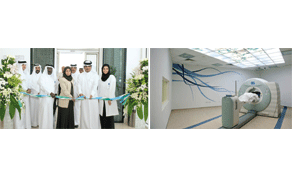
| HE al-Qahtani is seen with al-Kuwari and others, as he cuts the ribbon to open the centre yesterday. Right: The newly launched PET-CT scanner at the centre |
The PET-CT exam is painless and safe, and the procedure generally lasts approximately 30 to 60 minutes.
While PET-CT is an important tool for patients with known or suspected cancer, it is also very helpful for patients with certain heart conditions as well as neurological diseases such as dementia and Alzheimer’s disease.
The technology can also be used to assess how well the disease is responding to a particular treatment.
The two-storey 2,500sqm PET-CT Centre for Diagnosis and Research is one of the most technologically advanced in the region and is located adjacent to the National Centre for Cancer Care and Research (NCCCR).
The NCCCR, under the umbrella of Hamad Medical Corporation, is the sole integrated comprehensive cancer diagnosis and treatment facility in Qatar.
Present at the inaugural ceremony were HMC managing director Hanan al-Kuwari and other HMC senior officials.
Following a tour of the new facility, HE al-Qahtani said: “We would like to congratulate HMC on the launch of this diagnostic centre, which is a great achievement for the diagnosis and treatment of cancer and other ailments. I hope this facility would be put to good use for the advancement of therapeutic services provided to our patients and would save them the agony of travelling abroad in search of diagnosis and treatment.”
He added that the completion of the centre, from design to commissioning, within a span of one year has been “a great achievement by all standards”.
The PET-CT centre, will offer complete patient care ranging from diagnosis and assessment of treatment response for cancer, cardiology and neurology patients. It houses a state-of-the-art combination PET-CT scanner, an imaging system that gives physicians highly defined, three-dimensional pictures of both form and function inside a patient’s body.
In addition, an adjacent cyclotron facility is equipped to produce radiopharmaceuticals, specialised drugs that can be targeted to specific metabolism and the function of cells.
PET-CT imaging is promising for the diagnosis of a variety of conditions. The images can be used by doctors to plan precise radiation therapies that target cancer cells but avoid healthy cells, and also to monitor response to treatment.
It has applications in many fields including cardiology, neurology and psychiatry.
The PET centre requires a cyclotron and a radiochemistry laboratory on site to produce the radiopharmaceuticals.
Dr al-Kuwari explained that the centre was equipped with the latest technology of cyclotron and radiopharmaceutical production equipments to serve HMC and other PET units within Qatar.
“This facility will make a substantial impact on patient care, and is a key deliverable of the national cancer strategy. It demonstrates the commitment of HMC to provide access to cutting-edge diagnostic and treatment monitoring technologies for optimal patient care,” she noted.
Prior to the opening of the facility, patients who required PET-CT imaging had to seek the services overseas.
“The opening of this facility establishes HMC as the premier centre for healthcare within Qatar and the region, and allows for the development of high-level research capability,” PET-CT Steering Committee chair and NCCCR Radiation Oncology programme director Dr Noora al-Hammadi said.
“The PET scanner shows the physician metabolism and the function of cells, while the CT shows detailed anatomy. With these combined images, doctors can get more information about a patient’s condition, enabling them to make the best choices regarding treatment,” Dr al-Hammadi added.