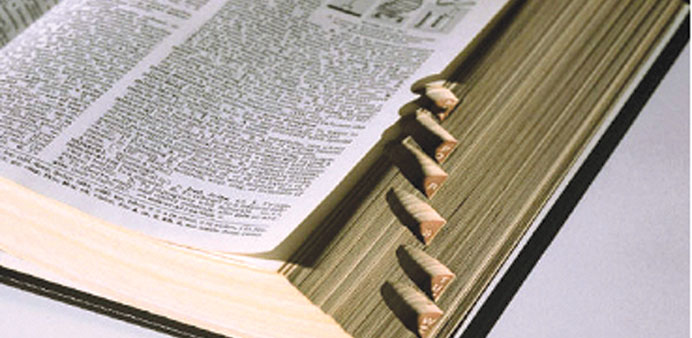
A good dictionary is an invaluable tool for anyone who uses the written word and would like to do so more effectively and correctly. Are you familiar though, with the different kinds of dictionaries — and the services that they offer?
There are three basic types of dictionary. They are the compact, historical and general purpose dictionary. The compact dictionary is, naturally, a small pocket sized variety that is somewhat limited in the scope of its content.
The historical dictionary, on the other hand, is an exhaustive volume that specialises in the history of words. It enlarges on where words come from and how they acquired their present meaning. The general purpose dictionary lies somewhere between these two extremes. This is the most common version that people would have in their home and is the best for everyday use.
The functions of the general purpose dictionary are to provide definitions, proper pronunciation, correct spelling and derivations as well as any restrictive labels attached to a word. Let’s consider these individually.
Definitions: It is embarrassing to use a word out of proper context, so consulting a dictionary for unfamiliar definitions is essential. Many words have more than one meaning. By using a dictionary you can determine which meaning applies to the sentence you are considering. Some dictionaries help you out further by giving specimen phrases of correct word usage.
Pronunciation: Pronunciation of a particular word may vary from region to region, so a dictionary will give the generally accepted pronunciation. There are at least 47 sounds in the English language. Dictionary compilers have devised ways to represent these sounds. The most commonly used method is to use accent marks above emphasised letters. The dictionary will provide an explanatory table to explain the system used. The dictionary will also use italics to indicate the syllable in a word to be stressed.
Spelling: In the English language, words are often spelt quite differently to how they sound. Many rules of grammar — such as ‘i’ before ‘e’ except after ‘c’ also have their exceptions. Thank goodness for the spelling function of your dictionary.
Derivations: Etymology, the study of word derivation, is a feature of your dictionary. This can bring words to life, and expand your knowledge base in a fascinating way.
Restrictive labels: If a word is marked ‘informal’, ‘colloquial’ or ‘slang’ it shouldn’t be used in formal settings. These labels, then, signal caution in their use.
Becoming more familiar with, and regularly consulting, your dictionary will open up the language to you. As a result your speech will be richer and your written communications more fluent. What a fine reward for a little time invested in your dictionary!
Dictionaries down the ages
The oldest known dictionaries were Akkadian Empire cuneiform tablets with bilingual Sumerian–Akkadian wordlists, discovered in Ebla (modern Syria) and dated roughly 2300 BCE. The early 2nd millennium BCE Urra=hubullu glossary is the canonical Babylonian version of such bilingual Sumerian wordlists. A Chinese dictionary, the circa 3rd century BCE Erya, was the earliest surviving monolingual dictionary; although some sources cite the circa 800 BCE Shizhoupian as a “dictionary”, modern scholarship considers it a calligraphic compendium of Chinese characters from Zhou dynasty bronzes. Philitas of Cos (fl. 4th century BCE) wrote a pioneering vocabulary Disorderly Words which explained the meanings of rare Homeric and other literary words, words from local dialects, and technical terms.
Apollonius the Sophist (fl. 1st century CE) wrote the oldest surviving Homeric lexicon. The first Sanskrit dictionary, the Amarakosha, was written by Amara Sinha circa 4th century CE. Written in verse, it listed around 10,000 words. According to the Nihon Shoki, the first Japanese dictionary was the long-lost 682 CE Niina glossary of Chinese characters. The oldest printed dictionary is Khaliq-e-bari compiled by Amir Khusro in 1320 India which mainly dealt with Hindi and Persian words.
Arabic dictionaries were compiled between the 8th and 14th centuries CE, organising words in rhyme order (by the last syllable), by alphabetical order of the radicals, or according to the alphabetical order of the first letter (the system used in modern European language dictionaries). The modern system was mainly used in specialist dictionaries, such as those of terms from the Qur’an and Hadith (Traditions of the Prophet Muhammad), while most general use dictionaries, such as the Lisan Al Arab (13th century, still the best-known large-scale dictionary of Arabic) and Al Qamus Al Muhit (14th century) listed words in the alphabetical order of the radicals.
The earliest modern European dictionaries were bilingual dictionaries. In 1502 appeared the Cornucopia of Ambrogio Calepino, which in fact was a multilingual glossary.
English dictionary
The history of how English dictionaries came into being is like reading an adventure story. The hero (or editor) seemed in constant battle with those in authority until, in the end, a volume is produced.
It is worth noting as well that English dictionaries have never been produced by the British government, official body or learned committee. It was always left to enthusiastic eccentrics. Here are two of them:
• Samuel Johnson’s The Dictionary of the English Language had some 43,000 words supported by 114,000 quotations. Johnson (1709-1784) was blind in one eye, incompletely educated, and coarse in manner. But his work (at a lowly £200 per year) achieved in nine years what many scholars could not have done in many decades.
• Dr W C Minor contributed tens of thousands of words from his private library to the Oxford English Dictionary. In one year alone he contributed 12,000 entries. When he was invited to a contributors’ meeting by the dictionary’s publishers, he had to decline. He was an inmate of Broadmoor, a prison hospital for the criminally insane. — Internet research