


By Noimot Olayiwola/Staff Reporter
The Hamad Medical Corporation’s Ambulance Service is planning to introduce an electronic Computer Aided Dispatch (CAD) that is expected to get ambulances dispatched to patients much quicker, it was disclosed yesterday.
CAD is a method of dispatching taxicabs, couriers, field service technicians, mass transit vehicles or emergency services assisted by computer.
“The central idea of the CAD system is that persons in a dispatch centre are able to easily view and understand the status of all units being dispatched. CAD provides displays and tools so that the dispatcher has an opportunity to handle calls-for-service as efficiently as possible,” Ambulance Service Operation manager Chaker Khenissi told journalists yesterday during the introduction of the service’s new Toyota Landcruiser GX vehicles for assisting injured persons in the desert.
At the event held at the Mushara desert area (singing dunes), he demonstrated to a group of local journalists how the ambulance service carries out its emergency rescue operations with the Toyota Landcruiser GX vehicles.
The four new 4X4s vehicles, operational since the start of the winter camping season, have being working in the desert to complement the range of support available from the Ambulance Service in the desert.
They are primarily used to transport injured people from the area of sand dunes to the nearest tarmac road where they will be met by one of the Mercedes Sprint ambulances.
In serious cases, the 4x4 unit that are stationed at the Ambulance Service’s bases in Sealine and Al Udeid, can also prepare a landing site for LifeFlight, the Ambulance Service’s helicopter.
During the demonstration of the ambulance service exercise yesterday, journalists were taken through the rudiments of how an injured person in the desert get help by the ambulance service.
The ‘mock’ scenario presented an accident involving a middle-aged man, who was injured after rolling over his all terrain vehicle (ATV) while driving on a sand dune.
The patient was found by a passer-by, who quickly dialled 999 and followed the five steps of emergency response to save his life.
“Immediately someone dials 999, the call taker at the National Command Centre direct the call to the ambulance service and the emergency dispatchers are promptly notified after conducting a programme questions and answer (Pro Q&A) with the caller to know the seriousness and the location of the patient,” Khenissi explained.
He mentioned that patients in the urban and rural areas are reached within 10 minutes and 15 minutes respectively.
“Community members should be aware that the Ambulance Service has three categories of patients it responds to, namely: Zulu (very serious); Yanky (normal cases); and X-ray (less serious),” he said.
According to him, an average of 321 calls including some 176 critical cases, are being received daily by the ambulance and each year the service records a 10% increase on number of calls.
Up to 85% of total calls received are from within Doha, he said.
The official also said that total number of ATV accidents increase to around five cases per day during the weekend –Thursday, Friday and Saturday.
The official reiterated that the Ambulance Service has designed its ‘hub and spoke’ model based on the population and the areas where the highest number of calls are coming from daily.
“The spoke is an estimated point where an ambulance is stationed for 24 hours for immediate dispatch to patients around that area. For instance, we have a spoke at Umm Ghuwailina area, specifically at the Capital Police Department, in order to reach patients in areas around that place as quickly as possible,” Khenissi said.
There are presently a total of 52 ambulances transporting patients round-the-clock and an additional 14 ambulances stationed at spokes bringing the number to 66 ambulances.
However, the Ambulance Service has a fleet of more than 100 ambulances of various shapes and designs.
Ambulance Service Public Relations manager Rashid Andaila said: “Often the emergencies in the desert can be a serious trauma where every second counts. This is why the 4x4 vehicles are so important. They can get to the scene quickly and safely and then arrange for the patient to be transferred to the National Trauma Centre located at Hamad General Hospital.”
According to him, the Trauma Centre receives and evaluates more than 5,300 trauma and injured patients each year, of which more than 3,000 are admitted to hospital for definitive care.
Ambulance Service chief executive officer Dr Robert Campbell Owen said: “Each winter during the camping season we see significant numbers of injuries from desert activities. This is improving thanks to the work the Ministry of Environment has done to change the road to Sealine, so it is no longer possible to drive onto the road at any point; instead vehicles can only join the road at a point where it is safe to do so.”
“However, we do still see a large amount of trauma from accidents in this area. The Ambulance Service aims to continuously evolve our service to meet the needs of our community, and the introduction of these new vehicles is a testament to that and our commitment to saving lives,” Dr Campbell added.
The Ambulance Service is currently running a campaign asking the public to ‘Help us Help You’ by knowing a five-step messages:
* Dial 999 immediately in a medical emergency.
* Know your location, so the ambulance can find you easily.
* Answer all questions on the call so the ambulance knows what support you need.
* Follow all instructions given by the emergency call handler, it may help save a life.
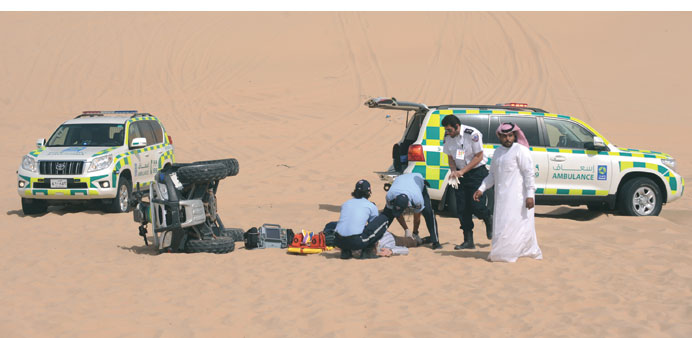
The Ambulance Service paramedic staff are seen attending to the patient after receiving a call from the passer-by (standing to the right in thobe); in