


Deputy News Editor
 |
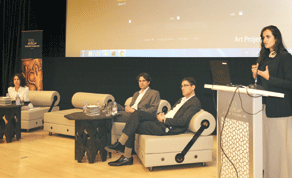
| Al-Khater (right), who was explaining some of the artwork from the MIA. Also present were al-Khudairi, Kesisoglu, and Kanaan. PICTURES: Thajuddin |
Currently, 174 artworks by 136 artists from MIA and 90 artworks by 51 artists from mathaf are uploaded onto the path-breaking virtual platform featuring more than 30,000 artworks from over 150 museums in 40 countries.
More artworks are to be added to the website in subsequent phases. MIA has about 5,000 artworks and mathaf has over 6,400.
An event hosted by QMA yesterday at the MIA to celebrate its partnership with Google was attended by MIA director Aisha al-Khater, mathaf director Wassan al-Khudairi, and Google officials Ari Kesisoglu (regional manager, MENA) and William Kanaan (new business development manager, emerging markets).
“Through Google Art Project, the MIA is connecting Doha to the world and the world to Doha,” observed al-Khater while pointing out that QMA chairperson HE Sheikha al-Mayassa bint Hamad bin Khalifa al-Thani wants the MIA to be the centre of research and education for Islamic art.
She expressed the hope that art teachers across the world would include Islamic art in their curriculum as a result of the MIA’s exposure on Google Art Project.
 |
| Participants of the event |
In a pre-recorded video message, Google Art Project head Amit Sood described the MIA and mathaf collections as “very special” and added “we were trying to include Islamic art into the project for quite some time”.
Al-Khudairi said participating in Google Art Project is a unique way for mathaf to broaden its outreach to an even wider audience.
“It offers an exciting way to share our collection and continue the museum’s goal to expand people’s ideas about the region and present an Arab perspective on modern and contemporary art,” she maintained.
Kesisoglu explained that the project has attracted more than 20mn visitors so far and they have created more than 200,000 private collections online.
“This started as a ‘20% time’ project which encourages our engineers to work on what they’re really passionate about,” he recalled.
Google Suggest, AdSense for Content, and Orkut are among some of the other products that came out of “20% time”.
“Until today, we had no representation of a major Islamic art collection online. Millions of people from around the world can enjoy it now,” Kesisoglu added.
Google started the discussion with the QMA for the project just nine months ago, revealed Kanaan, who went on to give a demo of the site and its features.
 |
| A screenshot of MIA’s homepage on Google Art Project |
Also available on Google Art Project is a virtual tour of the MIA, created using Google’s 360-degree Street View technology, which currently covers 46 museums.
The major attractions of the online art gallery includes exploration of a wide range of artworks at brushstroke level and a feature that allows users to create their own online collections and share them with friends.
Users may browse the content by an artist’s name, artwork, type of art, museum, country, collections, and time period.
Google+ and video hangouts are integrated on the site, allowing viewers to create even more engaging personal galleries.
Though all the images are in high resolution, there are select images in great detail using super-high resolution or “gigapixel” photo capturing technology.
Each such image contains around 7bn pixels, enabling the viewer to study details of the brushwork and patina beyond that possible with the naked eye.
 |
|
A screenshot of mathaf’s homepage on Google Art Project |