


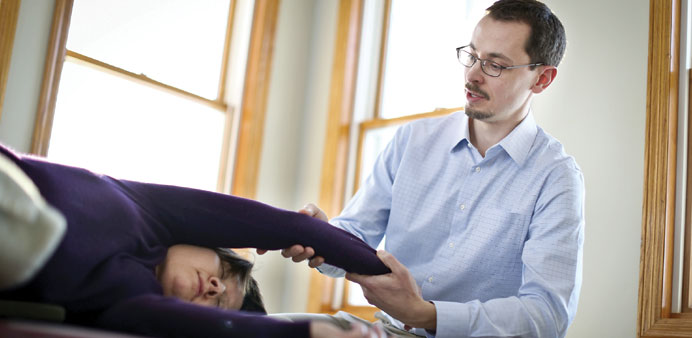
Feldenkrais practitioner Nick Strauss-Klein works on client Kathy Combs at his home studio in Eagan, Minnesota.
By Mary Lynn Smith
By the time people come to see Lisa Walker, they’re usually desperate.
These injured athletes, dancers, musicians or office workers are trying to fix what’s broken. Some are looking for a way around the limitations caused by a stroke, Parkinson’s disease or cerebral palsy. Others just want to run faster, notch up their golf game or improve their horse riding.
“In a nutshell, I help people move better,” said Walker, who practises both in Rochester, Minnesota and near Red Wing, Minnesota.
Walker breaks down a single complex movement into smaller ones, which helps her clients learn how to use their entire bodies to make any movement easier. “It’s about sensing for yourself the difference between what is efficient, effortless movement and what’s not,” she said.
The method is called Feldenkrais.
“Felden-what?” is how people usually first react, said Nick Strauss-Klein, a practitioner based in Eagan, Minnesota. While it sounds like a religion or maybe even a cult, it’s just the name of the guy who founded the method.
Born in Russia, Moshe Feldenkrais was a physicist and mechanical engineer and a judo expert with a debilitating knee injury. After rejecting surgery because it might not keep him out of a wheelchair, Feldenkrais used his extensive knowledge of the body and the mind to come up with a way to move more easily and walk pain-free.
Feldenkrais brought his method to the United States — first to the West Coast in 1977 and then the East Coast. Now it’s taking hold in the Midwest, with about a dozen trained practitioners in Minnesota, according to Strauss-Klein.
“The lessons teach better alignment and more co-ordination between the muscles and the skeletal and soft tissues,” said Julia Pak, a Feldenkrais practitioner and the New York City director of the Balanced Runner.
Some practitioners offer group classes, in which students lie down on mats and then are guided through a series of movements. There also are one-on-one sessions that zero in on the places where a client is unwittingly restricting movement. A slight change — sometimes inches, maybe millimeters — can cascade into effortless movement that helps resolve a high school athlete’s chronic running injury, alleviates a violinist’s neck pain or allows an elderly woman to roll over in bed with ease.
“I’m finding the places where people are stuck neurologically,” said Walker. “It’s really about learning.”
For example: “If you have tight hamstrings, it’s because the way you’re moving is causing them to be short and tight,” she explained. “There are other muscles that should be working but aren’t. So the hamstrings are overworking and the other muscles are sleeping.”
While the method is very good at what Walker calls “re-rooting old habits,” Feldenkrais has its limits.
“If someone has a torn ACL, I’m not your person. The medical profession has perfected that,” Walker said. “But this is phenomenal for people who don’t want to wear out their joints so fast, because when you move better you’re not putting stress on those joints.”
Tom Williamson, a 59-year-old Boston Marathon finisher and triathlete, was suffering from plantar fasciitis when he turned to Walker in 2004. After a couple of one-on-one lessons, he became an avid student in Walker’s Awareness Through Movement classes. Williamson said he now has a “low-impact” gait and has remained injury-free.
“You don’t consciously change your running style,” he said. But Feldenkrais has given him the awareness to know when “things are off” and given him insight to make adjustments that allow him to run more efficiently. “You’re not just running numb,” he said.
Still, he hasn’t been able to convert fellow runners to the Feldenkrais method. “People seem to think the name is goofy,” he said.
Dr Margaret Houston, a family physician in Rochester, Minnesota, gets the same reaction.
“People roll their eyes because it’s an alternative therapy and nobody understands what it is, and it’s really hard to explain,” she said. “I explain that learning to relax the muscles in one part of the body can help them walk differently. I tell them to take it on faith. It works and it’s made a huge difference for me.”
Houston, who suffered neck and back pain, was introduced to Feldenkrais by her horse trainer. After she took classes, she said, the pain disappeared.
The change made perfect sense to her. “People often attribute pain to one thing,” she said. “They have pain in their knee or their hip but they don’t realise that everything in your body moves as a unit.”
Houston is quick to point out that Feldenkrais isn’t for everyone. “Some people just want a quick fix,” she said. “They want an injection or they want to see a specialist right away.”
And if that fails, that’s when they try Feldenkrais, said Pak. — Star Tribune/MCT
Slimming tips for the elderly
Excess weight is a growing problem among the elderly, according to a new report by the German Nutrition Society (DGE).
As much as 74% of men and 63% of women between the ages of 70 and 74 weigh too much. Many elderly people believe it is impossible to lose weight but experts disagree. Discipline is paramount, but it does not require a radical change in diet.
“Every person will lose weight if their energy consumption is higher than their intake,” says Hans-Michael Muehlenfeld, a general practitioner. But any radical diet aiming to lose weight quickly will be counter-productive.
“It’s not about instant success but about finding a way that suits my life,” says nutritionist Dagmar Amberg-Duenne. There’s no point in banning certain foods. “Because what’s forbidden becomes interesting.”
Over the long term it’s best to look at one’s eating habits and to write down everything that one eats. “You should also pay attention to why you eat — maybe because you are sad, nervous, disappointed, angry or stressed out,” Amberg-Duenne says. It might prove helpful to stop for a moment, breathe deeply — and look for a different way of finding comfort.
Muehlenfeld says: “Many patients say that they don’t eat a lot. This might be right about the amount of food, but they eat too much food high in energy.”
Amberg-Duenne recommends eating certain foods to shed the kilogrammes but drinking a lot of fluids also helps to lose weight. Two litres of water, unsweetened tea or fruit juices should be part of your daily intake of liquids.
Five portions of fruit and salad and three portions of vegetables should also be on a daily meal plan. Your own hands can serve as a reference for the right amount: For loose foods such as berries both hands serve as a portion; for firm foods such as apples it’s a single handful.
In addition come four servings of carbohydrates such as pasta, cooked rice, potatoes and bread - one hand equals one serving. Red and white meat, fish and eggs add another three servings rich in protein. And two servings of fat can either come from two teaspoons of oil or butter. Snacks, drinks or sweets should only be consumed in moderation.
The second pillar to losing weight is exercise. A slender figure’s best friends are muscles, which even burn energy when one is being lazy. “One kilogramme of muscle needs 75 calories even while resting, one kilogramme of fat needs just four calories,” says Joern Giersberg, a personal trainer.
But muscles don’t remain active by themselves. Muscles start to diminish continuously by the age of 30 if people don’t do sports.
Giersberg recommends training two to four times a week for between 20 and 60 minutes. The good news: Even at an older age muscles can be built up and retained. And exercise boosts metabolism.
For those who don’t like going to a gym, try working out at home with dumb bells, knee-bends and press-ups. Yoga and Pilates are good alternatives. Even with arthritis and high blood pressure, exercise is possible by walking, swimming and cycling but a doctor should do a check-up in advance.
From a medical perspective reducing weight is necessary if it causes a risk to your health - such as diabetes, high blood pressure or secondary diseases related to coronary heart disease. But weight alone is not decisive. “Many people who are fat are fit. In the end it’s about feeling good,” says Amberg-Duenne.— DPA
A wearable way to settle your stomach
By Mary Macvean
When I was pregnant the second time, I found myself wearing wristbands non-stop that looked like they were meant for athletes but actually were to fend off morning (try all day long) sickness. They were functional but not too attractive.
Psi Bands (pronounced “sigh” and referring to pounds per square inch) are acupressure wristbands that bring a little style to nausea relief for people who can’t or don’t want to take medications. They were designed by two moms and look rather like an inexpensive watch; the pressure applied to the wrists is adjustable. There are five designs.
Acupressure bands are used by people who suffer nausea from morning sickness, motion, chemotherapy or other reasons. Psi Bands (www.psibands.com) come two to a package. — Los Angeles Times/MCT
What is binge eating
and how do you stop?
By Alva Carpenter
Binge eating means eating a large amount of food really quickly when you are not hungry. Binge eaters often carry on eating past the stage of feeling full. Binge eaters usually have certain favourite foods that they start eating, very often in secret, and cannot stop eating until all these items are gone.
There are warning signs that you may be a binge eater and that you need to start to tackle the problem:
l You hide secret supplies of food that you like to eat and then you eat them in secret when no one else is around.
l You think about food all the time and everything revolves around food.
l When you have a problem at work you go home and sit and over-eat on your favourite binge foods such as chips, ice cream, cakes, bread or chocolate.
l You are eating even when you do not feel hungry and you keep eating even when you feel full.
l If you do give up these foods that you regularly binge eat you get withdrawal symptoms.
If you know that you do at least three of the above then you have fallen into a pattern that needs to change: otherwise you will put on weight and possibly damage your health and your self-esteem.
What happens when your binge eating is over is that you end up feeling very full and guilty and cross with yourself.
Many people eat for reasons other than hunger. They eat to feel better. We all do this to a degree but if you are regularly eating large amounts of food and then feel over-full and guilty you need to tackle how you take care of yourself.
Food does not make the problems go away.
Regular binge eating means you have a problem that is out of control and you need to take back control. Remember: you control your mind; it does not control you. You can control how you think about food.
Kathy was often bullied at school and came home and ate large amounts chocolate, crisps, ice-cream and soda to comfort herself.
It is normal to come home from school and have a snack but Kathy ate a pile of treats until she felt unwell and cross with herself. Eventually she felt able to talk to her aunty about the bullying of a group of school friends and she soon realised that these school friends did not even know how to behave nicely towards one another and stopped being upset by their poor behaviour. Her aunty encouraged her to make a new circle of friends and this solved the problem. Kathy now goes home after school and has a small healthy snack. She no longer feels the need to binge eat.
Regular binge eating is a sign that something is causing you unhappiness.
It is important to realise that you are using binge eating to cope with a problem. It may be unhappiness or bullying, or even stress at work. You are using this way of eating to comfort yourself.
There are other ways of coping with problems and there is no problem on this earth that has not been experienced before by someone else. You are not alone and one of the best ways to sort out a problem is to talk to a trusted friend or relative, or even your doctor. Most people feel honoured when friends and family share problems with them and ask for advice: I know I do. If you really cannot share your problem then write it down: and then write down possible solutions.
Healthy recipe
My Eve’s Pudding
Ingredients
500g frozen or fresh mixed berries
100g butter
100g caster sugar
75g self-raising flour
25g ground almonds
2 eggs
15g flaked almonds (to finish)
Method
1. Pre-heat the oven to 180°C/350°F/Gas Mark 4
2. Cream the butter and sugar until fluffy
3. Beat in eggs, one at a time
4. Gently fold in the flour and ground almonds
5. Place the berries in an oven proof dish and lightly sprinkle with sugar to taste
6. Cover the berries with the cake mixture and scatter with flaked almonds
7. Bake in the oven for about 40 minutes until golden brown and cooked in the centre
8. Serve with low-fat ice cream