


Reuters/Rome
A visibly moved Pope Benedict XVI tried to assure his worldwide flock yesterday over his stunning decision to become the first Pontiff in centuries to resign, saying he was confident that it would not hurt the church.
The Vatican, meanwhile, announced that a conclave to elect his successor would start sometime between March 15 and March 20, in keeping with church rules about the timing of such gatherings after the papal see becomes vacant.
“Continue to pray for me, for the church and for the future pope,” he said in unscripted remarks at the start of his weekly general audience, his first public appearance since his shock decision on Monday that he will step down on February 28.
It was the first time Benedict, 85, who will retire to a convent inside the Vatican, exchanging the splendour of his 16th century Apostolic Palace for a sober modern residence, had uttered the words “future pope” in public.
Church officials are still so stunned by the move that the Vatican experts have yet to decide what his title will be and whether he will continue to wear the white of a pope, the red of a cardinal or the black of an ordinary priest.
His voice sounded strong at the audience but he was clearly moved and his eyes appeared to be watering as he reacted to the applause in the Vatican’s vast, modern audience hall, packed with more than 8,000 people.
In brief remarks in Italian that mirrored those he read in Latin to stunned cardinals on Monday, he appeared to try to calm Catholics’ fears of the unknown.
His message was that God would continue to guide the church.
“I took this decision in full freedom for the good of the church after praying for a long time and examining my conscience before God,” he said.
Benedict XVI said that he was “well aware of the gravity of such an act” but also aware that he no longer had the strength required to run the 1.2bn member Roman Catholic Church, which has been beset by a string of scandals both in Rome and round the world.
He said that he was sustained by the “certainty that the church belongs to Christ, who will never stop guiding it and caring for it” and suggested that the faithful should also feel comforted by this.
He said that he had “felt almost physically” the affection and kindness he had received since he announced the decision.
When Benedict XVI resigned on Monday, the Vatican spokesman said that the Pontiff did not fear schism in the church after his decision to step down.
Some 115 cardinals under the age of 80 will be eligible to enter a secret conclave to elect his successor.
Cardinals around the world have already begun informal consultations by phone and e-mail to construct a profile of the man they think would be best suited to lead the church in a period of continuing crisis.
The likelihood that the next pope would be a younger man and perhaps a non-Italian, was increasing, particularly because of the many mishaps caused by Benedict XVI’s mostly Italian top aides.
Benedict XVI has been faulted for putting too much power in the hands of his friend, Secretary of State Cardinal Tarcisio Bertone. Critics of Bertone, effectively the Vatican’s chief administrator, said that he should have prevented some papal mishaps and bureaucratic blunders.
“These scandals, these miscommunications, in many cases were caused by Pope Benedict XVI’s own top aides and I think many Catholics around the world think that he was perhaps ill-served by some of the cardinals here,” said John Thavis, author of a new book The Vatican Diaries.
Benedict XVI’s papacy was rocked by crises over sex abuse of children by priests in Europe and the US, most of which preceded his time in office but came to light during it.
His reign also saw Muslim anger after he compared Islam to violence.
Jews were upset over rehabilitation of a Holocaust denier. During a scandal over the church’s business dealings, his butler was accused of leaking his private papers.
“When cardinals arrive here for the conclave ... they are going to have this on their mind, they’re going to take a good hard look at how Pope Benedict XVI was served, and I think many of them feel that the burden of the papacy that finally weighed so heavy on Benedict was caused in part by some of this in-fighting (among his administration),” Thavis told Reuters.
Vatican spokesman Father Federico Lombardi urged the faithful to remain confident in the church and its future.
“Those who may feel a bit disorientated or stunned by this, or have a hard time understanding the Holy Father’s decision should look at it in the context of faith and the certainty that Christ will support his church,” Lombardi said.
Lombardi said that on his last day in office, Benedict XVI would receive cardinals in a farewell meeting and after February 28 his ring of office, used to seal official documents, would be destroyed just as if he had died.
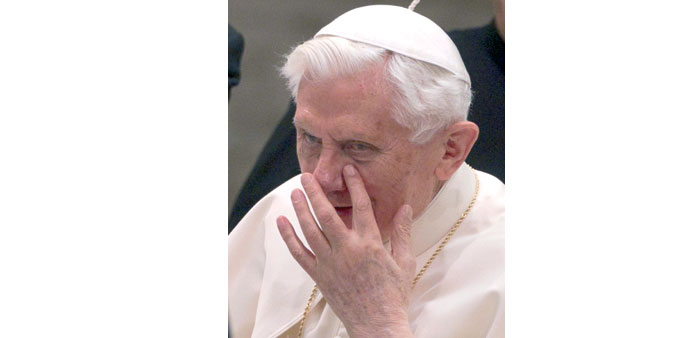
Benedict XVI: aware of the gravity of his decision.