


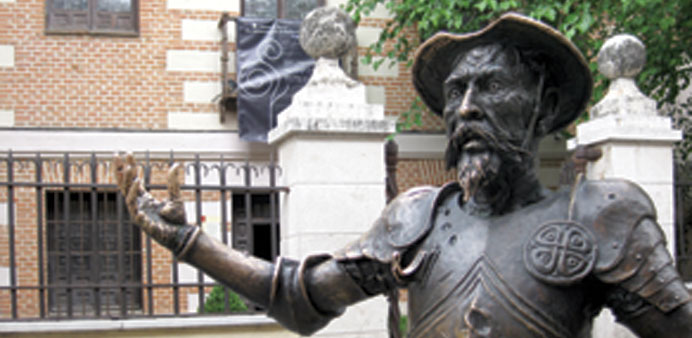
A statue of the literary character Don Quixote in Alcala de Henares in Spain, birthplace of Spanish writer Miguel de Cervantes.
By Nestor Rojas Mavares
The satirical novel Don Quixote, written in 1605-1615 by Miguel de Cervantes, is considered the most important literary work ever written in the Spanish language and to emerge from Spain.
However, a Venezuelan researcher claims that the man who inspired its chivalric and overly idealistic gentleman hero, Don Quixote of La Mancha (a region in Spain), was actually a soldier in Venezuela.
His name was Alonso Andrea de Ledesma and he was 58 years old when he made a solitary, romantic and failed attempt to defend the port of Caracas from invading British pirates in May 1595.
Caracas, which was only a small town at the time, was under siege by English pirates who were cohorts of Sir Walter Raleigh and were spreading terror throughout the Caribbean region.
Historic record has it that De Ledesma attempted to stage his own desperate resistance against the invading marauders. He rode out mounted on a hack and protected by rusty armour and a helmet and armed with a spear.
The pirates, after observing the challenge from the solitary defender, killed him with a single musket shot.
But the English attackers so admired his courageous effort that their leader, Amyas Preston, ordered that De Ledesma be carried on his shield and receive a hero’s honours before being buried.
According to the Venezuelan writer and researcher Eduardo Casanova, the image of the elderly rider wearing rusty armour, wielding a lance and charging alone against a horde of corsairs became a stock story which arose from that episode.
For the last 30 years Casanova has been arguing that De Ledesma’s story inspired Cervantes to write his famous work.
To defend his hypothesis Casanova offers a series of historical references and coincidences.
Although he admits that it is only hypothetical and can never be proved, Casanova says it must be seen like the “body of evidence” that often constitutes proof in a court case, even without direct proof of causation.
“There are so many clues that exist that it can be truthfully said that Cervantes must have used the news item about a Caracas resident who stood up alone to an invading English army as the starting point for his famous character ...
“These starting with the first name that he gave his character, Alonso,” said Casanova. The hero’s proper name is Alonso Quijano.
“Logically, he must have learned about the events that occurred in Caracas not so long after they occurred and just before he began to write his novel,” Casanova told DPA in an interview.
Casanova has searched for firmer evidence to confirm his hypothesis even though he knows this too is a “quixotic” (unrealistic, impractical) endeavour.
He has traced De Ledesma’s personal history and found that he was born in Spain in 1537 and embarked for the Americas with his brother Tome.
The odyssey took him first to Santo Domingo and in 1567 he was among the Spanish conquistadors who, led by Diego de Losada, founded the city of Caracas.
“What I want to vindicate is the real possibility that attributing the creation of Cervantes’ Don Quixote to the death of Alonso Andrea de Ledesma is not mere speculation,” Casanova said.
According to Casanova, events that took place in the Americas at that time were the news of the day in Spanish cities such as Seville or the capital Madrid and everybody discussed them.
“Such an “unfortunate” event with a Spaniard conducting the solitary defence of Caracas against the English, could not have been ignored in Seville, where Cervantes lived from 1587 to 1602, Casanova said.
He added that Cervantes had wished to travel to the Americas and closely followed what was going on there.
Casanova said that the claim that the Don Quixote character was created in the town of Argamasilla de Alba, in La Mancha, is merely a ploy to draw tourists because no real evidence to back it exists.
“On the contrary, it has been proven that shortly after De Ledesma’s death, when news of his last stand reached Seville through Gaspar de Silva, Cervantes was in that city,” he added.
In 1595, Cervantes was sent to prison in Seville because he had failed to pay debts.
According to Casanova, Cervantes would have been in a prison cell when he heard the story and would have marvelled at it, probably in August, since it took about three months for news to arrive from New Spain.
“In his prologue, Cervantes says that it was in prison that he came up with the idea of Don Quixote,” Casanova said.
The late Venezuelan historian and writer Francisco Herrera Luque writes in a book entitled Mythical History that the beautiful and true episode involving Alonso Andrea de Ledesma is unknown to most Venezuelans.
“This marvellous epic happened 10 years before Cervantes published his magnificent work. De Ledesma died in 1595 and Don Quixote was published in 1605. In all honesty what we should say is that Don Quixote is the Spanish Ledesma,” he wrote.
Literary critic Carlos Sandoval has weighed into the controversy, dismissing the story of De Ledesma’s solitary defence of Caracas astride a horse as “an anecdotal event” and not really relevant to Cervantes achievement.
Sandoval said the real discussion should be about how Cervantes published a novel in 1605 that was able to create such a universal character as Don Quixote, even if De Ledesma did possess quixotic features before Don Quixote existed. — DPA