


Two professors at Georgetown University School of Foreign Service in Qatar (SFS-Q) have co-authored a book on water security titled International Conflict over Water Resources in Himalayan Asia: Conflict and Co-operation over Asia’s Water Resources.
Robert G Wirsing, professor at SFS-Q, and Daniel C Stoll, associate dean for academic affairs at SFS-Q, joined Christopher Jasparro of the US Naval War College as tri-authors, combining decades of experience in examining
water resource rivalry.
“Water has always been an essential resource and, at times, a cause of conflict in Asia,” said SFS-Q dean Gerd Nonneman. “Water security issues can be dauntingly complex, because they intertwine with a whole host of historical, political and economic dynamics and with a mix of local and external interests. They can become a question of life and death reverberating well beyond their immediate locales.”
Published by Palgrave Macmillan, the book explores the freshwater crisis of Himalayan Asia, the depletion of its water resources and the increasing disputes over who owns trans-boundary river waters and their basins.
Touching on themes such as river rivalries, trans-boundary river waters, alternatives to water conflict and the future of Himalayan rivers, the broad range of chapters include topics relevant to the region, including climate change.
Discussing the book’s utility, Dr Wirsing said, “The book has no jargon. It is written in a way that is accessible to laypeople, to students and to professionals dealing with these issues. It’s packed with useful information for people concerned about water security.”
Dr Stoll said “while issues of water scarcity have long been of concern to policymakers, there is an increasing emphasis on the connection between water supply and the impact on domestic and foreign policy”.
Focusing on a region where abundant river resources combined with “rapidly modernising, increasingly affluent and demographically multiplying societies” have resulted in the emergence of constant resource challenges, the book enters the debate on the impact of this resource crisis in the Himalayan Asian region’s present and future interstate relations.
Commenting on the scope of the book, Nonneman said: “It takes exceptional scholars to address such a subject in ways both incisive and accessible, balanced and comprehensive. That is exactly what the authors have accomplished in this superb
volume.”
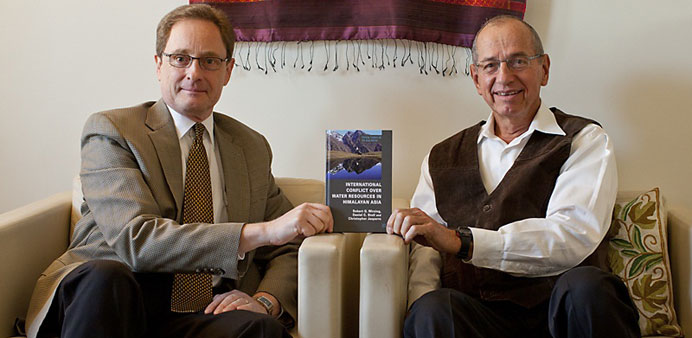
Daniel C Stoll and Robert G Wirsing.