


DPA/Berlin
The issue of race in politics flared up in Germany this week, sparked by controversial comments that a ruling coalition member made about Angela Merkel’s Vietnam-born deputy.
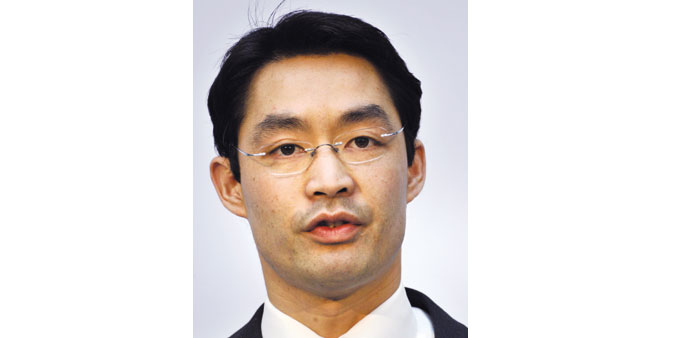
The election-year row centres on Vice-Chancellor and Economy Minister Philipp Roesler, the only non-Westerner member of Merkel’s cabinet, who was adopted from Vietnam at nine-months-old by a German couple.
A state party chief of Roesler’s pro-business Free Democratic Party (FDP), Joerg-Uwe Hahn, has drawn fire over comments he made to the Frankfurter Neue Presse newspaper.
“Where Philipp Roesler is concerned, I would love to know if our society has evolved to the point of accepting an Asian-appearance deputy chancellor in the longer term,” he told the paper.
While Merkel’s government has stayed mum, opposition parties have accused Hahn of encouraging racism.
His defenders have argued Germans need to openly thrash out the issue of voter racism.
Roesler – the party chief of the FDP, the junior coalition partner in Merkel’s government – has defended Hahn, while avoiding comment on whether he had experienced racial hostility.
“Hahn is blameless of even the suspicion of racism,” said Roesler in a statement, adding that Hahn, who is minister of social integration and leader of the FDP in the central state of Hesse, was both a long-time ally and a “personal friend”.
“I don’t understand the fuss about his interview on Thursday,” added Roesler, a former German Army doctor who was raised in Germany and speaks no Vietnamese.
In Berlin, Merkel’s deputy spokesman Georg Streiter rejected calls for the role of race in politics to be debated more deeply, saying that “the chancellor has never brought this issue up”. Hahn’s comment was no reason to make more of the issue, he said.
Christian Democratic Union (CDU) leader Merkel, who has high popularity levels, faces a general election in September.
The FDP, with low poll ratings, has been seen as a liability for her coalition government.
She would be unable to re-form her current centre-right coalition if Roesler’s party failed to win any parliamentary seats, as some polls predict.
Roesler – who recently stared down party rivals challenging his claim to the party leadership – has refused to be drawn about whether racial hostility helps explain his low popularity.
But a leader of the FDP youth wing, Lasse Becker, addressed the issue in an interview.
“I hear this when I’m in a campaign stall in a pedestrian zone: ‘I’d only vote for you if you get rid of the Chinaman’,” he said.
A leader of the Turkish community, Germany’s biggest ethnic minority, said that a debate about whether many Germans are racist was long overdue.
“One pretends it’s not there,” he told DPA, adding that institutional racism was a reality in Germany. “We ought to talk about it openly.”
About 16mn of Germany’s 82mn people are foreign born or the children of immigrants, but there are only a tiny handful of minority-origin people holding senior government posts.