


Chief Business Reporter
 |
|
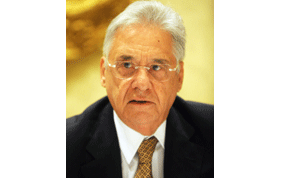
Fernando Henrique Cardoso |
Qatar’s sovereign wealth fund and other strategic investors have abundant opportunities in Brazil including the Latin American country’s infrastructure, energy, real estate and financial sectors, Cardoso said in an interview with Gulf Times here yesterday.
“We have some big construction companies in Brazil with considerable experience in building roads among other projects in Iraq, Iran and North African countries. Our robust financial sector can also co-operate with yours,” Cardoso said.
Brazil’s economy, which recently overtook Britain as the world’s sixth largest, is forecast to grow at 2.7% in 2012 and 5.3% in 2013, according to Itaú Unibanco, Latin America’s largest bank. This, according to the bank’s economists, is primarily due to interest rate cuts and fiscal measures aimed at fuelling economic activity.
It has also set a new national record in foreign direct investment in 2011, attracting in excess of $66.7bn.
Brazil’s growing private equity industry, estimated to oversee over $35bn, is regarded as a good exposure channel to the country’s various dynamic sectors, in particular the rapidly growing consumer market, a sector that is under represented in the stock exchange.
Despite the global economic crisis, Brazil is now performing quite well. This, Cardoso said, has been due to major reforms introduced by the country since the early 90s.
“These reforms continue and have established a sound financial system in our country. Our banks are well regulated,” said Cardoso, who was Brazil’s president from 1995 to 2003.
Brazil now boasts of more than $300bn in its reserve and the country’s trade balance has been healthy in the last 15 years, the former president said.
Cardoso is widely credited with having wrestled Brazil’s inflation back from 30% a month to around 7% per year and stabilising the country’s economy at a “critical time” in its history. He introduced seven different programmes to curb inflation including the launch of a new currency and controlling budgets.
In doing so, he provided the economic platform that has since enabled Brazil to “grow and prosper successfully”.
On the prospects of the grouping of emerging countries – Brazil, Russia, India, China and South Africa (BRICS) driving global economy, Cardoso said, “These are big countries with big population. But they are quite different. China, for example, is a state-controlled economy. Russia is basically a primary economy with a clear market orientation. In the case of Brazil and India, the markets are more stable. South Africa is also coming up.
“We are not referring to a homogenous situation in BRICS; but economic dynamism in the group. And what’s important from the global viewpoint is that these countries have the ability to produce surpluses. They have good reserves. That’s why the whole world is focused on these countries,” said Cardoso, who was previously Brazil’s finance and foreign relations minister.
Cardoso, who is in Qatar with a high-level team from Itaú Unibanco, Brazil’s top bank, and among the world’s eight largest lenders, will hold meetings with political and business leaders in Qatar and elsewhere in the region.
The bank’s delegation includes Ricardo Villela Marino, board member and partner of Itaú as well as CEO of the bank’s Latin American operations; and Roberto M Nishikawa, managing director and Global Head of Institutional Clients and International Asset Management.
The purpose of the visit is to foster and strengthen existing as well as prospective relationships between key institutions in Qatar and Brazil.
Cardoso will also be discussing how Brazil has navigated through the economic crisis relatively unscathed, the vast opportunities that the Brazilian and Latin American economies offer to GCC investors, as well as exploring the widespread reforms implemented in the Brazilian economy.
According to the Arab-Brazilian Chamber of Commerce, Brazilian exports to Arab countries generated revenues of $15bn in 2011, an increase of 20% on 2010, while imports were up 43%, reaching $10bn.
Moreover, Brazil’s trade with the Arab world in 2011 increased by 28% more than 2010, to $25.13bn and is expected to grow by 15% this year.
The GCC imports from Brazil totalled $7.86bn, with $337mn attributable to Qatar; while exports to Brazil from Qatar reached $238mn, from a GCC total of $4.25bn.