


Reuters/London
The government yesterday said crime lay behind some cases of horsemeat finding its way into “beef” products on supermarket shelves, amid a growing scandal in a country where many regard the idea of eating horse with horror.
Investigations into suppliers have been launched in recent weeks after the revelation that beef products sold to companies including Britain’s biggest grocer Tesco and fast-food chain Burger King contained horsemeat.
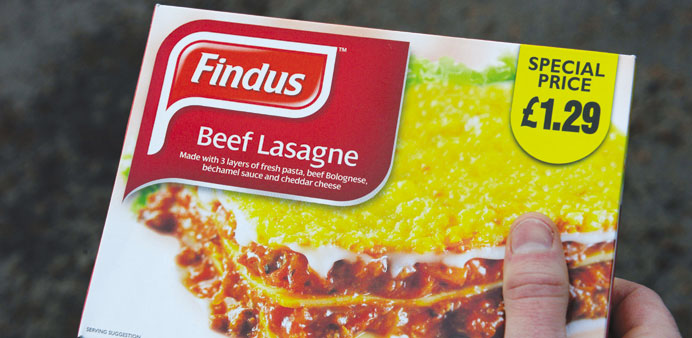
On Thursday the scandal appeared to widen further with the news that horsemeat had been found in Findus’s beef lasagne, prompting the government to call it “very distasteful”, and forcing the firm to apologise to customers.
“At the moment we’re looking at two incidents that have come to light, which at the heart are acts of criminality,” Prime Minister David Cameron’s spokeswoman said yesterday.
“If you are a company buying a particular meat and you are led to believe it is what you asked for, but then you find it’s not, then clearly there’s been some law broken there,” the spokeswoman said.
In a statement Findus said it knew there was a possible problem with its ready meals two days before the products were withdrawn from supermarket shelves.
“We understand those concerns, we are sorry that we have let people down and we want to outline the facts,” it said.
“Findus UK had extensive DNA testing completed by leading independent experts. On February 6, the tests confirmed that horsemeat was present in a number of samples and this information was shared with the Food Standards Agency.”
Supermarket chains Aldi, Lidl, Iceland and the Co-operative Group have also been sold beef products found to contain horse DNA. The Food Standards Agency (FSA) put the horsemeat content at Findus at more than 60% while one Tesco burger contained about 29% horsemeat, making those the two most serious incidents to date.
Tesco has since dropped the Irish supplier of frozen beef burgers, Silvercrest, a unit of ABP Food Group. Findus began a recall of its beef lasagne from retailers earlier in the week on advice from its French supplier, Comigel.
In response to the problem, the FSA has demanded that food retailers and suppliers test all beef products and present their findings to the agency by February 15. The issue dominated government yesterday, with Prime Minister David Cameron’s office promising to review food standards and enforcement.
Cameron’s spokeswoman said there was no evidence to suggest any health risk from the products. Experts say horsemeat could contain traces of veterinary drug phenylbutazone, or “bute”, which can be harmful to humans in high concentrations. “It is completely unacceptable that a product which says it’s beef lasagne turns out to be mainly horsemeat,” Environment Minister Owen Paterson said in a statement, adding that “urgent” checks were being made on meat supplies to schools and hospitals.
Two senior lawmakers earlier yesterday advised against eating processed beef products. Asked whether Cameron would continue to eat such products, his spokeswoman said the premier would follow the advice of the FSA.
The FSA advised against eating Findus beef lasagne products, but - pending further testing for bute - said it had no evidence to suggest the product was a food safety risk.
French firm mum over scandal
The French food company that supplied frozen lasagne found to contain up to 100% horsemeat to British supermarkets yesterday shut down its website and declined to answer media enquiries. Comigel, based in the northern city of Metz, supplies frozen meals to supermarket chains and other clients in 15 countries, with Germany, the Netherlands, Belgium and Scandinavia the main markets, according to industry websites. In the latest in a string of food scares in Britain, where eating horses is largely taboo, frozen food supplier Findus has withdrawn its beef lasagne products from sale after tests found some meals supplied by Comigel contained 60% to 100% horsemeat. Erick Lehagre, the director of Comigel, declined to respond when contacted by the company for comment. The firm’s website has been taken down and showed only photos of some of its products—including a lasagne dish—along with a note saying the site was “under construction and will soon be renewed”.