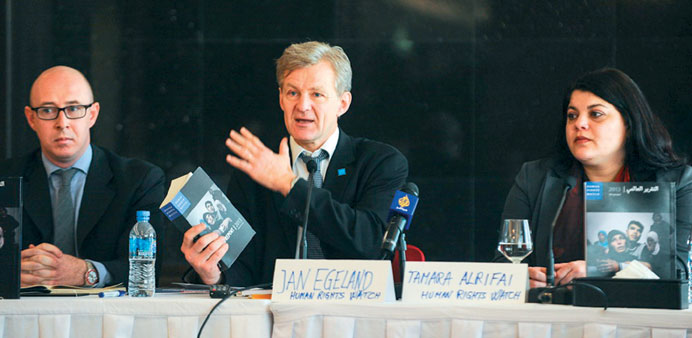
Human Rights Watch’s Egeland, flanked by his colleagues McGeehan and al-Rifai, speaks in Doha yesterday. Picture: Noushad Thekkayil
More than two years after it won the right to host the 2022 World Cup, it is high time for Qatar to deliver on its promise for reforms that would lead to improvement in the working conditions of the expatriate labour force in the country, Human Rights Watch (HRW) said yesterday.
The US-based international rights group called for introduction of measures to prevent trafficking and forced labour of migrant workers, though Qatar has taken a slew of steps to curb any such practice.
“Qatar has not delivered on its pledges to improve migrant workers’ rights,” stated Jan Egeland, the deputy executive director of one of the world’s leading independent organisations dedicated to defending and protecting human rights. “The Qatar 2022 Supreme Committee – the tournament’s quasi-governmental delivery committee – has made encouraging pledges on workers’ rights, but these lack detail,” he told a press conference convened in Doha to explain HRW’s World Report 2013.
“Nor do they mask the failure of the Qatari authorities either to reform exploitative laws, such as the kafala system of sponsorship-based employment and the prohibition on trade unions, or to enforce the prohibition on illegal recruitment fees and the confiscation of passports,” Egeland asserted.
The official, who is also the Europe director at HRW, recalled that ‘Qatar asserted in 2010 that the country’s successful bid for the World Cup could inspire positive change and leave a huge legacy for the region.’
“But, the past two years have seen an absence of reform and if this persists, the tournament threatens to turn Qatar into a crucible of exploitation and misery for the workers who will build it,” Egeland said.
“We are here because Qatar has become an important place in the world and play a key political and economic role. We hope Qatar can become a positive example in human rights and migrant workers’ rights. We want Qatar to treat employees like the rest of the world does,” he stated.
In its 665-page report, HRW assessed progress on human rights during the past year in more than 90 countries, including an analysis of the aftermath of the Arab uprisings. “Looking at the Arab awakening, we are very worried that there are setbacks for aspirations to realise freedom, including in Egypt,” Egeland maintained. “The willingness of new governments to respect rights will determine whether the Arab uprisings give birth to genuine democracy or simply spawn authoritarianism in new clothes,” he said.
The HRW official pointed out that the ‘Qatari labour law excludes domestic workers, almost all of them girls or women, denying them basic protections such as limits to hours of work and weekly days off. “A maid is not supposed to be on duty 24 hours. There should be stipulated working hours and rights,” Egeland reminded.
In June 2012, HRW had, in a 146-page report titled ‘Building a Better World Cup,’ outlined the ‘shortcomings in Qatar’s legal and regulatory framework, and the consequences’ for its migrant workers’ who number way above 1mn out of a population of 1.9mn. The human rights organisation had observed that the numbers of migrant workers will continue to rise as World Cup 2022 construction begins in earnest in 2013. HRW pointed out that most come from countries in south Asia. It demanded strict enforcement of the laws intended to protect workers in Qatar.
“Employers routinely confiscate passports, making it harder for workers to leave, and workers typically pay exorbitant recruitment fees to agents who operate in Qatar and in the countries of origin. Migrant workers have no right to unionise or strike, though they make up the majority of the private sector workforce,” HRW said.
Egeland, accompanied by his colleagues Nicholas McGeehan (Middle East researcher) and Tamara al-Rifai (Middle East advocacy director) described HRW as ‘an impartial and independent organisation, which gives enormous resource to researchers to document the truth.’
“We have prepared our report after interviewing hundreds of sources and that is why we are confident of the facts,” he said while adding that ‘when truth is exposed in the media, it results in positive change.’
However, sources among local employers said the Labour Ministry is very strict in enforcing the laws and firms that violate the rules are severely punished. “Qatar has outlawed confiscation of passports and the inspectors at the Labour Ministry have been vigourosly enforcing the laws, leading to huge improvement in the situation,” they claimed.
According to figures released by the Labour Ministry, the Inspection Department served as many as 7,337 warning notices on companies in 2012, asking them to redress various violations.
They also pointed out that inspectors visited 46,624 sites including offices and workplaces during last year to check on the compliance of labour laws by employers and said the HRW allegations are not true.