


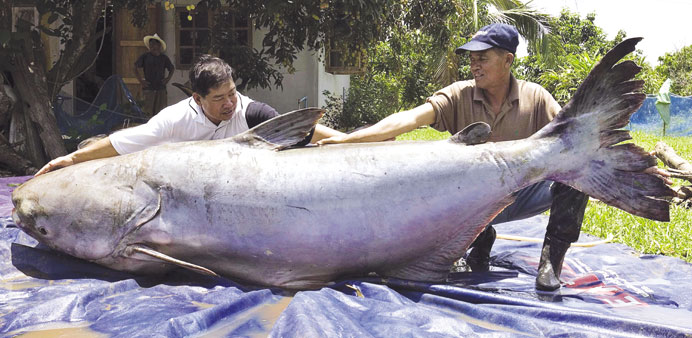
A handout photo released by the World Wildlife Fund (WWF) shows a Mekong giant catfish caught by Thai fishermen at Chiang Khong city along the Mekong River, Chiang Rai province, northern Thailand.
DPA/Bangkok
A planned dam on the Mekong River in Laos promises to disrupt the reproductive cycle of the giant catfish, one of the world’s largest freshwater fish, but experts disagree on how best to help it.
The Xayaburi hydroelectric dam will stand in the way of the Pangasianodon gigas, thought to migrate hundreds of kilometres from the Tonle Sap Lake in Cambodia to spawn near Chiang Khong in northern Thailand, after passing through Xayaburi province in northern Laos.
Cambodia and Vietnam, downstream of the project, have expressed concern over potential impact on fish migration and sediment flows.
Both countries have urged that the $3.5bn dam - the first on the Lower Mekong - be postponed until the impact has been thoroughly evaluated.
Studies are underway, but Laos and its Thai partners are proceeding with construction, scheduled for completion in 2019. The design includes a fish ladder: a series of watery shelves alongside the dam that allow migrating species to make their way upstream and past the obstacle.
But experts fear the giant catfish, which can grow to 3 metres and 300 kilograms, will be unable to use it.
“Giant catfish need deep water to migrate,” Naruepon Sukumasavin, fisheries ecology expert at Thailand’s Department of Fisheries, said. “It will be impossible for the catfish to pass.”
Lao officials claim to have adapted the design for larger fish. “A lot of experts suggested that giant catfish move at the bottom of the river, and thus migration, if any, would be at the bottom of the Mekong and that’s why a fish lift was added to the system,” said Viraphonh Viravong, vice minister of energy and mines.
Fish lifts are located in the centre of the waterway, and work by mechanically hoisting the fish in a container of water to the top of the dam.
“I don’t think it will work,” said Naruepon. “It’s not like salmon that come thousands at a time. The giant catfish comes one or two at most, and how are you going to get it in the lift?”
Experts say they still know very little about the migratory or mating habits of the giant catfish. But they agree the critically endangered species is vulnerable to changes in its habitat.
The population in the Mekong River has fallen 90% over the past 50 years, due mainly to overfishing, according to Zeb Hogan, a large-fish expert at University of Nevada in the US.
“The Mekong giant catfish is one of the most, if not the most, vulnerable to dams like the Xayaburi,” Hogan said.
Its sensitivity makes it a litmus test for other species in the river, ranked as the world largest inland fishery with a harvest of 2.5mn tonnes annually, valued at about $3.6bn.
“The very real danger is that the Mekong giant catfish is the tip of the extinction iceberg, and that populations of many other species, including the most important fisheries species, will decline as more and more dams are built on the mainstream Mekong,” Hogan said.
In Thailand, the fisheries department has had a successful breeding programme with catfish caught at Chiang Khong since 1984.
Over the past three decades, it has restocked the species in the kingdom’s reservoirs, rivers, lakes and even fish-farms.
Unlike Cambodia and Laos, where it is illegal to catch or eat, the giant catfish features widely on Thai menus, although fishing it from the Mekong itself has been banned for the three years.
“There are plenty of giant catfish harvested, in fact, we have an over-supply,” Naruepon said. “Everyone eats the catfish lemon grass soup, and fried spicy catfish.”
But while the restocking programme has succeeded, there is still no evidence that the giant catfish is reproducing naturally in the new habitats, and conservationists remain skeptical.
“The major flaw of nearly all captive breeding programmes is that they fail to restore wild populations in the absence of a more comprehensive plan, including restocking, fisheries management, maintenance of environmental flows, and habitat restoration,” Hogan said.
“In the absence of a healthy, well-managed river, most captive breeding programmes are a short-term solution to avoid species extinction.”