


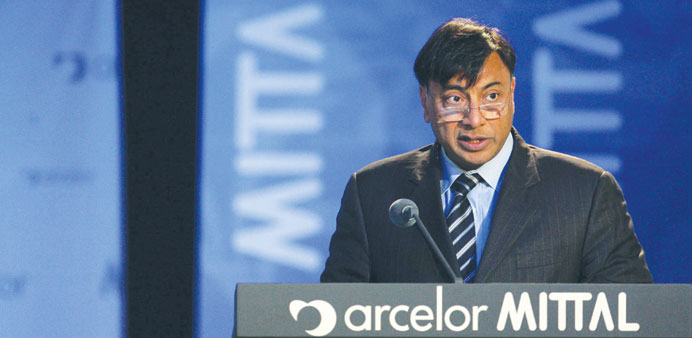
The world’s top steel producer ArcelorMittal stumbled into the red last year with a net loss of $3.72bn (€2.75bn) largely due to costs related to Europe, but said its shuttering of plants was sufficient to support a rebound this year.
ArcelorMittal has had a difficult couple of months, with plant closures in Belgium and France sparking at times violent clashes and the company booking a multibillion charge to revalue its assets.
But ArcelorMittal shares jumped 2.57% to €12.75 in morning trading on a Paris market up 0.29% after the company said that the restructuring effort had been completed and improvement was on the way.
Operating profit measured by earnings before interest, tax and other charges (EBITDA) fell by 30% to $7.1bn in 2012, close to analyst expectations.
“2012 was a very difficult year for the steel industry, particularly in Europe where demand for steel fell a further 8.8%,” chief executive Lakshmi Mittal said in a statement.
The net loss was caused by a $4.3bn accounting charge the company announced in December to write down the value of its assets in Europe, where demand for steel has fallen by nearly a third since the global economic crisis set in.
The Luxembourg-registered company also took another $1.3bn in restructuring charges.
ArcelorMittal, which also has interests in iron-ore mines, had posted a net profit of $2.3bn in 2011.
Sales fell by 10.4% to $84.2bn in 2012, with shipments of steel down 2.3% to 83.8mn tonnes.
Shipments of iron ore rose by 5.4% to 54.4mn tonnes, however, with more than half shipped at market prices.
The company said it expected steel sales to improve this year, climbing by 2-3%, with iron ore sales at market prices to rise by 20%.
ArcelorMittal said this should help it increase operating profit in 2013.
“Although we expect the challenges to continue in 2013, largely due to the fragility of the European economy, we have recently seen some more positive indicators,” said Mittal.
These, along with the steps the company has taken to focus on its most competitive assets and reduce its net debt “are expected to support an improvement in the profitability of our steel business this year”, he added.
The company’s chief financial officer, Aditya Mittal, told a conference call that they were new seeing improvements in shipments in all markets compared to the previous quarter, including in Europe. He said that they expected European steel consumption to drop by 1.0% this year after contracting by 9.0% in 2012.
The announcement last month that it is shutting down six cold-processing facilities in Belgium sparked exchanges of paving stones and tear gas between workers and police over the loss of 1,300 jobs.
In France, ArcelorMittal faced threats last year of nationalisation of one facility over the fate of two blast furnaces.
After heated talks with the French government the blast furnaces are likely never to be reopened but the company promised to invest €180mn into the Florange facility and not cut any jobs.
Aditya Mittal said the closures bring down the number of the company’s blast furnaces in Europe to 21, of which 16 are operating.
The company also said that its net debt fell by $1.4bn over the fourth quarter owing to improved cash flow to stand at $21.8bn at the end of the year.
ArcelorMittal is aiming to raise $3.5bn in stock and subordinated notes to reduce its massive debt, which ratings agencies have warned threatens to break bank loan agreements.
Volvo
Swedish heavy truck and construction equipment maker Volvo expects a weak start to 2013 as orders decline due mainly to the crisis in Europe, the group said yesterday as it announced plunging profits for 2012.
Volvo registered a net profit of 841mn kronor (€98mn, $133mn) in the fourth quarter, down by 82% from the same period a year earlier.
For the full-year 2012, the group posted a profit of 11.3bn kronor, a 38% drop from the previous year.
Sales slipped by 2% for the full-year, to 303.6bn kronor, but the trend deteriorated in the fourth quarter when they slid by 17% to 71.8bn kronor.
That was below market expectations, with analysts surveyed by Dow Jones Newswires expecting quarterly sales around 74.6bn.
“In the fourth quarter demand for trucks continued to be subdued and we saw orders coming down by 10% compared to last year,” Volvo chief executive Olof Persson said in a statement, citing “continued sluggish demand in southern Europe.”
The coming year also looked to be off to a bad start.
“The first quarter of 2013 will also be difficult as a result of the low order intake in many markets during the fourth quarter of 2012,” Persson said.
“Profitability will be affected by low capacity utilisation, high spend levels in research and development and costs associated with the launch of new products,” he added.
Volvo announced in late January that it expects to overtake Daimler as the world’s leading producer of heavy trucks, after acquiring a 45% stake in Chinese auto manufacturer Dongfeng.
Vestas
Danish wind turbine maker Vestas yesterday offered some hope its turnaround plan is beginning to bear fruit, after it flagged an improvement in profitability this year and reported a rise in fourth quarter profits and revenue.
The wind power sector has been hit hard by overcapacity, a faltering global economy and a cut in subsidies for renewable energy by cash-strapped governments, prompting Vestas to axe jobs, stop non-profitable projects and shut factories.
Battling to restore investor confidence after profit warnings, Vestas forecast a positive free cash flow for this year, as well as an underlying EBIT margin of at least 1% — putting a floor under previous guidance for a positive margin.
Vestas shares traded up 5.7% at 1145 GMT, against a 0.8% increase in the Copenhagen stock exchange’s benchmark index.
Investors have worried in particular about the company’s free cash flow.
In the fourth quarter, Vestas returned to positive free cash flow after reporting negative cash flow in the first three quarters of 2012.
At an investor briefing following the results, the group said it was not currently considering raising capital.
Vestas has been the subject of takeover speculation for months as it became clear it needed funding.
It announced last month it had secured final approval for credit facilities totalling €1.8bn, loans it initially agreed with banks in November, ending speculation it might need to issue shares and winning more time to adjust to plunging demand.
The company is also in talks with Japan’s Mitsubishi Heavy Industries about some kind of co-operation, on which it offered no update yesterday.
Compared with the same period of a very depressed 2011, fourth quarter earnings before interest and tax (EBIT), excluding one-off items, more than tripled to €155mn ($210mn). This missed analysts’ average forecast of €191mn in a Reuters poll.
However, fourth-quarter revenue climbed 23% to €2.51bn, beating analysts’ forecasts for 2.26bn.
The group forecast 4-5 gigawatts of turbine shipments in 2013, compared with its previous guidance of 5 gigawatts.
Warning 2013 would still be a tough year, Chief Executive Ditlev Engel told an investor briefing he believed the turbine price level was likely to have reached bottom.
Vestas launched its restructuring plan at the end of 2011 in a bid to restore investor confidence after a profit warning in October that year. Another warning was issued in January 2012 following manufacturing problems that wiped out its 2011 earnings.
Its shares remain down about 95% from their highs of 2008.
Spanish rival Gamesa last year unveiled plans to cut 20% of global staff and slash output as part of a drive to break even in 2013.
Part of Vestas’s plan is to bring down the number of employees to 16,000 by the end of 2013, compared to 22,721 by the end of 2011, to cut costs and reduce
Mazda
Japanese car giant Mazda yesterday said it swung back to a profit in the nine months to December as it boosted its full-year earnings forecast.
Japan’s fifth-biggest automaker logged a net profit of ¥25.6bn ($273mn) for the April-December period, reversing its net loss of ¥112.8bn a year earlier. Sales rose 8.5% to ¥1.54tn, it said.
It credited the results to a bounce in sales and cost-cutting after suffering a double punch from a strong yen and falling demand in key markets during the corresponding period in 2011, when manufacturers were also hit by effects of Japan’s quake-tsunami disaster.
In China, Mazda sold 129,000 vehicles for the nine-month period, down 21.5% from a year earlier, “but sales are on a recovery trend,” it said, echoing similar comments from Toyota, Japan’s biggest automaker.
On Tuesday, Toyota said the China market was improving as it net profit in the nine months to December quadrupled while it also lifted its full-year earnings outlook.
Demand for Japanese cars in China, the world’s biggest vehicle market, plunged last year in the wake of a consumer boycott sparked by a territorial spat between Tokyo and Beijing over an East China Sea island chain.
Mazda also said it was projecting a full-year net profit of ¥26bn, up from an earlier estimate of ¥10bn, while sales are forecast to be ¥2.19tn, compared with an earlier ¥2.17tn prediction.
Japan’s automakers have been posting strong results, underscoring their recovery from the twin disasters and the surging value of the yen, which has been in steep decline in recent months.
Ralph Lauren
Ralph Lauren Corp yesterday reported holiday quarter sales and profits that showed renewed momentum after a rough patch earlier in the year, helped by steady business in the Americas and improvement in Europe.
The fashion company and retailer, whose portfolio also includes brands such as Club Monaco and Chaps, said its gross profit margin rose 2.2 points to 59.3% during the quarter that ended December 29, helped lower product costs and a bigger percentage of sales coming from more profitable items.
Ralph Lauren now expects a bigger improvement in its operating profit margin for the year than initially projected, and shares were up 6.7% in premarket trading.
Revenue in the quarter rose 2.2% to $1.85bn.
The company forecast company-wide revenues would rise by a “mid-single-digit” percentage in the current fourth quarter.
Sales at Ralph Lauren have suffered from its decision to phase out stores and boutiques operated by local partners in China and replace them over time with company-run shops in better spots.
And the discontinuation of the American Living brand, which was dropped by low-price department store J C Penney Co last year, also hurt.
Excluding the impact of its China store closings and the American Living brand, revenue rose 5% in the quarter.
Wholesale revenues, which come from sales to department stores and others that carry its brands, were down 2%, a much gentler drop than in the previous quarter.
At Ralph Lauren’s own stores, revenue was up 6%, also a better performance than last quarter.
Chief Operating Officer Roger Farah credited “continued momentum in the Americas and improved trends in Europe,” a market that has been a drag on the company growth this year.
Net income rose 27.6% to $215.7mn, or $2.31 per share, in the third quarter ended Dec. 29, from $169.0mn, or $1.78 per share, a year earlier.
Time Warner
Time Warner posted higher fourth-quarter profit that beat Wall Street estimates yesterday, as growth in its cable networks offset declines in the film, TV entertainment and publishing units, sending shares up 5%.
The company said it expects its 2013 adjusted earnings to rise in the low double-digits in percentage terms from $3.28 per share in 2012. This falls short of the 11% increase that analysts, on average, were expecting.
The company also said it will take a $60mn restructuring charge on its Time unit.
Time Warner said it is raising its quarterly dividend by 11% to $0.2875 per share and that the board authorised a new $4bn share repurchase programme that started in January.
Net income for the company, which owns the CNN and TNT cable networks, premium TV service HBO, People magazine and a movie studio, rose to $1.16bn, or $1.21 a share, from $773mn, or 76¢ a share, a year ago.
On an adjusted basis, its EPS was $1.17, which beat Wall Street estimates by 7¢, according to Thomson Reuters.
Revenue fell 0.4% from a year earlier to $8.16bn. Analysts were expecting $8.22bn, according to Thomson Reuters.investments.
The group has also closed factories worldwide and transferred sales staff from southern Europe to South America.