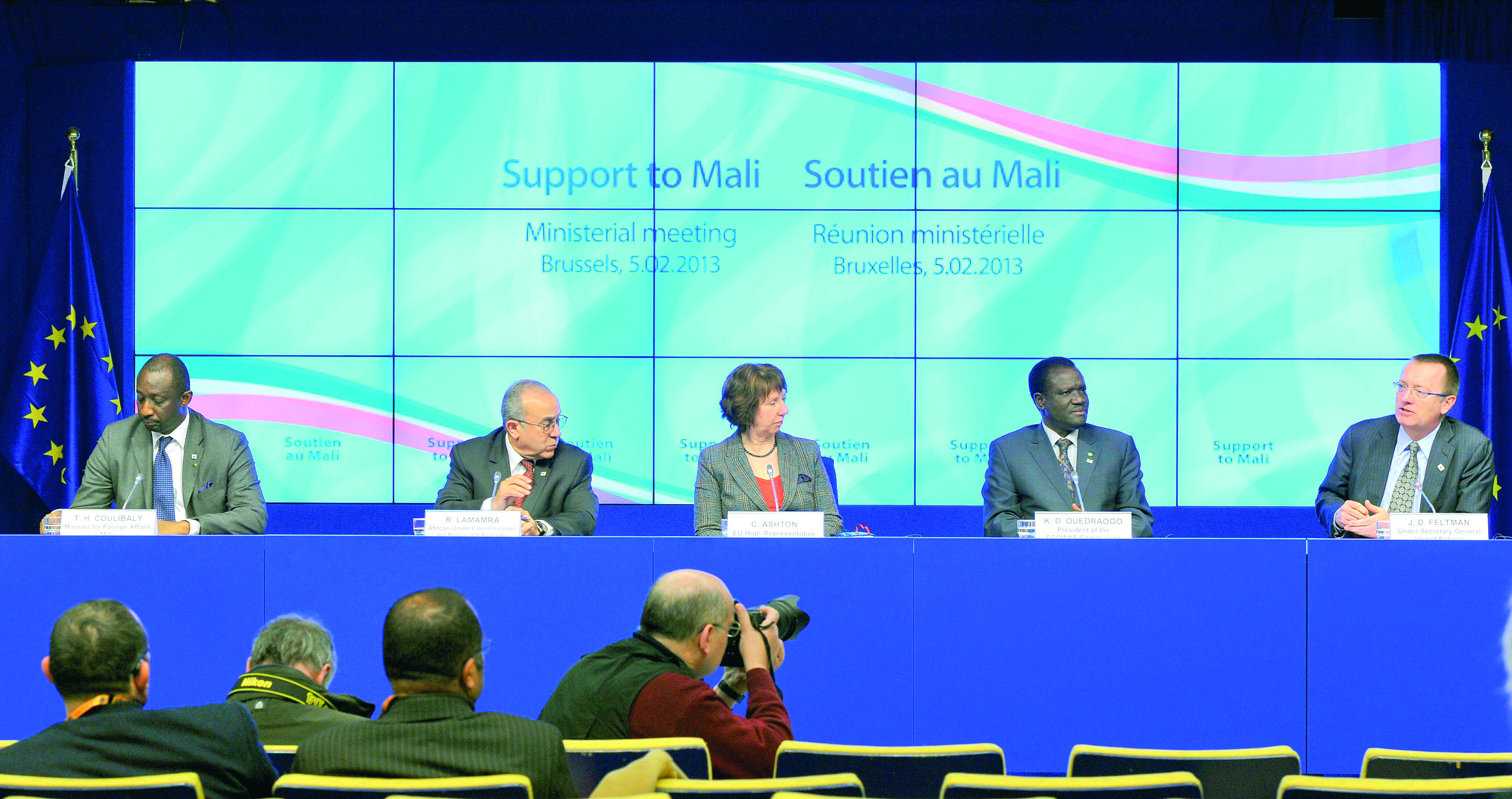
(From left) Malian Foreign Minister Tieman Coulibaly, African Union commissioner for Peace and Security Ramtame Lamamra, High Representative of the European Union for Foreign Affairs and Security Policy Catherine Ashton, Ecowas Commission president Kadre Desire Ouedraogo and UN junior secretary general for Political Affairs Jeffrey Feltman address a press conference at the EU headquarters in Brussels on the situation in Mali.
Agencies/Bamako/Brussels
Chadian troops swarmed yesterday into the desert town of Kidal in northeastern Mali, securing the last Islamist bastion as global players met in Brussels to carve out a path back to stability for the troubled west African nation.
The French defence ministry said 1,800 Chadian troops had entered Kidal to “secure” the Saharan outpost, after days of air strikes in the surrounding mountains where Islamist insurgents are believed to be hiding in hillside caves near the Algerian border.
“The French are controlling the airport with the back-up of two paratrooper units,” a ministry official said, adding that nearly 4,000 French troops were now on the ground in its former colony.
The official said French air strikes had hit 25 targets in recent days, “mainly logistical depots and training centres” in the areas of Aguelhok and Tessalit, near the Algerian border.
French-led forces have driven out the extremist fighters, who had for 10 months controlled a swathe of northern territory the size of Texas, from their key strongholds after sweeping to Mali’s aid on January 11.
The rebels slipped away into the Adrar des Ifoghas massif around Kidal, a craggy mountain landscape honeycombed with caves where they are believed to be holding seven French hostages kidnapped in Mali and Niger in 2011 and 2012.
A Tuareg group formerly allied with the Islamists, the Azawad National Liberation Movement (MNLA) - which was fighting for an independent state but fell out with the extremists who were more interested in imposing Shariah - said it was working with the French against “terrorists” in the region.
“In the framework of anti-terrorist co-ordination put in place with French forces” the former MNLA rebels will provide intelligence on “top terrorist officials” they have arrested, a spokesman said in Burkina Faso.
The group said it was responsible for the arrest on Sunday of two Islamist leaders, Mohamed Moussa Ag Mohamed, the number three in Ansar Dine (Defenders of the Faith), and Oumeini Ould Baba Akhmed of the Movement for Oneness and Jihad in West Africa (Mujao).
The MNLA launched a rebellion a year ago fighting for an independent homeland for the desert nomad Tuareg people, who have long felt marginalised by the central government.
But, after being chased out of their strongholds by the Islamists, they have voiced a willingness to negotiate since France launched its intervention. And Mali’s interim leadership has welcomed them at the table if they renounce their claim to an independent state.
In France, President Francois Hollande, whose decision to intervene in Mali won him a hero’s welcome there during a whirlwind tour on Saturday, defended the decision to send troops in his first address to the European Parliament since taking office.
“There was no time to lose,” he said, otherwise “terrorism would have conquered all of Mali”.
Hollande also urged Europe to fight drug trafficking in west Africa, saying “terrorism feeds on narcotics trafficking”.
Analysts say the groups that seized northern Mali depend on drug trafficking, smuggling and kidnapping to arm themselves.
Western powers have raised concerns the region could become a new breeding ground for terrorists.
In Brussels, global players met to carve out plans for Mali’s future once the 26-day-old offensive draws to an end.
Mali’s Foreign Minister Tieman Coulibaly said as he arrived for the talks that the threat in northern Mali “concerns all civilised countries”.
At the top of the immediate political agenda in Brussels will be the dispatch of human rights observers, amid fears of reprisals against light-skinned Tuareg and Arabs who are accused of backing the Islamists.
Aside from rustling up aid and speeding up plans to deploy a formal UN peacekeeping force, the delegations from the UN, African Union and other blocs will also mull how to assist Mali hold elections before July 31, restoring constitutional rule after a coup that tipped Mali into chaos on March 22.
Separately, pro-autonomy Tuareg rebels said yesterday they had occupied the northeastern town of Menaka, seeking to extend their presence as they push for talks with the government after the retreat of Al Qaeda-linked insurgents.
It was not possible to independently verify whether the MNLA’s fighters had entered Menaka, some 250km southeast of their stronghold of Kidal.
Menaka was a cradle of their uprising last year that seized northern Mali but was subsequently hijacked by Al Qaeda and its allies.
Malian military officials have accused the MNLA of seeking to exaggerate its footprint in northern Mali to strengthen its hand in possible talks with Bamako after a three-week French-led offensive drove the Islamist fighters into the far northeast.
“Our forces have entered Menaka,” MNLA spokesman Ibrahim Ag Mohamed Assaleh told Reuters by telephone from Ouagadougou, the capital of neighbouring Burkina Faso, declining to say how many fighters were in the town.
Ag Assaleh said the MNLA had entered the town because there were groups of rebels from Al Qaeda’s north African wing AQIM, as well as its splinter group MUJWA and Ansar Dine operating nearby, after they were driven from the region’s main towns.
“We took Menaka to make sure the area was secure ... The Malian army do not want to leave Gao,” Ag Assaleh said. “Any town which is not secured, we will take it.”
Malian military sources said it was possible the MNLA had entered Menaka because Islamist rebels had fled and no other military force was occupying the town, which lies some 100km from the border with Niger.
France has urged Mali’s government to open a dialogue with northern communities including the Tuaregs, and Malian interim Dioncounda Traore says he is ready to talk to the MNLA provided they drop any claim for territorial independence.
Failure to solve the Tuareg issue could hamper the efforts of France and its regional and international allies to forge a lasting peace in Mali’s remote north and prevent its use by Al Qaeda as a launch pad for jihadist attacks.