


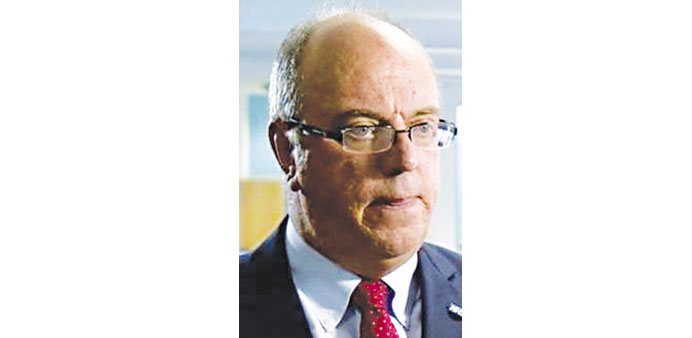
Guardian News and Media/London
When the long-awaited Francis report on why health service managers and regulators failed to spot the terrible failures of care at Mid Staffordshire hospital trust is published today, the media and political spotlight will home in on what it says about the actions of one individual in particular: Sir David Nicholson.
Nicholson was the inquiry’s star witness. As a regional NHS official he had oversight of the performance of Mid Staffs in 2005, at the time the clinical failures were happening.
In his subsequent role as chief executive of NHS, he was formally accountable for the way in which the service responded to the emerging scandal. He is arguably the most powerful person in the NHS.
The significance of the inquiry’s judgment on Nicholson lies partly in its assessment of how personally culpable he was for the handling of one of the worst ever NHS care scandals.
The report will also be seen as a more general verdict on the way the health service has been run in recent years, and the centralised, top-down, target-driven management style and culture that Nicholson has come to personify.
Despite his apology to the people of Staffordshire last week, Nicholson will face calls to resign. Whether the Health Secretary, Jeremy Hunt, agrees Nicholson should go will be instructive.
Nicholson’s departure would enable ministers to send a symbolic message that they have called time on an NHS era they claim their reforms will leave behind.
But Hunt also knows this is not a straightforward call.
Nicholson is a great survivor, and part of the reason for this is that whatever politicians of all hues say about “light touch” leadership and the “post-bureaucratic era”, the volatile world of NHS politics means they ultimately find the robust, centralist Nicholsonian style indispensable.
Nicholson is, everyone agrees, a big character. In an era of grey-suited managerialism, few top public servants have come to embody so vividly the culture and practice of the service they run.
In leadership terms he is a colossus: after nearly seven years, one of the longest-serving NHS chief executives, and arguably its most successful. He has served no fewer than five health secretaries across two governments. No one (including him) expected Nicholson to get the NHS top job in 2006, because at that time Labour wanted a high-flying private healthcare executive, preferably from the US.
No one (including him) expected Nicholson to survive the transition to coalition government, but he outlasted its first health secretary, Andrew Lansley, who almost everyone supposed would be his nemesis.
Political bosses as ideologically diverse as Patricia Hewitt, Andy Burnham and David Cameron have relied on him, not least because he has almost invariably delivered their priorities.
After the NHS ran up a billion-pound deficit in 2006 (a crisis that led to the sacking of his predecessor) he swiftly pulled it back into the black.
When the service was rocked by hospital-acquired infections scandals in 2007, he delivered the clean-up. Waiting times have remained relatively stable three years into the biggest efficiency drive ever mounted in the NHS, even as Nicholson presented a £3bn surplus to the Treasury.