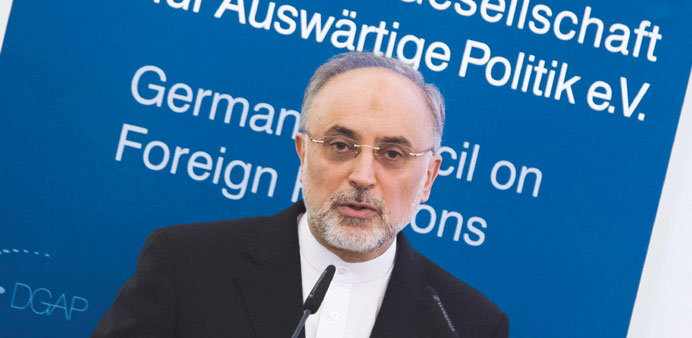
Iran’s Foreign Minister Ali Akbar Salehi delivers a speech at the German Council on Foreign Relations in Berlin yesterday.
Reuters/Berlin
Iranian Foreign Minister Ali Akbar Salehi said yesterday he saw US Vice President Joe Biden’s offer this weekend of bilateral dialogue between their two countries as a sign of a change in approach to Tehran by Washington.
Iran is embroiled in a long standoff with big powers over its nuclear programme. Tehran insists its atomic activity is for peaceful energy only while the US and other powers suspect it of seeking the capability to build a nuclear weapon.
“As I have said yesterday, I am optimistic, I feel this new administration is really this time seeking to at least divert from its previous traditional approach vis-a-vis my country,” Salehi told the German Council on Foreign Relations.
Salehi, who attended the Munich Security Conference at the weekend where Biden made the offer, said in Berlin that it was still very difficult for Tehran and Washington - more than 30 years after they severed relations - to trust each other.
“How do we trust again this new gesture?” he said.
Salehi said he hoped Barack Obama would keep what he said was a promise by the US president to “walk away from wars ... and approaches that bring destruction, killings, bloodshed”. He did not elaborate.
Negotiations between Iran and Russia, China, the US, Britain, France and Germany over Tehran’s nuclear activities have been deadlocked since a meeting last June.
European Union officials have accused Iran of dragging its feet in weeks of haggling over the date and venue for new talks.
“I think it is about time both sides really get into engagement because confrontation certainly is not the way,” Salehi said in Berlin, referring to the US.
“And another thing: this issue of the nuclear file is becoming boring,” added Salehi, a physicist by training who once headed the Iranian atomic energy agency and represented his country at the International Atomic Energy Agency (IAEA).
The European Union said this weekend it had proposed talks in the week of February 24 which could take place in Kazakhstan. Salehi called this “good news” - but the EU said Iran has not yet accepted.
Speaking on a visit to London, Iranian former nuclear negotiator Hossein Mousavian said the nuclear deadlock would not be solved without a meaningful parallel dialogue between Tehran and Washington.
“I believe they should start immediately. They should put all issues on the table. They should start with issues of common interest like Afghanistan in order to create a positive momentum,” he said after a speech at the Chatham House think tank.
Mousavian seemed less upbeat on the prospect of success at the Kazakhstan round of talks, citing UN sanctions imposed on Iran to pressure it to curb its nuclear programme. “As far as they (the West) are going to keep the main sanctions, they should not expect Iran to respond with concessions,” he said.
In Berlin, Salehi faced tough questioning about Iranian support for Syrian President Bashar al-Assad in a civil war in which about 60,000 people have died.
Salehi denied Iran was sending soldiers to help Assad, saying: “The army of Syria is big enough, they do not need fighters from outside.”
Iran was only sending economic assistance, food and fuel, said the minister, adding that the Damascus government and opposition should sit down, agree a ceasefire and call free elections in which he said Assad should be free to take part.
About 100 Iranian opposition members protested outside the Berlin venue where Salehi spoke.