


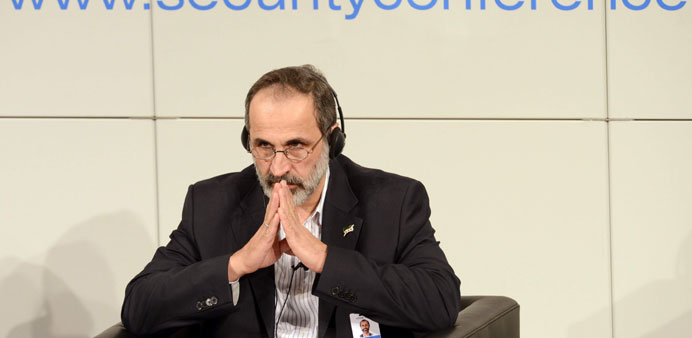
Khatib: “The ball is now in the regime’s court.”
AFP/Damascus
Syria’s opposition chief urged President Bashar al-Assad yesterday to respond positively to a call for dialogue and to delegate his deputy to end 22 months of warfare that has cost tens of thousands of lives.
“The ball is now in the regime’s court. They will either say yes or no,” Moaz al-Khatib told Al Jazeera, following up on his surprise announcement last week that he was ready for talks with the Damascus regime—subject to conditions, including the release of 160,000 detainees.
He later elaborated, telling Al Arabiya news channel he was ready to meet Assad’s deputy, Vice President Farouq al-Shara.
“Since the start of the crisis, Mr Shara has seen that things are not going in the right direction,” said Khatib. “If the regime accepts the idea, I ask it to delegate Farouq al-Shara for us to hold discussions with him.”
Assad last month announced he was ready for talks with the opposition but ruled out meeting groups such as Khatib’s National Coalition which back armed rebels seeking to overthrow his regime.
Opposition groups, including the National Coalition, have in the past demanded Assad step down before peace talks can begin.
“Doctor Bashar, this country is in grave danger, come out of your bubble, if only for a moment. Look into the eyes of your children and you will recover some of your humanity,” Khatib said, addressing Assad by the term adopted by state media and his supporters.
“We can help each other in the interest” of the people, Khatib said.
“The regime needs to take a clear position. We will extend our hands for the sake of the people, and in order to help the regime leave in peace.”
Some opposition figures have denounced Khatib’s proposal as traitorous.
But he rejected the criticism and said: “Our people are dying, and we will not allow that.”
His comments came as Iranian Foreign Minister Ali Akbar Salehi said Tehran would continue talks with Khatib following a preliminary meeting on Sunday on the sidelines of a security conference in the southern German city of Munich.
“We had 45 (minutes) to an hour discussion which was very fruitful... and we committed ourselves to continuing this discussion,” Salehi said in Berlin.
Khatib also meet in Munich on Sunday with Russian Foreign Minister Sergei Lavrov, who while expressing an interest in “maintaining regular contact” with the opposition, said the dissidents’ insistence on Assad going was “the main reason for the continuation of the Syrian tragedy”.
Adding to the latest flurry of diplomatic activity, another Iranian official, Saeed Jalili, the head of his country’s Supreme National Security Council, was in Damascus yesterday where he renewed Tehran’s support for Assad.
Jalili also issued a warning to Israel after the Jewish state confirmed an air strike near Damascus, saying it would regret its latest “aggression against Syria”.
“Just as it has regretted all its wars... the Zionist entity will regret its aggression against Syria,” Jalili said. “Syria is at the forefront of the Muslim world’s confrontation with the Zionist entity.”
Israeli Defence Minister Ehud Barak has implicitly confirmed that the Jewish state staged the air strike on Syria, following reports of a raid which Damascus said targeted a military complex near the capital.
Fresh violence yesterday killed at least 81 people across Syria, including six children who died as regime warplanes raided the outskirts of the rebel-held town of Douma near Damascus, the Syrian Observatory for Human Rights said.
And a three-year-old child and his 17-year-old brother were killed in army shelling of the northern province of Raqa, said the Britain-based watchdog.