


By Noimot Olayiwola/Staff Reporter
|
|
A new set of guidelines that will ensure that food handlers at outlets serving eatables and drinks in Qatar are disease-free is being compiled for implementation this year by the Supreme Council of Health (SCH) in collaboration with the Ministry of Municipality Affairs and Urban Planning, it was learnt yesterday.
The new initiative is in addition to the annual medical test by the Medical Commission to check them for contagious diseases such as tuberculosis and hepatitis as part of a pre-requisite to renewing the licence for food handling.
Also on the anvil is a plan to implement, later this year, an early warning system in collaboration with the World Health Organisation’s regional office, which will improve surveillance on the outbreak of food poisoning and other food-borne diseases. Salmonella is one of the most common causes of food poisoning.
There are more than 50 outbreak reporting centres and 197 focal points in the primary healthcare centres across Qatar.
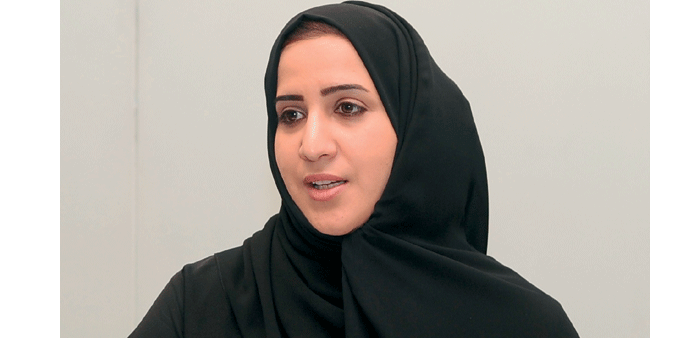
“We have started drafting a proposal for a new set of guidelines that should be strictly followed by all food handlers, be it in the five-star hotels or in small juice stores across the country, in order to ensure adequate protection for the health of their patrons as well as the entire residents as a whole,” SCH’s Food Safety, Health and Environmental Division manager Dr Wassan al-Baker said.
She was speaking to journalists on the sidelines of a three-day workshop on “Mock Exercise Food Poisoning Outbreak” which began yesterday.
The official said that a new website, being dedicated solely to informing the public about food bans and health products recalls, was underway.
She said the workshop, being attended by some 20 participants from SCH, the Hamad Medical Corporation and the Primary Health Care Corporation, was focusing on imparting knowledge of reporting food poisoning outbreaks as well as filling gaps in taking prompt actions during incidences.
Speaking about the proposed guidelines for food handlers, SCH Health Protection and Communicable Disease Control department’s Surveillance and Outbreak section head Dr Hamad Eid al-Romaihi noted that the new guidelines would first focus on providing orientation about food safety and food preparation for newly-arrived handlers beside certifying them for the profession.
“As part of the guidelines, we will conduct a short course for all new food handlers in order to enhance their capacity in ensuring food safety as well as maintaining good personal hygiene that will prevent them from contracting preventable diseases and from spreading it to their consumers,” he explained.
However, according to al-Romaihi, it would become mandatory for those food handlers already certified by the SCH to take the course before their re-certification.
“The short course is also a means of creating awareness among this category of people in order to ensure that all food they prepare are safe for consumption.”
The official said that the mock training was being held to prepare participants for the action to take in case of diseases and food poisoning outbreaks.
“There have been sporadic (single unrelated) cases of food poisoning in the country within the past two months and these occurred mostly in labour camps due to poor hygiene and there were also minor outbreak of chicken pox involving four cases in a private school, which is expected during winter,” he said without giving specific figures.
He claimed that necessary precautions and measures were taken to contain the situation.
The official said that there were plans to co-ordinate with all schools through the School Health Promotion department at the PHCC on how to mitigate and notify about disease outbreak in school.
A form will be made available to schools in that regard, he said.
He said the planned early warning system, expected to be fully implemented by 2015 between the SCH, HMC and PHCC, was one of the projects (project 3.5) under the National Health Strategy (2011-2016) and part of the Communicable Diseases Prevention project.