


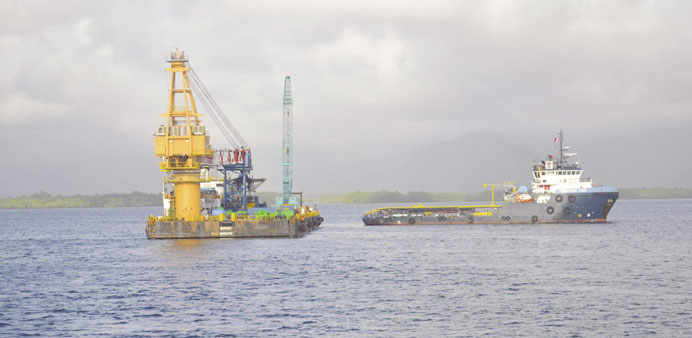
Crane ship, SMIT Borneo from Singapore, that will help extract the USS Guardian from Tubbataha Reefs after it ran aground, arrives off the coast of Palawan province, west of Manila in this handout picture provided by the Philippine Coast Guard.
By Bernice Camille V Bauzon /Manila
The US government is prepared to provide “appropriate compensation” to the Tubbataha Reef for the damages caused by the grounding of the USS Guardian there in mid-January.
In a statement, the US Embassy in Manila said yesterday that its government considers the coral reefs in the Philippines, including the protected Tubbataha Reef, as some of the “most important biodiversity centres in the world.” “In view of damage caused by the USS Guardian accident at Tubbataha Reef, the US has expressed its regret and is prepared to provide appropriate compensation to the Republic of the Philippines,” the embassy said.
“In addition to compensation, the US government is planning a number of other activities, which will underscore its commitment to Tubbataha’s recovery and the protection of the marine resources of the Philippines,” it added.
The embassy also said that helping the Philippines conserve these “remarkable resources” is a long-standing commitment of the US government. The embassy underlined that over the past decade, the American people have supported efforts by US government agencies, US academic institutions and non-governmental organisations “that have had a positive impact on the Philippines’ marine ecosystems.”
Through the US Agency for International Development (Usaid) Office in Manila, the US government has already invested over 1.9bn pesos to support marine biodiversity conservation programmes in the Philippines, the embassy said.
It claimed that the financial support paved the way for an “enhanced food security, stronger environmental governance and sustainable economic growth.”
The programmes, which were aimed to address open access, over-fishing, illegal, unregulated and unsustainable fishing, and habitat degradation, have resulted in increased fish stocks, rehabilitation of critical fish habitats and mitigation of conflicts over natural resources. —Manila Times