


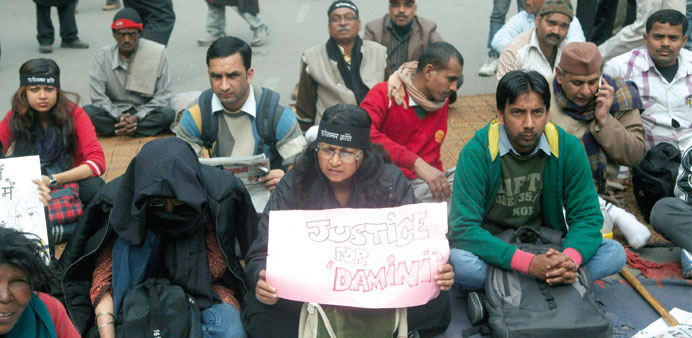
Activists participate in a protest held against the brutal gang-rape of a woman in New Delhi yesterday. A Delhi court yesterday formally charged five men with rape and murder.
Agencies/New Delhi
Five men pleaded not guilty yesterday to charges they raped and murdered a trainee physiotherapist, in a case that led to a shake-up of laws against sexual crimes after protests about a rising number of attacks on women.
Police say the gang lured the 23-year-old woman onto a bus in New Delhi, where they repeatedly raped and assaulted her with a metal bar before throwing her bleeding onto a highway. She died of internal injuries two weeks after the December 16 attack.
The men filed into the court room with their faces covered, where lawyers in the case said they were read 13 charges including murder, which carries a maximum penalty of death. They left after 15 minutes.
Judge Yogesh Khanna who heads a fast-track court in Delhi’s southern area of Saket read 13 charges including murder, gang-rape, abduction, destroying evidence and criminal conspiracy in the closed hearing.
“After the judge read out the charges, the five pleaded not guilty and walked out” said A P Singh, a lawyer defending two of the accused, Vinay Sharma and Akshay Thakur.
Singh said the prosecution will call three witnesses to the next hearing on Tuesday, which is the formal start of the trial. The prosecution says it has strong evidence against the five men including blood stained clothing, DNA matches, mobile phone records, confessions and eyewitness statements.
Singh says Sharma was never on the bus and Thakur was hiding beneath a seat and never took part in the crime.
The other men - brothers Ram and Mukesh Singh and Pawan Kumar - are represented by two other lawyers. Mukesh Singh has replaced a lawyer who claimed his client was tortured in police custody, and no longer claims mistreatment.
A sixth person police say was part of the gang that attacked the woman and her friend is a juvenile and will be tried separately.
Pre-trial proceedings in the case started on January 21 at the fast-track court.
The charge-sheet, with annexures, ran into thousands of pages and included the victim’s statement, details of the accused, evidence and forensic reports.
The brutality of the attack was shocking even to a nation inured to a rising wave of sexual crimes against women. Thousands of young protesters took to the streets in the weeks that followed. In response to the public outcry, on Friday the cabinet fast-tracked new, tougher penalties for sex crimes.
Under the new rules, due to be signed into law by the president in the coming days, gang-rape that leads to death will be punishable by death while minimum penalties will be raised to 20 years for gang-rape and rape of a minor. The laws must later be ratified by parliament.
Govt moves to strengthen laws against sex assaults
Agencies/New Delhi
India’s cabinet has approved an ordinance to strengthen harsher punishments for rapists, including the death penalty, after a brutal gang-rape in New Delhi that sparked national outrage.
The government-appointed Justice J S Verma committee recommended the changes after the death of a 23-year-old woman who was savagely raped and attacked in a bus on December 16 and died nearly two weeks later.
The case ignited nationwide demonstrations by protesters demanding better safety for women.
The ordinance, which must be approved by President Pranab Mukherjee to become law, includes doubling the minimum sentence for gang-rape and imposing the death penalty when the victim is killed or left in a vegetative state.
“We have taken swift action and hope these steps will make women feel safer in the country,” Law Minister Ashwani Kumar told reporters late on Friday.
“This is a progressive piece of legislation and is consistent with the felt sensitivities of the nation in the aftermath of the outrageous gang-rape,” he added.
Yesterday, the gang-rape victim’s brother praised the cabinet’s decision to make sentences tougher for attackers, calling it a “positive initiative.”
Under the changes, the minimum sentence for gang-rape, rape of a minor, rape by policemen or a person in authority will be doubled to 20 years from 10 and can be extended to life without parole.
Under the current law, a rapist faces a term of seven to 10 years.
The cabinet has also created a new set of offences such as voyeurism and stalking that will be included in the new law.
But, the ordinance diverged on issues such as marital rape, capital punishment and the prosecution of armed forces personnel who commit sexual assaults.
The changes to the rape laws were expected to be approved by Mukherjee as early as this weekend but must be ratified by parliament or they will lapse.
However, some women’s organisations urged the president not to sign the ordinance.
“The ordinance is a complete betrayal of the people’s faith. We are alarmed at the complete lack of transparency displayed by the government in proposing an ordinance as an emergency measure. We call upon the president not to sign such an ordinance,” woman activists said at a press conference here. They also wondered why such a measure was necessary when parliament would convene for the budget session in about 20 days.
The women also complained that the cabinet had not paid adequate attention to the recommendations of the Verma committee.
“It is an absolute mockery of Justice Verma’s panel’s recommendations. We were alarmed to see the ordinance as it ignored many recommendations of the committee. The government has stealthily passed this ordinance without sharing it with the public and without actually debating and discussing it. All the recommendations than can actually strike at the heart of impunity have been dropped,” Kavita Krishnan, secretary of the All India Progressive Women’s Association (AIPWA) said.
Some women said they would take to the streets in protest once again just as they had protested after the brutal gang-rape of the woman.
“We will be holding protests, likely from Monday at 2pm, but we are yet to finalise it. We would definitely continue to agitate. How can the union cabinet, in just a few hours, sit and cherry-pick what J S Verma and his team strenuously worked on for a whole month?” asked Krishnan, adding that the government acted stealthily, passing the ordinance without sharing it with the public and without debating and discussing it.