By Santhosh V Perumal/Business Reporter
The Qatar Exchange maintained its positive trajectory for most part of the trading sessions during the week with buying interests stronger among the industrials, telecom and transport sectors.
Gainers outnumbered the losers as the Qatar Index rose 0.4%, Total Return Index by 1.05% and Al Rayan Islamic Index by 0.75% in the week that saw Dubai shoot up 5.32%, Abu Dhabi (3.39%), Bahrain (1.37%), Kuwait (0.68%) and Saudi Arabia (0.65%); while Muscat fell 0.34%.
Major gainers included Commercialbank (Cb), Qatar Islamic Bank, Masraf Al Rayan, al-Khaliji, Mawashi, Industries Qatar (IQ), Gulf International Services, Nakilat. United Development Company, Qatar Telecom and Milaha; even as QNB, Doha Bank, Ahlibank, Barwa, Mazaya Qatar and Vodafone Qatar bucked the trend in the week that witnessed QNB contemplate “sizeable” acquisitions to achieve scale as part of its comprehensive to become a Middle East and Africa (MEA) icon by 2017.
Doha’s bourse gained 4.38% year-to-date against Dubai’s 16.34%, Abu Dhabi (9.37%), Kuwait (5.24%), Saudi Arabia (3.56%), Bahrain (1.83%) and Muscat (0.68%).
The QE All Share Index (comprising wider constituents) added 0.73% with the industrial index surging 1.67%, telecom (1.35%), transport (0.69%), banks and financial services (0.29%) and insurance (0.13%); while the indices of consumer goods and realty fell 0.14% and 0.05% respectively in the week that saw Ahlibank shareholders approve the Qatar Foundation’s stake purchase from Bahrain’s Ahli United Bank.
Year-to-date, the telecom sector has been the best performer with the group extending 6.94% gains, industrials (6.17%), banks and financial services (4.52%), transport (4.08%), consumer goods (3.21%); even as the indices of insurance and real estate fell 2.03% and 0.19% respectively.
Of the 42 stocks; 24 advanced, while 16 declined and two were unchanged in the week that saw foreign institutions continue to be net buyers, albeit with lower intensity.
Seven of the 12 banks and financial services, five of the eight consumer goods, four of the eight industrials, three of the five insurers, two each of the four realty and the three transport and one of the two telecom stocks closed higher in the week that saw the country’s non-oil non-Qatar Petroleum exports get a fillip with Qatar Development Bank’s export development agency, Tasdeer, launching an ambitious export-driven initiative, Exim Link.
However, market capitalisation was down 0.03% or QR16mn to QR475.37bn with mid and large cap equities notably shedding 0.61% and 0.2%; while micro and small caps gained 0.69% and 0.56% respectively in the week that saw an International Monetary Fund official say that Qatar would launch riyal-denominated bonds this year.
Year-to-date, mid and large cap equities have gained 5.45% and 3.95%; whereas micro and small caps fell 1.87% and 0.73% respectively.
Qatari individual investors’ net selling sunk to 3.93% or QR41.49mn. A marginally lower 33.05% of them were into purchasing stocks against 34.05% the week ended January 24 and a lower 36.98% were into offloading compared to 43.53%.
However, non-Qatari retail investors turned net buyers to the tune of 0.3% or QR31.7mn. A lower 9.92% of them bought scrips against 12.14% the previous week and a lower 9.62% sold compared to 12.82%.
Foreign institutions’ net buying fell to 10.24% or QR108.10mn. A higher 36.57% of them bought equities against 31.53% the week ended January 24 and a higher 26.33% offloaded compared to 20.48%.
Domestic institutions’ net profit booking soared to 6.59% or QR69.57mn. A lower 20.47% of them were into buying against 22.27% the previous week whereas a higher 27.06% into selling compared to 23.17%.
The bourse’s price-earning ratio, a measure of expensiveness, was 12.35 times in the last week of January against 11.92 times in the comparable period of 2012.
The price-to-book value was 1.73 times at the end of January 31 against 1.66 times in the year-ago period.
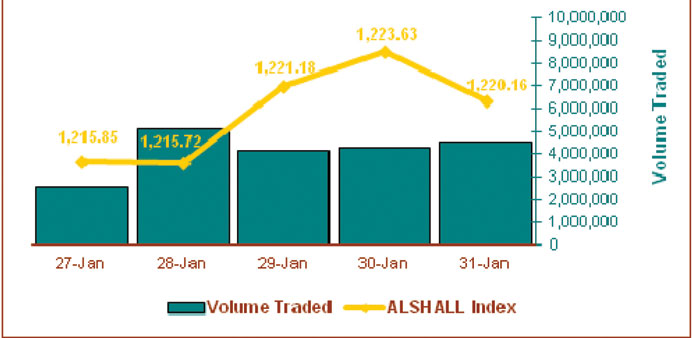
Total trading volume was up 1% to 20.52mn shares, while value fell 6% to QR1.05bn and transactions by 4% to 13,927 in the week.
In terms of volume, banks and financial services stocks accounted for 41.08% of the total against 56.94% the previous week, industrials 16.72% (8.02%), transport 12.91% (8.32%), real estate 11.55% (7.92%), consumer goods 7.02% (7.58%), telecom 6.82% (8.42%) and insurance 3.9% (2.81%).
The industrials sector’s trading volume more than doubled to 3.43mn shares, transport’s surged 57% to 2.65mn, realty by 47% to 2.37mn and insurance by 40% to 0.80mn; while that of banks and financial services plummeted 27% to 8.43mn, telecom by 18% to 1.40mn and consumer goods by 6% to 1.44mn.
In terms of value, the banks and financial services sector’s shares constituted 44.76% of the total compared to 59.58% a week ago, industrials 26.19% (12.63%), consumer goods 7.69% (11.27%), transport 6.54% (4.80%), telecom 5.26% (5.81%), insurance 5.06% (3.33%) and real estate 4.51% (2.6%).
The consumer goods sector’s stocks trading value plunged 36% to QR81.17mn, banks and financial services by 29% to QR472.47mn and telecom by 15% to QR55.51mn; while that of industrials shot up 95% to QR276.43mn, realty by 63% to QR47.61mn, insurance by 43% to QR53.44mn and transport by 28% to QR68.99mn.
IQ stocks accounted for 15.45% of the total stocks trading value, QNB (14.37%) and Cb (9.37%). In terms of transactions, the banks and financial services sector’s share in total was 39% against 50.8% the previous week, industrials 20.24% (12.29%), transport 12.3% (8.46%), consumer goods 11.17% (12.58%), real estate 7.84% (5.03%), telecom 6.35% (7.86%) and insurance 3.10% (2.98%).
The banks and financial sector’s stocks transactions tanked 26% to 5,431; telecom by 23% to 884; consumer goods by 15% to 1,556 and insurance by less than 1% to 432; whereas those of industrials expanded 58% to 2,819; realty by 49% to 1,092 and transport by 39% to 1,713.