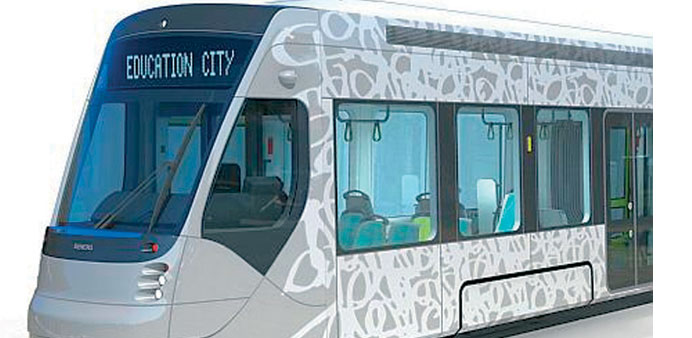
A conceptual image of an LRV for the proposed Education City light rail system. PICTURE: Siemens
The proposed $412mn Education City light rail system will get the most modern ballastless tracks and the production of nearly 14,000 concrete sleepers is to begin soon in Saudi Arabia.
Rail.One, one of the leading manufacturers of concrete sleepers in Europe, is to install the track system for the light rail, which is being designed and built by the civil works contractor Habtoor Leighton Group (HLG).
HLG has awarded Rail.One a contract to supply its Rheda City ballastless track system for the project, www.rail.co has reported. The 25-station line, due to open in autumn 2015, will link Education City with the proposed Doha Metro network.
The Rheda City ballastless track system requires almost no maintenance, offers perfect ride comfort, supports heavy loads, and ensures great safety, according to www.railone.com
Track ballast (crushed stone) forms the trackbed upon which railway sleepers are laid. It is packed between, below, and around the sleepers. The term ‘ballast’ comes from a nautical term for the stones used to stabilise a ship.
The Rheda City system was designed especially for mass rapid transit, and is especially effective in applications for trams systems and surface commuter train lines. Rheda City is characterised by simple construction technology: modified bi-block sleepers with lattice trusses facilitate installation and guarantee precise track gauge at the same time. Rheda City provides additional advantages by the monolithic structure of its track supporting layer, and by its low installed structural height. Rheda City can be covered with asphalt, concrete, or paving blocks, as desired.
Rail.One will produce around 14,000 TB/ZB bi-block concrete sleepers for the 11.5km Education City light rail line, with production scheduled to begin in the first quarter of this year at its facility in Ha’il, Saudi Arabia.
It was reported in July 2012 that Qatar Foundation has awarded Siemens a turnkey contract worth more than €100mn to build and equip the Education City light rail line. The contract includes signalling and communications systems, electrification, and depot equipment, as well as platform screen doors at four stations.
Siemens also will supply a fleet of 19 Avenio low-floor LRVs (light rail vehicles), which will be equipped with the Sitras HES system for catenary-free (the removal of the overhead line equipment and the pantograph from the tram system) operation.
Each roof-mounted Sitras HES module combines a double-layer capacitor with a Nicket Metal Hydride (NiMH) battery, allowing the vehicle to store both traction and braking energy.
Power converters transform the three-phase current with a rated voltage of 11kV into the 750V direct current required for charging the energy storage unit. The system will complete its charging cycle in just 20 seconds, taking power from charging points installed at each of the line’s 25 stations, which will be fed by centralised rectifier substations.
The LRVs will also be adapted to operations in high temperatures, with a powerful air conditioning system and sun shades to protect roof-mounted electrical equipment from radiant heat. The 27.7m-long vehicles will feature a 2.55m-wide bodyshell and will accommodate up to 239 passengers.