


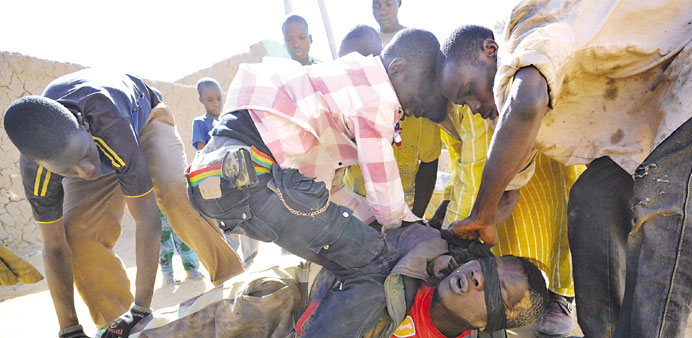
Malian youths restrain an alleged shop looter after arresting him in the northern city of Gao.
AFP/Mali
French troops yesterday entered Kidal, the last Islamist bastion in Mali’s north after a whirlwind Paris-led offensive, as France urged peace talks to douse ethnic tensions targeting Arabs and Tuaregs.
French troops arrived at the Kidal airport just days after the capture of Gao and Timbuktu in a whirlwind three-week campaign that Paris hopes to wind down and hand over to African forces.
However French Defence Minister Jean-Yves Le Drian said yesterday the troops had been unable to leave the airport due to a sandstorm.
“French elements were deployed overnight in Kidal,” French army spokesman Thierry Burkhard said in Paris earlier.
A spokesman for the breakaway Islamic Movement of Azawad, which on Monday announced it had taken control of the town, said its leader was speaking to the French. Kidal lies 1,500km northeast of the capital Bamako and until recently was controlled by the Islamist group Ansar Dine (Defenders of the Faith).
Last Thursday however, the newly formed group announced it had split from Ansar Dine, that it rejected “extremism and terrorism” and wanted to find a peaceful solution to Mali’s crisis.
Ansar Dine and two other Islamist groups took advantage of the chaos following a military coup in Bamako last March to seize the north, imposing a brutal form of Islamic law.
Offenders suffered whippings, amputations and in some cases were executed while Islamists also destroyed sacred shrines in the ancient city of Timbuktu that they considered idolatrous.
France swept to Mali’s aid on January 11 as the Islamists advanced south towards Bamako, sparking fears that the whole country could become a haven for terrorists, and now has 3,500 troops on the ground.
But in the longer term, Paris regards a political settlement between the government in Bamako and Tuaregs seeking a degree of self-rule as crucial to Mali’s stability.
The Malian parliament on Tuesday adopted a political roadmap which included a commitment to holding elections by July and negotiations with representatives of the north.
“This political process now has to advance concretely,” French foreign ministry spokesman Philippe Lalliot said, urging speedy “negotiations with the legitimate representatives of the peoples of the north and non-terrorist armed groups that recognise the integrity of Mali”.
“Only a north-south dialogue will prepare the ground for the Malian state to return to the north of the country,” he said.
Several reports say the main Islamist chiefs, Iyad Ag Ghaly of Ansar Dine and the Algerian Abou Zeid of Al Qaeda in the Islamic Maghreb (AQIM), have retreated to the mountains in the Kidal region, which borders Algeria and Niger.
In the face of ground strikes and devastating air bombings that destroyed their headquarters in Timbuktu as well as their fuel supplies and armoury, the Islamists had no choice but to flee.
But the lack of resistance for the moment does not mean they have been neutralised, said Alain Antil, the head of sub-Saharan affairs at the French Institute of International Relations.
“They can turn to classic guerrilla tactics including harassment, rapid attacks with kidnappings and bombings,” said Antil.
In Timbuktu on Tuesday, a day after the troops drove in to an ecstatic welcome, hundreds of people looted shops they said belonged to Arabs, Mauritanians and Algerians accused of backing the Islamists.
After reports fleeing Islamists had torched a building housing priceless ancient manuscripts in the city, an expert said many had been smuggled away before the insurgency which saw the insurgents destroy ancient shrines and tombs they considered idolatrous.
“A vast majority was saved... more than 90%,” said Shamil Jeppie, Tombouctou Manuscripts Project director at the University of Cape Town.