


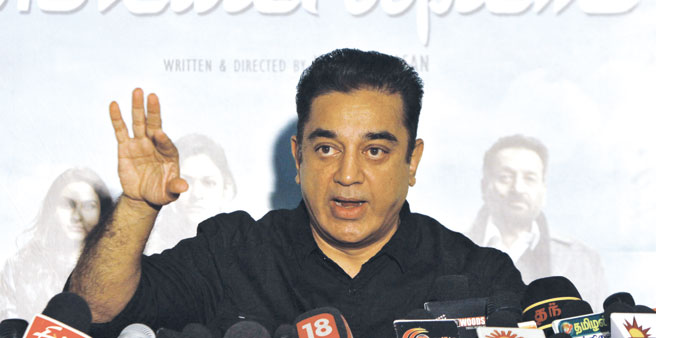
Actor and filmmaker Kamal Haasan speaks to the media in Chennai yesterday.
IANS/Chennai
The Madras High Court yesterday reimposed a ban on Kamal Haasan’s Vishwaroopam, escalating problems for the filmmaker who threatened to leave the country while also agreeing to delete some scenes that Muslim groups found objectionable.
As controversy swirled over the Rs950mn multilingual espionage thriller, the debate on creative freedom also intensified.
Kamal Haasan, one of southern cinema’s most successful stars, said if the ban on his film was not lifted, he might have to look out for a “secular state” within or outside the country.
He also agreed to cuts in the film following objections from the Muslim organisations.
“There is no difference between me and my Muslim brothers. It is our duty to take care of them. There are four scenes that are being pointed out and I am willing to remove these scenes from the movie,” he said.
Haasan said he was “fed up” by the controversy and would seek to live in another country just like India’s acclaimed painter M F Hussain who was targeted by Hindu hardliners and fled the country in 2006.
“I will find, hopefully, another country which is secular that might take me in. M F Hussain had to do it, now Haasan will do it,” he said.
“What would change is my passport; I would still be an Indian. I have pledged all my property for the film. I have lost my house because of delay in release,” he said.
“Going by what is happening with me, I’m very likely to seek a secular state or country to release my film, on which I’ve invested my lifetime’s savings, including all my assets,” Haasan said in an emotional outburst that came a day after Bollywood film icon, Shah Rukh Khan, asserted his secular, national identity.
Haasan said he was still trying to understand why “some members with strong political backing” were against his film. “The film is running successfully in other states and the feedback from the audience has also been positive.”
The lavishly mounted film, which stars Haasan and is written, produced and directed by him, was banned by the Tamil Nadu government after some Muslim groups complained that it portrayed their community in bad light.
The film was originally scheduled to release on January 25 in Tamil and Telugu, but was only released in a few places in Kerala, Karnataka and Andhra Pradesh. It was banned in these places as well after the first show on the release day.
Vishwaroopam was also banned in places such as Malaysia and Sri Lanka after two days of run in the cinemas.
Yesterday, uncertainty continued.
The Madras High Court, which on Tuesday had ruled in favour of the film and revoked the ban by the state government, yesterday overturned the order of the single bench. The high court bench chaired by Justice Dharma Rao nullified the revocation of the ban and asked the filmmaker and the state government to submit responses by Monday.
The film fraternity, and others too, came out in support of Haasan and his film, which was cleared by the Central Board of Film Certification (CBFC).
According to CBFC chairperson Leela Samson, the ban was unacceptable and “an infringement on the freedom of expression.”
“This is hounding of an artist, a man who is an icon of Tamil Nadu,” Samson told CNN-IBN news channel.
Actor Siddharth was also furious.
“Vishwaroopam’ screenings cancelled before starting and even stopped mid-show all over Tamil Nadu What a sad day. What a horrible week. Taliban Tamil Nadu,” Siddharth tweeted.
“Heartbreaking to see the greatest Tamil actor of all time talking about leaving Tamil Nadu, about bankruptcy and about unfair persecution,” he added.
Bollywood director Mahesh Bhatt said Haasan was a victim of state terrorism.
“This is the state even after 100 years of cinema. Sad!,” said director Madhur Bhandarkar.