


AFP/Cairo
President Mohamed Mursi yesterday declared a state of emergency in three provinces hit by rioting which has left dozens dead, warning he was ready to take further steps to confront threats to Egypt’s security.
Emergency measures would come into effect in the provinces of Port Said, Suez and Ismailia “for 30 days starting at midnight,” Mursi said in an address on state television.
Curfews would be imposed on the same three provinces from 9pm until 6am, he added.
“I have said I am against any emergency measures but I have said that if I must stop bloodshed and protect the people then I will act,” Mursi said.
He warned that he was ready to take further measures unless there is an end to the deadly unrest that has swept Egypt since Friday, when protests to mark the second anniversary of the revolution that toppled Hosni Mubarak turned violent.
“If I must I will do much more for the sake of Egypt. This is my duty and I will not hesitate,” the president warned.
He also held out an olive branch to the opposition and political leaders across Egypt, inviting them for talks today, saying “there is no alternative to dialogue”.
He added in his brief address: “There is no going back to freedom and democracy... the rule of law and social justice that the revolution has paved.”
The opposition has threatened to boycott upcoming parliamentary polls if Mursi did not find a “comprehensive solution” to the unrest.
The National Salvation Front, the main coalition of parties and movements opposing the ruling Islamists, said it would “not participate” in the polls unless a “national salvation” government was formed.
Mursi’s comments came after rioting sparked by death sentences being passed on fans of a local football team rocked Egypt’s Port Said for a second straight day yesterday, leaving another six people dead and more than 460 injured, according to medics.
Crowds attempted to storm three police stations in the canal city and others torched a social club belonging to the armed forces, looting items inside, security officials said.
The latest casualties, among the six a teenager shot in the chest, add to the toll of 31 people including two anti-riot police killed in the Mediterranean city on Saturday.
Unrest also erupted yesterday in Suez, another canal city, where protesters surrounded a police station, lobbed Molotov cocktails at security forces and blocked the road leading to the capital, security officials said.
And in the capital, clashes broke between police and protesters who accuse Mursi of betraying the goals of the revolution that ousted Mubarak, highlighting deep political divisions in the country now ruled by Islamists.
The rioting in Port Said began on Saturday after a Cairo court handed down death sentences on 21 supporters of the local football club, Al Masry, in the wake of football violence in 2012 that left 74 people dead.
Mursi insisted that the verdicts that triggered the violence “must be respected by all of us”.
He condemned the violence as “a violation of the law and a violation of the revolution”.
The president also said he had instructed the interior ministry to “use all decisive force against those who attack the security of the people, government buildings, those who use weapons, block roads, those who throw stones on innocents...”
Residents of Port Said earlier yesterday carried out the grim task of burying those killed the previous day, with bodies wrapped in white shrouds being carried in open coffins by a sea of mourners along the city’s main avenue.
“Our city is being hit by the interior ministry!” and “Down with Brotherhood rule!” chanted the crowd, referring to the Muslim Brotherhood from which Mursi draws his main support.
A brief burst of gunfire sent mourners running in several directions amid chaotic scenes, which later degenerated into rioting again.
Clashes during the night in Cairo near Tahrir Square—symbolic heart of the 2011 uprising that ousted Mubarak—continued sporadically during the day and into yesterday evening, witnesses said.
The US and British embassies, located just minutes from Tahrir Square, closed their services to the public for the day.
Egypt’s top cleric must ratify Saturday’s verdicts, as is customary. The sentences are also subject to appeal. Verdicts will be announced on March 9 for another 52 defendants, including nine police officers.
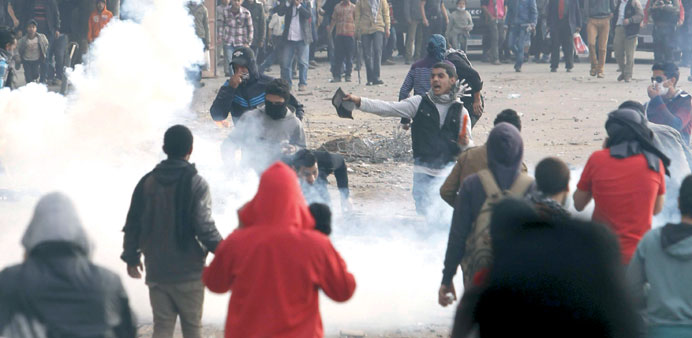
Protesters flee from teargas fired by riot police during clashes in Cairo yesterday.