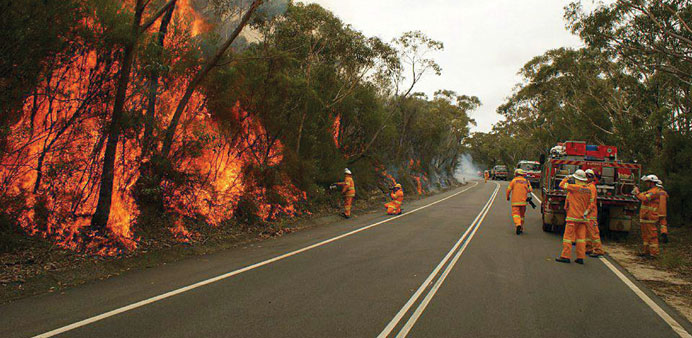
A supplied image of fire crews at a bushfire burning at West Head Road in Towlers Bay, in New South Wales, Australia on January 19.
By Steff Gaulter
Whilst many people in the northern hemisphere are trying to dig themselves out of the snow, the southern hemisphere is in the middle of its summer. This is the time of year that Australia is often on alert for wild fires, and this year the fires have been particularly extreme.
Wild fires are a regular hazard of the Australian summer, but the past few years have actually been quite kind. The summers have been a little cooler than average, and as a result there have been fewer fires and those that have ignited have been fairly straight forward to extinguish. Whilst this has been a relief, the lack of fires over the past few years has allowed the forests to grow and the undergrowth has become thick and dense. Now the weather has turned hot and dry. The forests have turned into tinder wood, creating perfect conditions for wild fires.
The recent blast of hot weather started on December 27 in Western Australia. It spread eastwards, right the way across the country. The winds blew south from the desert interior, bringing hot, dry winds across the southern states. The country had its hottest day on record on January 7, with a nationwide average of 40.33°C (104.6°F), narrowly breaking the previous record of 40.17°C (104.3°F) set in 1972.
As many parts of the country sweltered in these record-breaking temperatures, the air was incredibly dry with a relative humidity below 10%, and the winds were gusting over 70kmph (45mph). These are perfect conditions for fanning the flames of a wild fire.
Many parts of southeastern Australia were scorched by the flames. Survivors told of terrifying conditions, of swirling flames and toxic fumes. One of the worst hit states was Tasmania. The island in the southeast of Australia normally enjoys a more temperate climate than the rest of the country, but this year the temperatures soared.
Fires sparked off throughout the state, with the worst being in the southeast. Here many properties were burnt to the ground, and thousands of people had to find temporary refuge. Even many people whose houses were untouched by the fires were told they would have to wait for several weeks for the power to be restored.
The states of Victoria and New South Wales, together with the Australian Capital Territory, Canberra, were also hit hard by the fires. Hundreds of fires raged in New South Wales, and in the forests around the national capital Canberra. As the fires raged around Canberra, they were described as the worst since 2003, a year that saw hundreds of homes being destroyed. This was also the year that the first confirmed sighting of a fire tornado was documented.
Fires don’t only burn trees and material things, the flames can swirl around and get caught up in the winds. I’m sure you have seen dust devils of sand in Doha, the thin wispy dust swirls that vaguely resemble very weak tornadoes. If these swirling winds catch a blazing mass, they can sweep the flames up into its vortex, resembling a tornado made of fire. Although these might look like fire tornados, they are different from actual tornadoes because they are far weaker and because twisters develop from thunderstorm clouds.
Therefore when you see a tornado, whether it is made of air or just fire, there always has to be a thunderstorm cloud above your head. However, a dust devil which sweeps up a fire is anchored to the ground and does not need to be attached to anything.
Before the pillar of fire in Canberra in 2003 was confirmed as a fire tornado, researchers had only been able to speculate that it was theoretically possible for a fierce blaze to produce one. Never before had enough evidence been collected to give conclusive proof of their existence. However, after studying weather observations, radar data, videos and photos, researchers at the Emergency Services Agency in the Capital Territory found the proof they needed. They certainly didn’t rush to their conclusion, only publishing their findings two months ago, almost 10 years after the event!
The 2003 fire tornado certainly wasn’t a feeble one. It was an EF2, a level two on the five-point Enhanced Fujita scale used to rate the severity of tornadoes. Although the tornado was towards the lower end of the scale of intensity, it was certainly still a powerful storm. To be classed as an EF2, the winds have to be gusting over 178kmph (111mph). As this tornado proved, this is still strong enough to rip roofs from houses and blow cars off roads.
The fire tornado tore towards Canberra, and by the time it reached the suburb of Chapman it had a diameter of nearly half a kilometre (0.3 miles). It barrelled forward at 30kmph, but on the ground, with all the other fires and confusion, it was barely noticed. This gives a clear indication on just how serious the situation becomes during a wild fire. The flames and strong winds, combined with the fear, panic and confusion, mean that an EF2 fire tornado was hardly noticed.
This year, although there has been major damage to property, the loss of life has been kept to a minimum. It is thought that only one man died; he was discovered in his burnt out car in the state of Victoria. The temperatures will continue to fluctuate in Australia for the remainder of the summer, but hopefully the weather over the next few years will be kinder. A repeat of this year’s dry and hot conditions would not be welcome.
(The author is Senior Weather Presenter at Al Jazeera English channel. She can be contacted on [email protected]
or on Twitter at @WeatherSteff)