


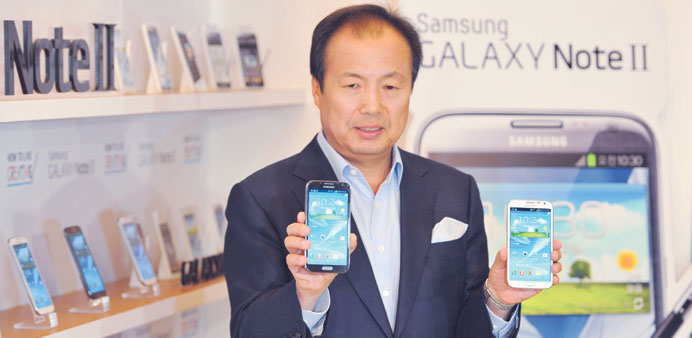
JK Shin, head of Samsung Mobile Communications, poses with Samsung Electronics smartphone Galaxy Note II in Seoul (file). Samsung Electronics turned cautious on spending for the first time since the global financial crisis, keeping its annual investment plan unchanged at 2012 levels.
Reuters/Seoul
Samsung Electronics turned cautious on spending for the first time since the global financial crisis, keeping its annual investment plan unchanged at 2012 levels, as demand for computer chips wanes and the smartphone market slows.
Samsung, one of the industry’s most aggressive spenders, has ramped up capital expenditure every year since 2004 except 2009 to meet soaring demand for its array of consumer electronics and mobile devices. It sold a record 700,000 smartphones a day in the last quarter.
But with the personal computer market shrinking for the first time in 11 years, the global smartphone market growing more slowly, and Apple moving to buy fewer of Samsung’s microprocessors used in the iPhone and iPad, the South Korean IT giant is now forced to keep a lid on spending.
“Overall its earnings momentum remains intact, and smartphone shipments will continue to grow even in the traditionally weak first quarter, as Samsung’s got a broader product line-up and Apple appears to be struggling in pushing iPhone volumes aggressively,” said Lee Se-chul, a Seoul-based analyst at Meritz Securities.
Samsung, which reported a record quarterly and annual profit yesterday, said it would keep 2013 capital expenditure unchanged from 2012.
“The key word for us in investment in 2013 is flexibility. We’ll decide as the market demand dictates,” Robert Yi, head of Samsung’s investor relations, told analysts.
Data from the company shows Samsung started to slow down planned investment in the last quarter.
Samsung said it spent 4.4tn won in October-December, pushing its 2012 investment to a record 23tn won ($21.5bn). But the company said in October that it was on course to spend 25tn won in 2012.
Analysts had expected a 4-20% cut in Samsung’s 2013 capital spending.
By contrast, Taiwanese rival TSMC is planning to raise its capital expenditure to $9bn this year, aimed in part at winning Apple orders away from Samsung.
Shares in Samsung fell 2.1% as of 0250 GMT, lagging a 1.1% decline in the wider market.
Samsung had poured money into factories to boost production of chips and panels used in Apple products and its Galaxy range devices, pushing its operating profit to 8.84tn won in the last quarter. The 89% increase from a year earlier was in line with its earlier estimate.
Profit at its mobile devices division, which makes phones, tablets and cameras, more than doubled to 5.44tn won in the quarter from a year earlier, lifted by a broader offering of smartphones - from the very cheap to the very expensive.
The division accounted for 62% of Samsung’s overall fourth-quarter profit, up from 55% a year earlier.
Samsung is also seeing strong sales of its Note phablet, which analysts expect to help Samsung get through any seasonal weakness better than rivals.
Samsung, which doesn’t provide a breakdown of smartphone sales, is estimated to have sold around 63mn smartphones in the last quarter, including 15mn Galaxy S IIIs and 7mn Note IIs.
Samsung sold 213mn smartphones last year and enlarged its share of the global market to 30.4% from around 20% in 2011, a report by market research firm Strategy Analytics showed on Friday. The sharp increase reflects Samsung’s aggressive marketing of its wide product range.
Apple’s share of the market rose slightly to 19.4% from 19.0% in 2011, according to the report.
Globally, sales of smartphones surged 42.7% last year to 700mn, Strategy Analytics said.
Samsung said yesterday it expects the global smartphone segment to shrink in January-March from the seasonally strong fourth quarter, and that growth of the overall handset market will slow to the mid single-digits this year.
The forecast is in line with industry estimates, with signs of a slowdown having already emerged.
Apple shipped 47.8mn iPhones in the three months ended December, a record that nonetheless disappointed many analysts accustomed to years of outperformance. The Cupertino, California-based company also missed Wall Street’s revenue forecast for a third straight quarter as iPhone sales lagged expectations.
Apple shares have dropped by more than a third since mid-September as investors fret that its days of hyper growth are over and its devices are no longer as ‘must-have’ as they were.
By contrast, shares in Samsung have risen 12% in the same period as the company once seen as quick to copy the ideas of others now sets the pace in innovation.
At the world’s biggest electronics show in Las Vegas this month, Samsung unveiled a prototype phone with a flexible display that can be folded almost like paper, and a microchip with eight processing cores, creating a buzz that these may be used in the next Galaxy range.