


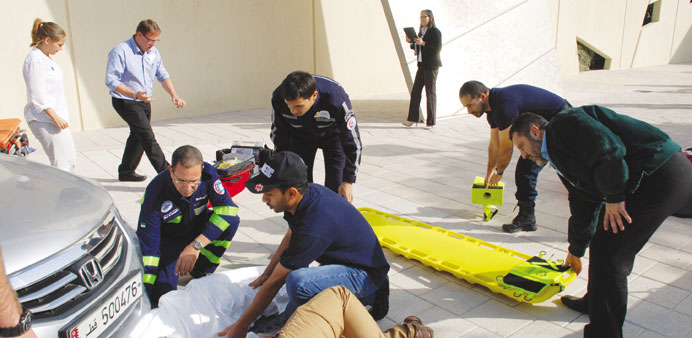
Participants were trained in advanced emergency medical care, which involved realistic simulation of road accidents, falls from height and cardiac arrest.
A first-of-its-kind training course was offered in Doha this week, featuring internationally renowned experts in life-saving techniques.
College of the North Atlantic-Qatar (CNA-Q), in collaboration with Prometheus Medical Mena, recently hosted Qatar’s inaugural Specialist Pre-Hospital Emergency Resuscitation (SPHERe) course on the CNA-Q campus.
There were two key events - a seminar comprising experts in emergency medicine - and a two-day course. The seminar had 130 attendees from emergency medical services throughout the region while the two-day SPHERe course was attended by 29 delegates, all of whom were either senior clinical paramedics or emergency medical physicians with responsibility for paramedic development.
On Sunday evening, CNA-Q hosted an energy-charged event to launch the two-day assembly of specialists in the field. The seminar featured a guest panel of medical experts from the UK and Qatar, including Dr Robert Campbell-Owen, CEO of the Hamad Medical Corporation Ambulance Service; Dr Malcolm Russell, CEO of Prometheus Medical Mena; Dr Richard Lyon, medical course director of Prometheus; and Robin Pap, clinical manager, Hamad Medical Corporation. CNA-Q president Dr Ken MacLeod introduced the panel and explained the training course to the audience.
Dr Campbell-Owen, the opening address speaker, said those first on the scene of a potentially fatal event can make the difference between life and death.
An expert in elite resuscitation, Dr Lyon said the immediate application of first aid and cardiopulmonary resuscitation in particular – known as the chain of survival – would significantly increase chances of surviving a potentially fatal heart attack. The application of CPR by a family member or whoever is on the scene first until EMS providers arrive may make all the
difference.
Candidates from across the Gulf Co-operation Council (GCC) attended the SPHERe programme, undergoing two days of specialist training in pre-hospital major trauma management and emergency resuscitation. They were given advanced clinical training, including realistic simulation, on the college grounds. This involved several scenarios, including falls from height, major road accidents and sudden cardiac arrest.
“CNA-Q’s School of Health Sciences is well equipped to support such an educational initiative and it is our pleasure and privilege to host the first SPHERe training course to be offered in Qatar,” said Irene O’Brien, dean of health sciences. “This event has brought together EMS professionals from around the region to learn from EMS specialists from across the world, providing an outstanding professional development opportunity for all participants. We are confident that this event is the first of many collaborative ventures between industry, healthcare providers and educators here in Qatar, which promotes best practices in the field of emergency medicine.”
Dr Lyon feels the training programme will change the face of emergency medical care in Qatar.“The SPHERe course aims to equip pre-hospital medical professionals with the most advanced clinical knowledge and skills to enable them to provide elite care in the event of a major accident or critical life-threatening emergency, such as a
sudden cardiac arrest.”
“We are deeply committed to helping reduce morbidity and mortality from trauma and cardiac arrest, not just in Qatar, but across the whole of the region,” said Dr Russell.
David Halliwell, managing director of Prometheus Mena based in Doha, says CNA-Q has played an invaluable role in helping them understand how paramedic education works in Qatar. “CNA-Q has been amazing… when I first knew I was coming to Qatar, I sought to meet those responsible for paramedic education. I was fortunate to meet the dean of health sciences, Irene O’Brien, who has been a huge supporter of this initiative,” said Halliwell. “I have also received great assistance from others within the college, who have taken the unusual medical work of Prometheus to their heart. I should add that Dr Robert Campbell-Owen has also been of incredible help.”
Halliwell said the feedback from participants had been overwhelmingly positive.“The participants seemed delighted to have an opportunity to learn from global experts, and to play with new pieces of equipment,” he said. “As the ambulance service in Qatar is very advanced, we have been able to share the knowledge from this country with others from the GCC.”