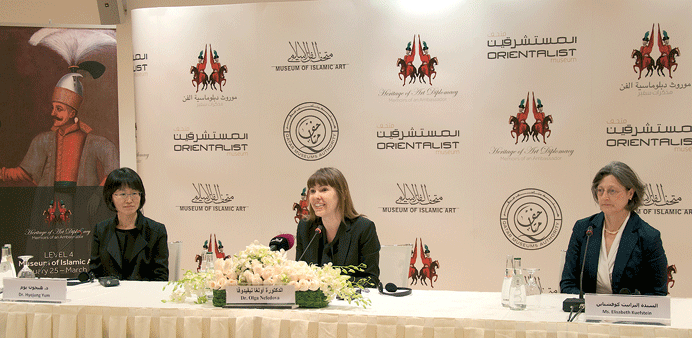
Dr Olga Nefedova (centre) speaks about the exhibition yesterday. Also seen are Dr Hyejung Yum and Elisabeth Kuefstein.
By Bonnie James/Deputy News Editor
The ‘magic’ of art restoration will go on show today when the ‘Heritage of Art Diplomacy: Memoirs of an Ambassador’ exhibition by Qatar Museums Authority’s Orientalist Museum opens for public viewing at the Museum of Islamic Art’ fourth floor gallery.
Four very rare 17th century Austrian oil paintings, restored after a meticulous and painstaking exercise over the past two years involving a team of up to 10 experts, and currently part of the Orientalist Museum’s collection are the key attractions.
Twelve gouache works from a collection in Austria – the original inspiration for the paintings – will also be on display at the exhibition, being held until March 18 under the patronage of QMA chairperson HE Sheikha Al Mayassa bint Hamad al-Thani.
The behind the scenes work of museum researchers and restorers shares the limelight with the four paintings commissioned by the Habsburg Ambassador Hans-Ludwig von Kuefstein after his diplomatic mission to Istanbul.
The House of Habsburg, also known as House of Austria, is one of the most important royal houses of Europe and is best known for being the source off all formally elected Holy Roman Emperors between 1438 and 1740, as well as rulers of the Austrian Empire and Spanish Empire and several other countries.
On the 9th of July 1628, the Grand Embassy of Holy Roman Emperor Ferdinand II, led by Kuefstein, departed from Vienna to Istanbul to the court of the Ottoman Sultan Murad IV.
“Ambassador Kuefstein’s delegation included staff from all categories apart from artists who made the gouache works,” said Orientalist Museum director Dr Olga Nefedova, the curator of the exhibition at a media preview yesterday. She was accompanied by Conservation Department head Dr Hyejung Yum and Ambassador Kuefstein’s family member Elisabeth Kuefstein.
“In addition to its diplomatic and political success, the embassy of Kuefstein is remembered and known nowadays for its artistic legacy and documentation of different aspects of its mission to Istanbul,” Dr Nefedova explained.
These documents include the ambassador’s diary, the draft of a final report to the emperor, some diplomatic correspondences, a list of the gifts presented and received, and a series of gouaches executed in Istanbul, as well as a number of oil paintings. The latter serve as illustrations of various aspects of Ottoman 17th century life and provide a detailed account of the ambassador’s mission.
The restoration process is often described a voyage of discovery, and the investigation and treatment of these four 17th century paintings was no exception, as the conservation and restoration of not one but a group of four very rare, large-scale paintings were both challenging and exciting.
The restoration started in early 2010, and as the paintings were uncrated and unpacked, a unique voyage of discovery began. The restoration process, documented on video, is also being screened as part of the exhibition. The paintings are titled ‘Dinner given by the Grand Vizier in honour of the Ambassador Kuefstein,’ ‘Imperial Procession,’ ‘Janissary,’ and ‘Sbahi.’
Speaking about the restoration process, Dr Yum said a detailed study about all aspects of the painting(s) was undertaken before starting the work. “We learnt about the techniques used by the artist(s), the original materials and tried to recreate them while cleaning and preserving the original work.”
Dr Nefedova recalled that the paintings were in a state of neglect and had been stored for many years, perhaps centuries even, in the bowels of a chateau in France where humidity and temperature were unchecked.
“Layers of thick grime and insect debris, holes, tears, patches and massive deformations of the canvases came to light. Heavy layers of varnish, considerably discoloured over the years, also covered the paintings.
“The original paint layers were further obscured by large areas of overpaint from past restorations, which were obvious even under the heavy layers of surface dirt and varnishes.
“However, despite the poor state of preservation, much of the original material seemed to have survived the centuries and justified an elaborate treatment with the objective to both structurally and aesthetically improve the paintings and meet long-term preservation goals.
“The blackened frames, when cleaned revealed a golden colour, with intricate patterns. They have been restored with gold leaves,” she added.
All the four paintings are attributed to Franz Hormann and Hans Gemminger and assisted by Valentin Muller.
A comprehensive education programme will complement the exhibition including an international conference on March 7. Distinguished scholars and specialists from art history, conservation science, and cultural studies will explore the subject of museum scientific activities in the fields of restoration and preservation.