


|
It is no mystery why the National Football League’s (NFL) Ravens have been embraced by the city of Baltimore after being imported from Cleveland 17 years go. |
A Super Bowl triumph in 2001, nine playoff berths and a shot at hoisting the championship Lombardi Trophy for a second time on February 3 when they face the San Francisco 49ers in New Orleans has helped the Purple-and-Black win hearts in the Charm City.
Jilted by their long-beloved Colts, three-time champions of the old NFL and winners of the 1971 Super Bowl who relocated to Indianapolis overnight in moving vans, Baltimore took a while to warm to their new team.
Baltimore, home of the Colts for 30 years, waited 13 years for the NFL’s return, provided when the late Cleveland Browns owner Art Modell moved his team to Maryland. It was renamed the Ravens after a telephone poll chose the moniker, alluding to the famous poem The Raven by mystery and horror tale author Edgar Allan Poe, who spent the early part of his career in Baltimore. It would be a fresh start for the team, who took University of Miami linebacker Ray Lewis with the 26th pick in the first round of the 1996 NFL Draft.
It was all so new then, of course, for both Lewis and the Ravens. “In 1996 when they drafted me, the first thing I asked was, ‘Do we have a team name? What are our jersey colours going to be and all that?’” Lewis recalled asking Ravens General Manager Ozzie Newsome over the telephone. Lewis, the Ravens’ senior citizen in NFL years, will crown 17 seasons in Baltimore with a retirement party after playing the Super Bowl.
While the Baltimore Colts became famous on the golden arm of quarterback Johnny Unitas, the sure hands of Raymond Berry and the fluid running of Lenny Moore—all three members of the Pro Football Hall of Fame—the Ravens were built on defense.
They went 4-12 in their debut season under coach Ted Marchibroda, a former Colts head coach, and in their fourth season, the Ravens replaced him with Brian Billick, who had been offensive co-ordinator for the high-scoring Minnesota Vikings.
STAUNCH DEFENSE
Billick improved the Ravens from 6-10 to 8-8 but in the next season the defense blossomed into a terrorising force under defensive co-ordinator Marvin Lewis while number one draft pick Jamal Lewis from Tennessee emerged as an elite running back.
After a 5-4 start to the 2000 season, Billick switched quarterbacks from Tony Banks to Trent Dilfer, and a conservative offense paired with the ferocious defense to dominate the NFL.
They won 11 straight games from that point, culminating in a 34-7 thrashing of an intimidated New York Giants team in the Super Bowl played in early 2001.
Baltimore’s defense set an NFL record for fewest points allowed in a 16-game season (165), Lewis was named Defensive Player of the Year and Made the Pro Bowl along with defensive teammates Sam Adams and Rod Woodson.
Billick remained in charge for seven more seasons that included three more trips to the postseason, but was replaced after a 5-11 season in 2007 by John Harbaugh, getting his first head coaching job after years as a special teams co-ordinator for the Philadelphia Eagles.
The Ravens had relied on their staunch defense, fueled by the likes of Lewis, Terrell Suggs, Ed Reed and Haloti Ngata, and their list of defensive co-ordinators has included Marvin Lewis, Mike Nolan, Rex Ryan and Chuck Pagano - all of whom graduated to head coaching jobs.
By contrast, their list of quarterbacks was much less impressive, numbering Banks, Dilfer, Elvis Grbac, Jeff Blake, Kyle Boller and a fading Steve McNair.
The revolving door at quarterback changed with the drafting of Joe Flacco from the University of Delaware, who arrived the same year as Harbaugh.
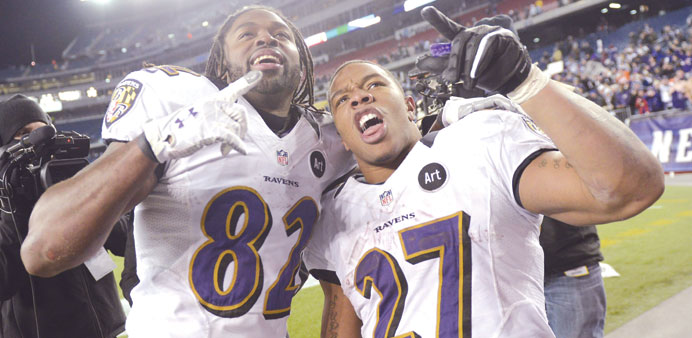
Baltimore Ravens Torrey Smith (L) and Ray Rice (R) gesture into the stands following their win over New England Patriots in the AFC Championship game at Gillette Stadium in Foxborough. (EPA)