


The National Geographic Society (NGS), one of the largest non-profit scientific and educational institutions in the world, is celebrating its 125th anniversary this year. Headquartered in Washington, DC in the United States, this premier institution was founded on January 27, 1888 and its interests include geography, archaeology and natural science, the promotion of environmental and historical conservation, and the study of world culture and history.
The National Geographic Society’s logo is a yellow portrait frame — rectangular in shape — which appears on the margins surrounding the front covers of its magazines and as its television channel logo.
The Society began as a club for an elite group of academics and wealthy patrons interested in travel. Thirty-three explorers and scientists gathered in a club on January 13, 1888, in Washington, DC, to organise “a society for the increase and diffusion of geographical knowledge.” Gardiner Greene Hubbard became its first president and his son-in-law, Alexander Graham Bell, eventually succeeded him in 1897 following his death.
In 1899 Bell’s son-in-law Gilbert Hovey Grosvenor was named the first full-time editor of National Geographic Magazine and members of the Grosvenor family have played important roles in the organisation since.
Over the years, the Society has sponsored many scientific research and exploration. It publishes an official journal, National Geographic Magazine, in 34 languages. It also publishes other magazines, books, school products, maps and publications besides web and film products in many languages all over the world. It gives grants to educational organisations and individuals to improve education in geography.
National Geographic runs a museum for the public in its Washington, DC, headquarters. It has helped to sponsor many popular travelling exhibits.
The National Geographic Magazine, later shortened to National Geographic, published its first issue in October 1888, nine months after the Society was founded as its official journal. There are 12 monthly issues of National Geographic per year, plus at least four additional map supplements. On rare occasions, special issues of the magazine are also created.
The magazine contains articles about geography, popular science, world history, culture, current events and photography of places and things all over the world and universe. Combined English and other language circulation is nearly 9mn monthly with more than 50mn readers monthly.
The magazine is available in its traditional printed edition and through an interactive online edition. On occasion, special editions of the magazine are issued.
The hallmark of National Geographic, reinventing it from a text-oriented entity closer to a scientific journal, to a magazine famous for exclusive pictorial footage, was its January 1905 publication of several full-page pictures made in Tibet in 1900–1901 by two explorers from the Russian Empire, Gombojab Tsybikov and Ovshe Norzunov. The June 1985 cover portrait of 13-year-old Afghan girl Sharbat Gula became one of the magazine’s most recognisable images.
The magazine has covered serious issues such as environment, deforestation, chemical pollution, global warming, and endangered species. In addition to being well known for articles about scenery, history, and the most distant corners of the world, the magazine has been recognised for its standard of photography. This standard makes it the home to some of the highest-quality photojournalism in the world.
The magazine’s Arabic version was launched in October 2010 and is now published in 15 countries across the Middle East and North Africa.
The Society also runs an online news outlet called National Geographic News. It previously published the National Geographic School Bulletin, magazine similar to the National Geographic but aimed at grade school children, was published weekly during the school year from 1919 to 1975, when it was replaced by National Geographic World.
Programmes by NSG are also broadcast on television. The Society sponsors the National Geographic Bee, an annual geographic contest for American middle-school students.
Every two years, the Society conducts an international geography competition of competing teams from all over the world.
The Hubbard Medal is awarded by the Society for distinction in exploration, discovery, and research. The medal is named for Gardiner Greene Hubbard, the first NGS president. — www.wikipedia.org
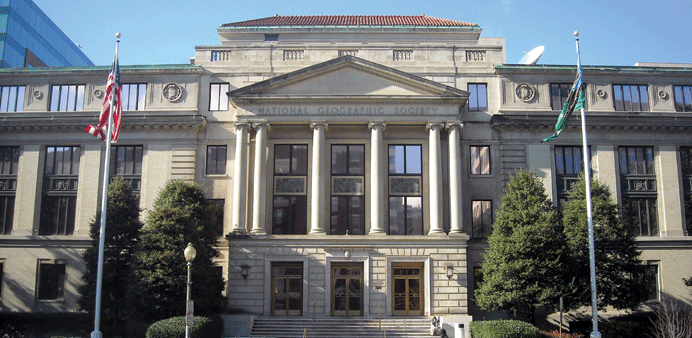
The headquarters of the National Geographic Society in Washington DC.