


AFP/Riyadh
Arab leaders began a two-day economic summit in Riyadh yesterday, calling for the strengthening of mutual trade and co-operation in order to face challenges brought on by the Arab Spring uprisings.
“We should achieve an Arab common market,” said Egyptian President Mohamed Mursi at the opening of the third Arab Economic and Social Development summit, urging Arab nations to “catch up” in the realm of free trade.
“Very little has been done to improve trade between Arab countries,” which reportedly comprises no more than 10% of total Arab commerce.
Saudi Crown Prince Salman bin Abdulaziz, who stood in for King Abdullah in hosting the summit, highlighted economic and social challenges facing the region and also pointed to weak inter-Arab trade.
“The urgent development issues that face our countries are very difficult, including poverty, unemployment and disease. Efforts must be made to confront and eliminate them,” he said.
“The level of trade between us does not match our ambitions.”
Arab foreign ministers who met ahead of the summit prepared a draft agreement on inter-Arab investment, which if approved would allow a free flow of investments and capital between states, Saudi Finance Minister Ibrahim al-Assaf said, according to news reports yesterday.
The 22 Arab states have a total population of more than 367mn, but total Arab gross domestic product represents no more than 3% of global gross domestic product.
The Arab region sits on 62% of the world’s crude oil reserves and its oil-producing nations account for 32% of total global exports.
The area is also home to 24% of the world’s natural gas reserves. But Arab gas exports represented only 5.8% of global exports in 2010.
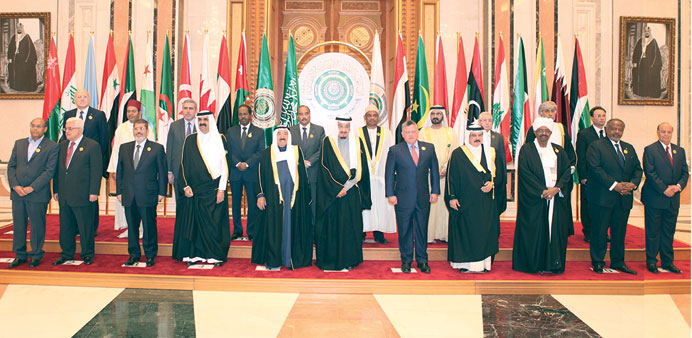
HH the Emir Sheikh Hamad bin Khalifa al-Thani with other Arab leaders at the third Arab Economic and Social Development summit in Riyadh yesterday