


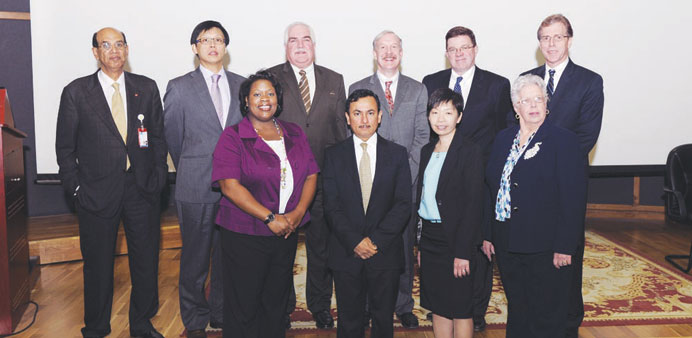
(Front row, from left) ACGME Review Committee for Internal Medicine associate executive director Felicia Davis, Dr al-Khal, Singapore-based National Healthcare Group Education director Yvonne Ng and US National Certification Board for Training Administrators in Graduate Medical Education founding member Jeri Whitten. (Back row, from left) HMC Medical Education assistant director Dr Mohamed el-Tawil, NHG-AHPL Residency Program in Singapore Designated Institutional official Dr Nicholas Chew, ACGME chief financial officer and senior Vice-President John Nylen, Dr Holmboe, ABIM Academic Affairs vice-president Dr William Lobst and Dr Brigham.
The Hamad Medical Corporation (HMC) recently hosted a ‘Grand Round on Professionalism’ lecture to open a three-day workshop and a number of activities that aim to develop the corporation’s faculty, thus bringing the organisation closer to accreditation by the Accreditation Council for Graduate Medical Education – International (ACGME-I).
Grand rounds are an important teaching tool and ritual of medical education and inpatient care, consisting of presenting the medical problems and treatment of a particular patient to an audience including doctors, residents and medical students.
The latest grand round, organised by the HMC Medical Education department, focused on the concept and importance of professionalism among physicians.
“HMC has started a programme on professionalism with the aim of training all the resident doctors on how to be more professional when dealing with patients and their families,” said Medical Education department director Dr Abdullatif al-Khal.
The ACGME-I workshops were held in collaboration with ACGME and ACGME-I. Professionalism is one of the six core competencies that physicians must possess according to standards of the ACGME-I.
The grand round lecture was delivered by Dr Eric Holmboe, MD, FACP, chief medical officer and senior vice-president of the American Board of Internal Medicine (ABIM) and the ABIM Foundation.
He spoke on evolving concepts of professionalism as healthcare becomes increasingly complex and on methods and tools for evaluating professionalism.
Holmboe explained the characteristics associated with professionalism, such as technical competence, altruism, empathy and effacement of self-interest for the interests of the patient, where the physician makes sacrifices to ensure patients are getting the care they need.“
Physicians have the moral responsibility to make sure patients have access to the right care at the right time and at the right place,” Holmboe said.
He said further that physicians have an obligation to pass on what they have learned to others and to developing the future of medicine.
“It is part of our moral and intellectual obligation to the future to make sure we are leaving it for better for those who follow,” ACGME Department of Education chief of staff and senior vice-president Dr Timothy Brigham said.
“Professionalism goes way back in history to the Hippocratic Oath that all physicians have to take – that they will do things for the benefit of the patients. Professionalism is a concept that has become more and more important, and it is one of six domains of competency that every resident has to master in order to go on to the unsupervised practice of medicine,” he pointed out.
Brigham explained that the domains of competency include knowledge about patient care, such as being able to complete procedures correctly and making the right decisions; medical knowledge; communication skills and interpersonal relations (communicating appropriately with patients and other members of the healthcare team); systems-based practice; practice-based learning improvement; and professionalism, which has been getting increasing attention.
The ACGME is the body responsible for accrediting the majority of graduate medical training programmes, such as internships, residencies and fellowships for physicians, in the US and the ACGME-I is the international arm of the ACGME.
HMC has recently achieved institutional accreditation from the ACGME-I, being the first hospital system in the region and the whole Middle East to do so.
Qatar is the second country outside of the US to be conferred with this prestigious accreditation.
“We are now working towards accreditation for 18 individual residency programmes and many other fellowship programmes,” Dr al-Khal mentioned adding: “Each programme will be reviewed for accreditation on its own.
“The workshop and didactic activities were held for programme directors, faculty and GME co-ordinators to help them develop their skills and understanding in certain competencies, as well as to help them improve their residency training programmes and bring them closer to accreditation by the ACGME-I,” the official added.