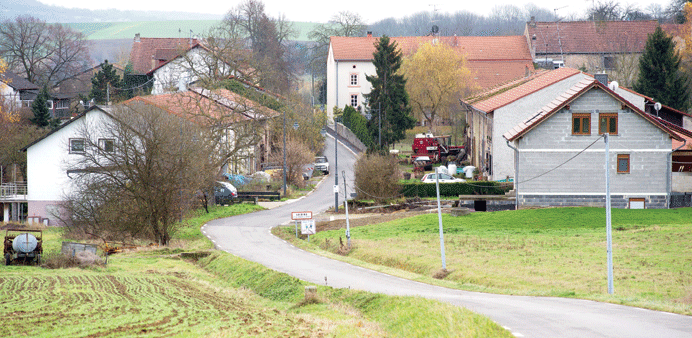
This road divides the village of Leidingen on the Franco-German border. The land on the left side is part of Saarland, Germany. The land on the right is in France. The village has been divided since 1827.
By Nicole Bastong
The bells ring out in Leidingen at noon, first from the bell tower of the French church Jeanne d’Arc, and then seconds later from the German church of St Remigius. They never sound simultaneously.
Leidingen may be one village, but it has two churches and three languages — two that divide, in the form of French and German, and one that unites: the common Frankish dialect.
What is known in German as Leidingen is called Leiding in French. Legally they are two villages on a border. Historically they are one village straddling the border, which runs right down the high street. The division has existed since 1827.
The street even has two names — Neutrale Strasse on the German side and Rue de la Frontiere on the French.
Leidingen lies between Thionville in France and Saarlouis in Germany.
It had a brief moment of fame in 1983 when an author and film director, Alfred Gulden, placed it at the focus of his documentary Grenzfall (Border Issue) which was awarded a German-French journalism prize.
Little has changed over the past 30 years. The village is less agricultural, and there are fewer children playing on the streets.
In 1983 there were still customs officers patrolling the main street.
There were fixed crossing times, and farmers could not simply go to their fields as they wished.
There is little for the occasional American or Japanese tourist to see here when they alight from their coach — an empty street, a derelict house and a few well-kept new buildings. There are few people, perhaps just a cat crossing the road.
“You see only the unreality,” Gulden says.
There is no one for miles around — a kind of no man’s land, a stream, a few villages, meadows and fields.
There Germany, here France, and between them just a street. Cross-border co-operation appeared unthinkable until recently: after such a long history of conflict, it seemed like too much trouble.
But a friendship between a German and a Frenchman has now led to change.
Wolfgang Schmitt, Leidingen alderman and Bathelemy Lemal, mayor of Heining, to which Leiding belongs, have long been friends and colleagues. Now they both hold office and are looking for joint solutions for their respective local body areas.
“This is the first time that the French and German parts of Leidingen have worked together,” Schmitt says. “And that is because the chemistry between us is good.”
Supplying drinking water and sewage for both villages is now done through the German side, while the street lighting for the main road is provided by France. The two sides take turns clearing snow.
“We have already achieved quite a lot,” Lemal says. Previously the border could easily be made out down the middle of the road, as each country tarred only its own half, but today the surface is smooth with the same lamp posts on both sides.
There were problems. EU funds had to be applied for and bureaucratic hurdles cleared on both sides. The two friends have initiated yet another project in the form of mutual border viewing platforms on both sides of the village.
These are two high window frames set in sandstone through which the church on the other side may be seen. Set in the window is Gulden’s poem, The Border, written in the local dialect as well as in German and French.
Each side has to read it in the “foreign” language.
“If you want to understand it, you have to go round to the other side,” the author says.
While it is just a short hop over to the other side, the street once divided people who were not really different. Then an attempt was made to bring their descendants closer together. German-French friendship was promoted and celebrated as an official objective.
“But a lot was repressed in an attempt at harmonisation,” says Gulden, who was born on the German side of the border.
“It is easy though to celebrate and to drink together, but just try to discuss the Algerian war — then the old prejudices come out, the old wounds open up.”
On the French side of the street, 26 people live, while on the German side there are almost 190. There is no shared community life, no central meeting point, no shops, no pub and no football field.
You greet your neighbour and go your own way. “People talk constantly about German-French neighbourliness, but everyone knows that being neighbours is 70% tension and conflict. Why should it be any different here?” Gulden asks.
The border may be invisible, but it is still there. To understand why, you have to know the history of the area. The border was laid down by the Congress of Vienna in 1815. Over the course of 200 years the locals changed nationality seven times.
Sometimes divided, sometimes together, for decades they have now have been either French or German.
“It will remain this way. Nobody wants it any different now,” Schmitt says, as Lemal nods in agreement.
Both sides have grown accustomed to the division. Out of one village, two have developed — in two countries, in past times with two currencies, with two educational systems and two refuse trucks.
The German church has an onion spire, the only one for miles around. The French got their own church in the 1930s when they refused to go to mass under the Nazi swastika.
On one side baguette, cheese and red wine, and on the other sausage and beer — each side has its own culture and idiosyncrasies, although the two are joined by the local dialect.
“But in 20 years no one will understand the other side any more. The Germans don’t speak French, and the French don’t speak German, while the youngsters don’t speak dialect anymore,” Lemal says.
The French mayor speaks fluent German, or rather the local dialect, as his mother tongue. He learnt his French at school. Now the two friends agree: “Language will become a huge problem.”
In an attempt to keep the local dialect going, they now aim to bring the children from the opposite sides together. Schmitt sets out their joint vision for the border region.
“We have but one hope — that there really will be unity in the form of Europe, that we are simply neighbours,” he says. — DPA