


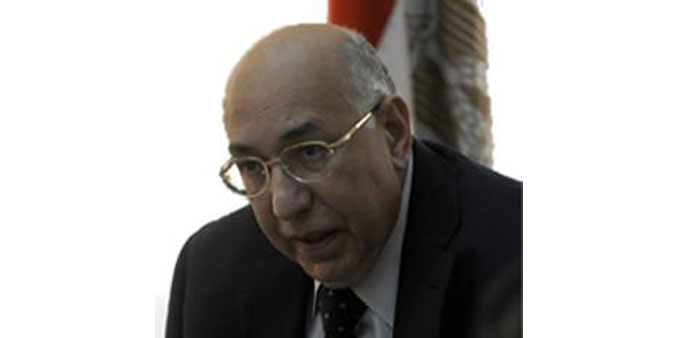
Reuters, Zawya Dow Jones/Cairo
Egypt’s foreign reserves have risen to $15.5bn, helped by a deposit by Qatar to support the economy, its finance minister said, although they are still close to critical levels after being run down to defend Egypt’s currency.
The central bank put reserves at $15.015bn at the end of December. It has implemented a new regime for buying and selling foreign currency and currency controls to try to stem a fall in reserves, which have tumbled from $36bn before the uprising that toppled Hosni Mubarak in early 2011.
Finance Minister Al-Mursi al-Sayed Hegazy told reporters about the new reserve figure yesterday without giving further details about the deposit by Qatar, a generous donor to Egypt.
Qatar said earlier this month it had lent Egypt $2bn and given it $500mn outright. It has pledged to stand by Egypt to help support the nation, which has been battered by political turmoil and violence that has scared away investors.
Hegazy said reserves should rise further in future after approval of a draft law allowing Egypt to issue sovereign Islamic bonds, known as sukuk. The draft law was passed by cabinet this week but needs the backing of the Islamist-led upper house of parliament.
The minister said in December that Qatar had deposited $500mn, although the reserve figure for that month was still around $15bn, the same as at the end of November.
The central bank has said reserves have reached a critical level. At $15bn, reserves cover roughly three months of imports.
Egypt has spent about $21bn of its reserves since the start of 2011 when the uprising against Mubarak erupted, plus several billion dollars in additional aid and support from Qatar and other donors to defend the Egyptian pound.
Cairo is negotiating a $4.8bn loan from the International Monetary Fund. After the deal was agreed in principle in November, it was delayed after Egypt postponed some unpopular tax rises viewed as needed to secure the IMF funds.
An IMF team is expected to return to Egypt in the coming weeks for fresh discussions.
Bill Gates is meanwhile leading a group of US investors who will spend $1bn acquiring a stake in Egyptian fertiliser company OCI in one of the largest currency inflows into the country since the revolution.
In a two-pronged deal, Orascom Construction Industries said it has offered to exchange its outstanding global depository receipts for shares in OCI, its fertilizer subsidiary, which will begin trading on the NYSE Euronext exchange on January 25.
The transaction also includes an offer to buy all of Orascom Construction’s ordinary shares in exchange for OCI shares or a cash amount of 280 Egyptian pounds ($42.41) per share.
The deal has attracted more than $2bn in commitments from international investors, Orascom Construction Industries said in a statement. The Sawiris family and the Abraaj Group, a private equity firm, together own about 60% of Orascom Construction’s GDRs.
The shares swap would be backed by Cascade Investment LLC, which is wholly owned by software mogul. Gates, alongside Southeastern Asset Management and Davis Selected Advisers.
The move will give Orascom Construction “deeper access” to the European market’s cheaper capital, the company said in the statement, allowing the firm to avoid the high cost of capital in Egypt where a revolution nearly two years ago has taken a serious economic toll.
The company is still committed to maintaining its headquarters and employees in Egypt, where it plans to expand its involvement in infrastructure development projects, according to the firm’s statement.
The deal “will not result in any changes to the day-to-day operations of the business in Egypt,” OCI said.
“This transaction is proof of the existing international appetite to invest in Egypt and bodes well for the Egyptian economy with more than $1bn committed by US investors,” said Nassef Sawiris, OCI’s chief executive officer in the statement. “OCI’s existing Egyptian operational headquarters, assets, and 45,000 Egyptian employees comprising half of the group’s global employee base stand to benefit from our expanded access to capital.”
OCI said that the foreign currency funds would be transferred into Egyptian pounds through Egypt’s central bank, offering additional foreign cash to Egypt’s withering currency reserves.
Egypt has bled through much of its foreign currency reserves since a revolution in early 2011 frightened off investors and tourists. The Egyptian pound still faces considerable downward pressure that has pushed the country to the brink of a liquidity crisis.
Despite Sawiris’s stated commitment to remaining an active participant in Egypt’s battered economy, the move may indicate a deliberate shift away from the Egyptian market.