


By Steff Gaulter
Finally winter has arrived in Doha. As usual, it turned up suddenly, rushing in on strong winds and liberally throwing dust around. It certainly got cool here in Qatar, but elsewhere in the region, the weather was far more destructive.
The cold weather we saw in Qatar was part of the same system which brought flooding and damaging winds to the eastern Mediterranean coastline.
A light coating of snow fell in the Greek capital, Athens, and in Turkey’s economic capital Istanbul, and elsewhere in the region the snow was far heavier. There were pictures of people digging snow off the roof of their cars with a spade, and dogs disappearing into mountainous snowdrifts.
Further south along the coastline of the Eastern Mediterranean, it wasn’t cold enough to snow, but it was certainly very wet and windy. Torrential rain brought widespread flooding to many places. At Beirut airport, 137mm (5.2 inches) was recorded in one single day. That’s enough to give flooding almost anywhere in the world, and this is a region which is not very well equipped to deal with wet weather.
Many of the countries along the east coast of the Mediterranean flood when it rains because, like Qatar, the land is baked hard by the sun and therefore can’t readily absorb moisture. This ensures that the rainwater sits on the surface of the land, forming vast puddles.
However, unlike Qatar, the Levant region is quite hilly. This means that the water runs downhill and collects at the bottom of slopes causing major problems, particularly for traffic.
This latest storm system brought days of torrential rain, ensuring the flooding was far more extensive than usual. Almost three-quarters of the average rainfall expected in the entire month of January fell in some cities in just 24 hours, and even after that, it continued to rain heavily for the next few days. In total, the rain fell for five straight days, from January 5 till 9, before finally clearing away on the 10th.
As well as the rain causing problems on the roads and railways, the strong winds also caused their fair share of destruction. Trees and power lines were torn down and power cuts were peppered across the region. The black-outs in Lebanon weren’t helped by an open-ended strike by the employees of the state-run power company. According to the Energy and Water Minister, the electricity workers were preventing anyone from fixing the problems.
With the winds raging, the sea churned. Many of the ports in the region were forced to close for several days as the storm raged. Even the southern port of Alexandria in Egypt was forced to shut.
Some of those worst affected by the storm were those already living in grim conditions. Tens of thousands of people who have fled the fighting in Syria, are currently living in refugee camps in Lebanon, Jordan and Turkey.
The strong winds ripped straight through some tents, destroying them, and many others were flooded by the relentless rain. When you’re living under tarpaulin, it’s incredibly difficult to keep your belongings clean, even if it’s not raining. I can only imagine the misery of those poor refugees whose tents collapsed on them and their families as they slept.
In one camp in Jordan, the misery gave way to anger, and some of the refugees attacked the aid workers with sticks and stones. Seven aid workers are believed to have been injured in the violence.
Snow fell on the mountains throughout the region, as far south as the Tabuk region of Saudi Arabia. Snow is not as rare as you might think in the mountains of north-western Saudi Arabia. On average it snows every three or four years, which is just rare enough to create a wave of excitement in the region. Many locals braved the icy conditions up Mount Allouz. The side of the road was crammed with people in parked cars, just watching the snow.
In Doha, we watched the stories of the storm across the Levant region, whilst we baked in weather which was pleasantly warm for January. The system headed east, bringing heavy snow to northern parts of Iraq and Iran, but the tail end of the system dragged southwards.
The part of the system which headed south did not have the immense moisture that was seen to the north, but it brought a lot of wind and a surge of cold air. In Kuwait temperatures dropped from 22°C (72°F) on January 9, to 16°C (61°F) the following day. The night time temperatures, which had been no lower than 12°C (54°F), suddenly plummeted to just 5°C (41°F).
The cold weather then marched southwards, down the Gulf. Bahrain saw the front before Doha. At about 10am, the winds swung round, to fire down from the northwest, and the winds increased dramatically. Just over three hours later, the cold blast reached Doha.
In the few hours leading up to its arrival it was unusually hot in Qatar.
The winds were blowing from the south, drawing up warm, humid air. The average January temperature in Doha is 21.7°C (71°F), but on Thursday 10 January, the temperatures climbed up to 28°C (82°F). This is nearer the temperature you’d expect in April rather than January.
Suddenly the winds swung round, screaming down from the north. Instantly the temperatures started to drop away. During the afternoon, the winds continued to pick up, eventually gusting to 61kmph (38mph) early the next morning. The day after the temperatures had soared to 28°C, they could only struggle to 19°C (66°F), and the winds ensured it felt even colder.
Over the next month or so, we can expect more cold snaps to hurtle their way down the Gulf towards us here in Qatar. Even if the temperatures creep up again in the next few days, don’t put those winter woollies away just yet.
(The author is Senior Weather Presenter at Al Jazeera English channel. She can be contacted on [email protected] or on Twitter at @WeatherSteff)
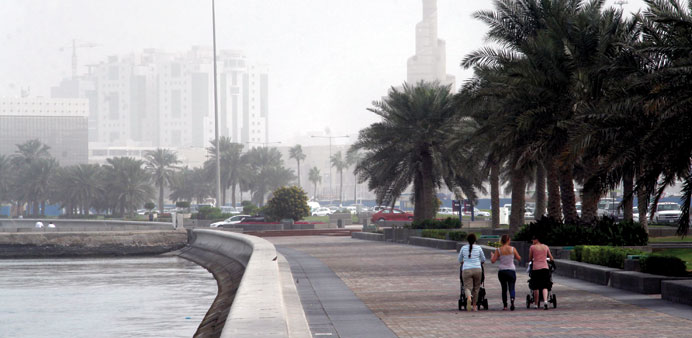
In the few hours leading up to the arrival of the cold weather, it was unusually hot in Qatar. Photograph by Najeer Feroke