


Fran Gillespie profiles Lord Charles Spencer Denman, one of the last British representatives in the Arabian Gulf, who died in November 2012
The death of Lord Charles Spencer Denman at the age of 96 in November 2012 saw the passing of almost the last of the British representatives who remembered Qatar as it was in the 1940s. Along with his friend, the British political officer Sir John Arthur Wilton, who died in June 2011 at the age of 89, Lord Denman could look back to the time when Qatar was just beginning to recover from the poverty that had afflicted it after the end of the pearling trade in the 1930s.
Lord Denman came from a very distinguished family — his uncle had been Governor-General of Australia in the early 20th century and his grandfather was a Lord Chief Justice.
But he himself started his career in a more humble role, as a gardener and later the owner of a market garden. However, all this was to change after World War II. Denman was recognised and decorated as a war hero when as a soldier in Egypt in 1942 he was wounded by a grenade but organised the rescue of a more seriously wounded comrade under very dangerous conditions.
The time spent in Egypt left Denman with a life-long fascination with the region, and after the war he found employment with the merchant traders Charles Tennant and Sons and came out to the Middle East.
For the next 61 years Denman made constant visits to the Arabian Gulf countries and Saudi Arabia, first as a businessman and then as a representative of the British government.
After his retirement he regularly accompanied British trade delegations as an advisor and unofficial diplomat. He was chairman of the trustees of the Arab-British Chamber Charitable Foundation which helped Middle Eastern nationals study in Britain, and a trustee of the charity Medical Aid for Palestinians.
At the age of 90, deeply disturbed about the involvement of British troops in Afghanistan, he visited the country to find out at firsthand about the conditions there.
I interviewed Lord Denman on what proved to be the last of his many visits to Doha, in February 2010. His memories of people, places and names from more than 60 years ago were remarkably clear. The following excerpts are taken from the transcript of the interview:
• “I was a merchant for a company called C Tennant & Sons & Company and we were building up a trading relationship with the Middle East; we had business in Iraq and Egypt. The Gulf was just beginning to move. I’d been in Bahrain and was told I should go over to Qatar, as the first of the oil revenues was just coming in and they would need some commercial agency to help them develop. I came over from Bahrain in a very small plane and we landed on the desert. The only building was a barasti hut.
“I was appointed together with Abdullah Darwish. He was really the dominant commercial figure in Qatar and we were in joint harness.
“Abdullah was a very forthright man and always said what he thought. Sheikh Ali made several visits to London, state visits, and I was responsible for much of the arrangements. On one occasion Abdullah Darwish and I came in ahead of Sheikh Ali who was going to stay in the Dorchester Hotel.
“Abdullah and I went to inspect the hotel, and when we went into the suite, the furniture was all what I would call ‘old English oak.’ Abdullah took one look and said, ‘You can’t have all this rubbishy furniture,’ — this was to the man from the Dorchester, — ‘Take the whole lot away and bring in something more acceptable.’ By which he meant the gilt furniture which was admired at the time, and it was done!
“While we were in London, Abdullah said he wanted to buy a Rolls-Royce. We got the head of the firm to come to the hotel, and we spent a long time going through the catalogues and deciding what it was he wanted. He eventually bought two, and then came the question of paying for them. Whereupon a suitcase of money was produced from under the bed and — I think it was about £70,000 — we spent the whole evening counting out £70,000 and giving it to the Rolls-Royce man to pay for these cars!”
•“Geoffrey Hancock was the Adviser to the Ruler. He’d been in the Sudan Political Service, which we always thought was the creme de la creme of the Arab world. He was a considerable success here, because he was a fine man, and I think Sheikh Ali liked him and he was a good Arabist. He was here for quite a long time.
“When I used to come here I usually stayed with Geoffrey and his wife Honor. They lived in a house which was just across from the old Diwan palace — you know the Clock Tower? — just across from there.
“I remember driving out with Geoffrey Hancock to an oasis where there was a big cistern of water, I suppose they must have had motor-driven pumps, and there was an old sheikh who was voluble in describing to Geoffrey how they had seen off the last of the Turkish soldiery in 1915 — I didn’t understand Arabic of course, but you could see he was enjoying telling the story to Geoffrey!”
• “Doha in those days was a typical mud building Arab town. There we no fine buildings or anything like that, it was like a rabbit warren with the little narrow streets going through. Our job was to bring in all the building materials for developing the place once they had some oil money. They were building the hospital, and we were largely responsible for that. John Harris won a competition to design the hospital, he was quite a young man and this was his first big contract.
“The engineer Hugh Hale decided they ought to put in mains drainage for the hospital and they had to dig trenches for the pipes; some of the trenches were very deep. We were appointed to do all the commercial work for the government but we were not appointed to manage all the money that was coming in. That was given to Barings.
“There was an old Barings director called Sir Edward Reid, and he had to come out here. I saw him in London several times to tell him what we were doing and what was happening, before he came out. It was customary for the British — Cochrane who was the head of the police force, and Hancock and the others — to entertain him for dinner in rotation. One evening he’d been dining with the Hancocks and was on his way home and he fell down one of these very deep trenches.
“He was a fat little man and he jammed between his stomach and his backside about half way down and was waving his legs about and bellowing like a bull! He couldn’t do anything, he was stuck. At last somebody heard him and we all had to go and get ropes and pull him out. The indignity was awful: he was a man who was very conscious of his own importance.”
•“The police had quite a substantial launch which was used at weekends for picnicking. I remember going out with Cochrane somewhere down the coast and we found a boat bringing pilgrims from Indonesia. It was said that the people running these boats would collect money from the pilgrims, put them ashore somewhere down near Umm Said and tell them. ‘You just go over that hill and you’ll find Makkah.’ And of course the people often died. It was said that the boat people would then come back and pinch all their possessions. Cochrane knew about this and he arrested the ship and we brought it back to Doha with us.
“I don’t remember what he did with the pilgrims. The maltreatment of pilgrims was endemic, it happened both in the Red Sea and here. ”
•“Another thing we had to do was to recruit staff for the government — police officers, engineers, even, I think, doctors. And we also had to look after any Qataris who were sent to England either for education or for medical reasons.
“Sheikh Ali was often given rather grand presents by the oil companies, they used to hand out cars and all sorts of things. Somebody gave Sheikh Ali an aged sea yacht, quite a big thing. In the end I had to arrange for it to be taken away and broken up somewhere in India because it was too expensive to repair. At around the same time somebody gave Sheikh Ali an elephant. I remember the elephant and its mahout standing mournfully outside the port and no one knowing what to do with it!”
•“There was an Englishman called Colonel Merrilees who was an expert water diviner. I was flying over with him from Bahrain and he had his divining stick with him and it was jumping about. I said, ‘Col. Merrilees, if you look out of the window you’ll see there’s rather a lot of water around!’ But he said that I didn’t understand what he was doing, he was divining where fresh water came through the sea bed. There were a lot of fresh water springs between here and Bahrain and the fishermen used to dive down and capture the fresh water and take it to sell in Bahrain.”
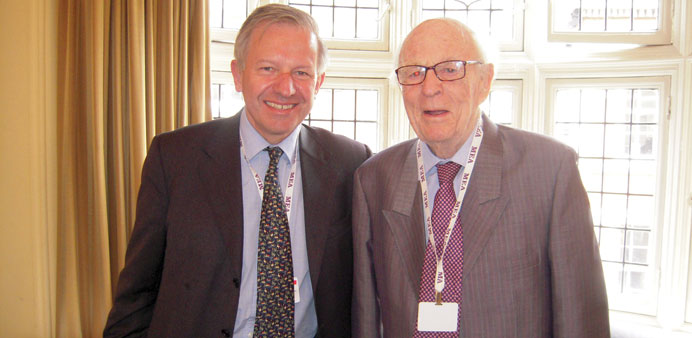
Lord Charles Spencer Denman (right) with Sir Sherard Cowper Coles.