


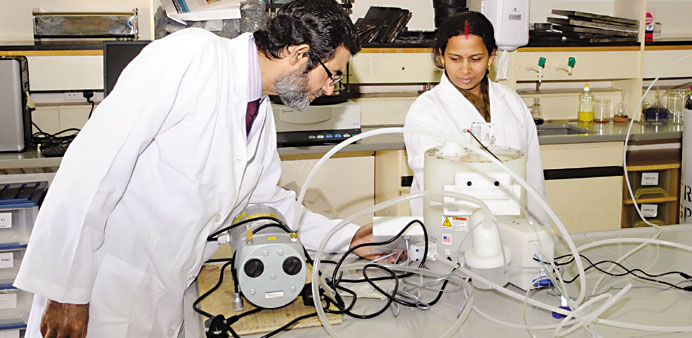
Dr Madi and Dr Bhadra in the laboratory of Qatar University’s Centre for Advanced Materials. PICTURE: Shemeer Rasheed
By Bonnie James/Deputy News Editor
Pioneering research is progressing at Qatar University’s Centre for Advanced Materials (CAM) to develop inexpensive and highly efficient conducting polymer based sensors (electronic nose) for detecting toxic gases.
The research fraternity includes associate professor and CAM director Dr Mariam al-Ali al-Ma’adeed, research associate and external manager Dr Noora Jabor al-Thani, associate researcher Dr Nabil Madi and post-doctoral researcher Dr Jolly Bhadra.
“The quality of the air we breathe is one of the most important concerns of the modern society,” Dr Madi told Gulf Times in an interview.
The emission of gaseous pollutants such as sulphur oxide, nitrogen oxide and toxic gases from related industries has become a serious environmental concern.
“Sensing of these gases, therefore, is at the forefront of the information acquisition chain about the environment in which we live,” explained Dr Bhadra.
Analytical gas sensors offer a promising and an inexpensive solution to problems related to such gaseous pollutants, according to Dr Madi.
The use of conducting polymers, such as polyaniline, polypyrrole and polythiophene, have gained a growing interest in the development of chemical sensors arrays for gas analysis in electronic engineering applications, he pointed out.
Conducting polymers can form selective layers in which the interaction between the analyte gas and the conducting matrix generates the primary change of a physical parameter in the transduction mechanism.
These sensors are worn by workers in the petrochemical industry to get accurate alerts about the presence of toxic gases and whether their concentration is harmful to health or not, Dr Bhadra stressed.
“Conducting polymer sensors have a number of advantages over gas sensors based on metal oxide semiconductors, which are widely used in the petrochemical industry,” Dr Madi stated.
If metal oxide semiconductor sensors are expensive and require a high operation temperature and long recovery period after each gas exposure, conducting polymer sensors are inexpensive and function in very low temperatures with good repeatability and low response time, he explained.
However, the poor solubility, deterioration in mechanical properties and processability limits their application. “We have to make them stable by blending with some insulating polymers and improve conductivity through doping with different acids or some metal oxides in nano scale,“ Dr Madi said.
Dr Bhadra revealed that various attempts have been made by CAM, using percolation phenomena, to blend polyaniline with insulating polymers such as polystyrene, polyvinyl alcohol or polyvinyl chloride that will enhance the mechanical strength of sensors.
“We have already succeeded to detect the concentration of carbon dioxide and ammonia gases, by using these sensors and the next step will be to develop high sensitivity and reversibility sensors through doping with nano metal oxides,” she said.
The blend solution upon drying can be made into a thin, freestanding, flexible film, which is easy to handle and therefore could be used in sensing application.
The blends are investigated by different techniques to analyse the chemical structure, thermal stability and electrical property and used to check sensitivity towards various gases under different atmospheric conditions.
“The polyaniline based sensors show good sensitivity to analytic gas with good repeatability and low response time. Even a small change in the concentration of analytic gas can be detected through conductivity change of the polymer,” Dr Bhadra stated.
Until now, Dr Madi and Dr Bhadra have tested in the lab the sensitivity and reversibility of the newly developed conducting polymer sensors to carbon dioxide and ammonia. Field tests would come at a later stage.
Raw materials such as polyaniline and polythiophene are inexpensive. Though polypyrrole is costly, only a few millilitres are needed in the lab.
Developing sensors for detecting toxic gases like hydrogen sulphide and nitrogen oxide are also on the agenda, Dr Bhadra said while pointing out that conducting polymer sensors are yet to be commercially available despite on-going global research since 2000.