


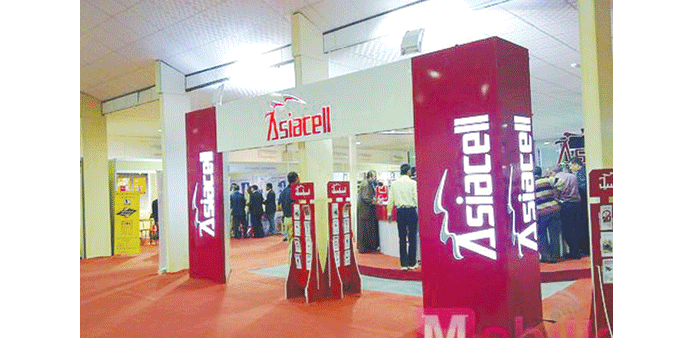
Asiacell, which is majority-owned by Qatar Telecom, plans to raise 1.49tn dinars ($1.3bn). The IPO is seen helping double the market value of the Iraq Stock Exchange (right) from $4.66bn last year.
Bloomberg/Dubai
Asiacell Communications, the Iraqi telecom operator planning the Middle East’s biggest initial share sale since 2008, has received commitments from sovereign-backed funds, according to the deal’s organiser.
Institutional investors from the Arabian Gulf, Europe and the US have registered orders, said Shwan Ibrahim Taha, chairman of Rabee Securities in Baghdad, the sole arranger of the initial public offering. “Some of these funds are sovereign backed,” he said in an e-mailed answer to questions on Tuesday without naming any of the funds.
The company, which is majority-owned by Qatar Telecom, plans to raise 1.49tn dinars ($1.3bn), the most for an initial public offering in the Middle East and North Africa since Saudi Arabian Mining Co (Maaden) received $2.5bn more than four years ago, according to data compiled by Bloomberg.
The IPO will help double the market value of the Iraq Stock Exchange from $4.66bn last year, chief executive officer Taha Ahmed Abdul Salam al-Rubaye said in a January 7 interview. That compares with $383bn for Saudi Arabia’s stock exchange, the largest in the region, $62bn for Egypt’s gauge and $9bn for Lebanon.
The sale will be the first in “a wave of listings” that will boost activity on the Iraq Stock Exchange, Taha said. Like Asiacell, Iraq’s two other main mobile companies - Zain Iraq, a unit of Kuwait’s Mobile Telecommunications Co, and Korek Telecom, part-owned by France Telecom - must sell 25% of their shares on the bourse as part of their contract.
“The Iraqi telecom market is promising as the country has the required critical mass and strong economic growth,” said Nabil Farhat, a partner at Abu Dhabi-based Al Fajer Securities. The success of the IPO will “depend on the risk appetite of the investors in relation to the turmoil in the political situation there.”
Iraq, which overtook Iran in June as the largest producer behind Saudi Arabia in the Organisation of Petroleum Exporting Countries, is reviving its energy industry nine years after the US-led invasion that toppled Saddam Hussein. Bouts of violence and sectarian tension, though, have hindered the recovery of the non-oil industry.
The bourse opened in 2004 after shutting down during the invasion, and prices were updated manually on a white board before electronic trading was introduced in 2009.
Banks have the largest market value among 74 listed companies, according to the latest data from the bourse received by e-mail January 15.
Asiacell obtained a 15-year mobile telecom licence in Iraq in 2007 and had 43% market share by revenue at the end of September with 9.9mn individual and corporate subscribers, the Sulaymaniyah-based company said in a December 25 statement. Holders will offer 67.503bn shares -equivalent to 25% of stock - at a minimum of 22 dinars a share, it said. The offer opened on January 3 and will close on February 2.
EFG-Hermes Holding, a Cairo-based investment bank, is offering international investors access to the Asiacell placement through its equity-swap product linked to Iraqi securities, according to Julian Bruce, head of institutional trading in Dubai.
“It’s really the first offering that should help to build a deep equity culture in Iraq as we see in other big Middle Eastern markets like Saudi Arabia and Egypt,” said Taha. “It’s all about giving ordinary Iraqis the opportunity to share the wealth of the country’s growing economy.”