


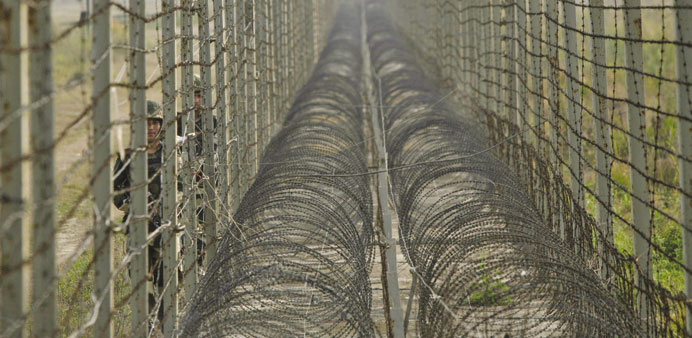
Border Security Force (BSF) soldiers patrol the fenced border with Pakistan in Suchetgarh, southwest of Jammu yesterday.
Agencies/New Delhi
India’s army has reached an “understanding” with Pakistan to “de-escalate” military tensions in Kashmir after a recent deadly flare-up in the disputed border region, a spokesman said yesterday.
“An understanding has been arrived at between the two directors-general of military operations to de-escalate the situation along the Line of Control (LoC),” army spokesman Jagdeep Dahiya said in reference to a de facto border in Jammu and Kashmir.
Dahiya said that the two sides’ senior military commanders had spoken for 10 minutes over the telephone where they reached their agreement.
“The two DGMOs spoke to each other at 10am for 10 minutes and the Pakistan DGMO said strict instructions have been passed not to violate the ceasefire,” he said.
Dahiya said Indian troops stationed along the border would also not breach the ceasefire forged between the two nuclear-armed rivals in 2003.
“We have always upheld the ceasefire and have only retaliated,” the spokesman said.
He did not give further details of the conversation between India’s DGMO Lieutenant General Vinod Bhatia and his Pakistani counterpart, Major General Ashfaq Nadeem.
An Indian military source in Kashmir said there had been no cross-border firing since the two generals spoke.
Earlier, the village of Dara Sher Khan in Pakistan’s Tatta Pani sector, where a solider was killed on Tuesday night, appeared deserted yesterday as residents cowered in their homes.
Mohamed Afsar, a former army man, said he and his family hid under bedding in their newly-built house, which was damaged by mortar shrapnel fired by Indian gunners.
“Indian soldiers keep watching our activities and we live in a state of constant fear,” he said.
The two generals spoke hours after Pakistan’s Foreign Minister Hina Rabbani Khar hit out at strident comments by Indian politicians over the clashes, and warned against “upping the ante” between the neighbours.
India says two of its soldiers have been killed, one of them beheaded, since hostilities erupted along the LoC. It has demanded the return of the soldier’s head which is still missing.
On Tuesday India was meant to begin allowing Pakistanis over the age of 65 to obtain a visa on arrival at the border in Punjab.
However the programme was put on hold indefinitely hours after Indian officials said it had come into force, although the delay was attributed to “technical” reasons.
Nine Pakistani players were also withdrawn from a new field hockey league in India and asked to return home.
Earlier, security analysts said Pakistan had to take concrete steps to reduce tensions. They also asserted that India’s “no business as usual” move towards its neighbour was a reflection of public sentiment.
Former Intelligence Bureau chief Ajit Doval said it was for Pakistan to address India’s concerns over the killing of its soldiers, through proper follow-up action that India could verify.
“The ball is in Pakistan’s court. If it takes suitable measures, the situation can be de-escalated. That would be in the interest of both countries,” Doval said.
“It will necessitate some concrete and verifiable actions by Pakistan rather than mere assurances,” he said.
Doval said Pakistan needed to stop violating the LoC. It must also act to trace the culprits responsible for killing and mutilating Indian soldiers, he said.
“Somebody is responsible, and Pakistan needs to take action,” he said.
Prime Minister Manmohan Singh said on Tuesday there can be “no business as usual” with Pakistan. He called on the neighbouring country to ensure that those responsible for the barbaric and heinous act be brought to book.
Indian Army chief General Bikram Singh on Monday termed the January 8 incident a “gruesome and an unpardonable act.” He said his forces could not be expected to remain passive, and would reserve the right to retaliate at a time and place of their choosing.