


By Noimot Olayiwola/Staff Reporter
The Supreme Council of Health (SCH) yesterday began a 10-day introductory certificate course for experienced health professionals to provide them with the knowledge and critical understanding of the principles and processes of designing, monitoring and evaluating a disease control programme in Qatar.
The two-week programme, ‘Designing and Management of Disease Control Programmes,’ being conducted here by the Liverpool School of Tropical Medicine (LSTM) and delivered through its new Centre for Health in the Eastern Mediterranean, is aimed at senior and mid-level health professionals working in the area of public health and health interventions. The overall aim of the module being taught at the course, which is a first-of-its-kind course to be organised by Liverpool School of Tropical Medicine in the Gulf region, is designed to introduce participants to good practice in planning, monitoring and evaluation of disease control programmes, through the development of skills and experience in the use of modern tools to plan, monitor and evaluate a specific project relevant to their work.
Other specific aims of the programme are to enable participants to develop knowledge and critical understanding of how to organise, manage and monitor a disease control programme for Qatar; become familiar with the latest recommended interventions to control the diseases in question and to consider effective mechanisms to implement and evaluate interventions.
“The major problem with communicable disease programmes is providing effective planning, monitoring and evaluation so that the programme responds promptly to changes in the major indicators of effectiveness,” LSTM reader in International Health Dr Amir Hassan, who is also the new centre’s External Teaching Programme lead, said yesterday.
“Interventions to control those diseases are well described at the international level but translating these into locally effective programmes can be a barrier to successful implementation,” he said.
He said that a country such as Qatar should not have the main problem of lack of resources, but political commitment and suitably trained manpower may be lacking and the organisation of the health sector may require some adjustments for the effective implementation of such programmes.
“Participants on this module will be taught how to take account of changing epidemiological and demographic profiles, become familiar with the latest recommended interventions to control selected diseases, and consider effective mechanisms to implement the interventions. They will also be given a range of options for graphically monitoring the success of the programme,” he said.
Dr Hassan said that another 12-week diploma course is being planned within the next six months based on the collaboration between LSTM and the SCH.
Both institutions are exploring more collaborations in healthcare programmes, he mentioned.
The SCH Public Health Department director Dr Mohamed al-Thani mentioned in his opening speech during the course that policy makers, programme staff and researchers face many questions related to the monitoring and evaluation of public health programmes.
“While there is a shortage of staff with the skills to answer these questions, monitoring and evaluation skills are crucial to the successful implementation, design, monitoring and evaluation of Disease Control Programmes,” he said.
He mentioned that monitoring and evaluation (M&E) which was hitherto weakly conducted or simply ignored, is now becoming an integral and indispensable part of the policy cycle and within the SCH public health programmes allowing for feedback into future health policy planning.
The successful completion of the programme including obtaining a pass mark at the assessment, will lead to participants being awarded with a certificate issued by the LSTM.
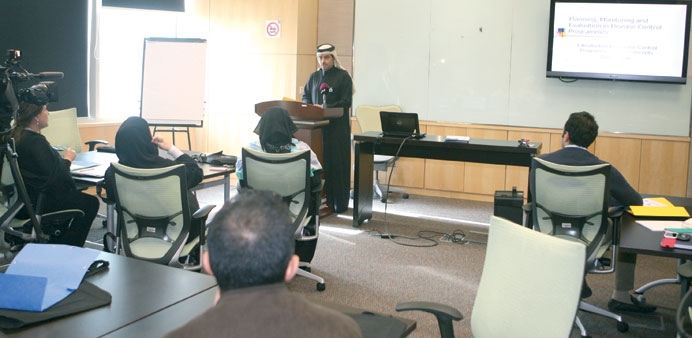
Dr Mohamed al-Thani speaks during the opening of the course yesterday.