


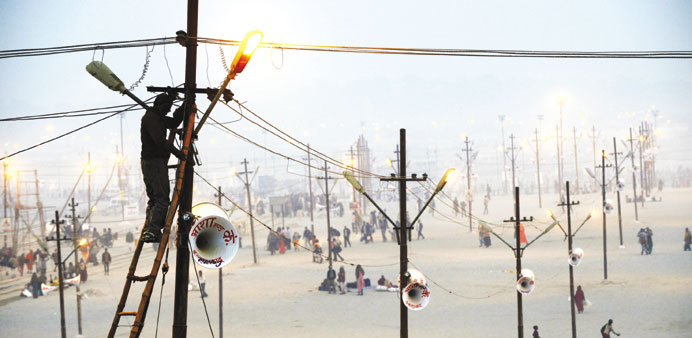
Workers fix a light post, one of many that will illuminate the vast grounds receiving Hindu devotees arriving for the Kumbh Mela, in Allahabad yesterday.
DPA/New Delhi
An estimated 11mn Hindus are expected to take a ritual dip in the Ganges River in the northern Indian town of Allahabad today, amid concerns over high pollution levels.
Hindus believe the ritual of the Kumbh Mela pilgrimage, the full version of which comes once every 12 years, cleanses the soul of sins and clears the path to heaven.
But environmentalists who recently conducted a testing tour concluded that none of the major rivers in northern India, including the Ganges, are fit to bathe in.
“We found, to put it simply, no river is a river, they are all sewers,” researcher Anil Prakash Joshi said.
“If you have any plans to take a holy dip in the Ganga in the upcoming Kumbh Mela, then you are more likely to be swimming in a soup of toxic content,” the Times of India newspaper reported.
Despite increased expenditures on sewage treatment plants, the Ganges still contains large volumes of human waste and garbage near Allahabad, the report said.
Industrial effluents also pour in from factories and other places along the river, including a hospital.
“The (hospital’s) waste disposal plant, constructed by the British and located behind the hospital, has been lying defunct for ages,” the Times of India reported.
Upstream dams have led to a decreasing volume of water at Allahabad, where the Ganges and Yamuna rivers join. Human settlements along the river have also increased by more than 20%, according to local government estimates.
Each year, religious leaders who lead the march into the river take a close look at the colour of the water and often threaten to boycott over high pollution levels.
The administration usually responds by letting additional volumes of water flow from the dams.
The Kumbh Mela, with its procession of sadhus, holy baths on designated days and a host of other rituals begins today and continues over 55 days through March 10.
Pollution warnings have not deterred the religious fervour over the Kumbh, with the festival administration saying it expected a total of 88mn people to attend the event.
Photographers, journalists, writers and tourists follow the Kumbh in search of inspiration. Among the celebrities expected this year is Hollywood actress Catherine Zeta Jones.
“I’m told it is a sight to behold for the eyes and soul. I’m hoping to find what I’m looking for here,” Times of India quoted her as saying.
More than 12,000 policemen will be deployed this year. Stampedes at Kumbh Mela are not uncommon, with huge crowds trekking down temporary roads and bridges to temporary steps leading to the river.
The worst stamped occurred in 1954 when more than 500 people died. During the 2003 festival in the western town of Nashhik, 45 people were crushed to death.