


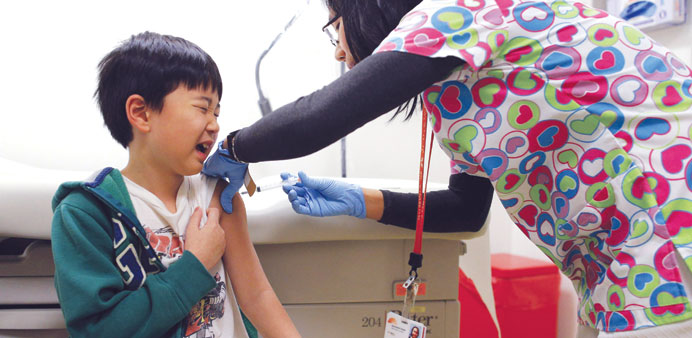
Reuters/Boston
Influenza has officially reached epidemic proportions in the US, with 7.3% of deaths last week caused by pneumonia and the flu, the US Centres for Disease Control and Prevention has said.
The early start and fast spread of flu this season - especially after 2011-2012’s very mild outbreak - has overwhelmed doctors’ offices and hospitals, forcing some patients to wait through the night to be seen in emergency departments.
Nine of the 10 US regions had “elevated” flu activity last week, confirming that seasonal flu has spread across the country and reached high levels several weeks before the usual late January or February, CDC reported. Only one region - the Southwest and California - had “normal” flu activity last week.
Tens of thousands of Americans die every year from flu, even in non-epidemic years. The threshold for an epidemic is that it causes more than 7.2% of deaths, but as yet there is no definitive count of the total caused by flu this year.
In Boston, flu cases are 10 times higher than they were last year, causing Mayor Thomas Menino to declare a public health emergency on Wednesday.
In Illinois, 24 hospitals struggling to cope with the flood of flu cases had to turn away people arriving in the emergency department, while in Pennsylvania, the Lehigh Valley Hospital outside Allentown has set up a tent for people who arrive with less-severe flu.
A total of 20 children have now died from this season’s flu, up two from the previous week, the CDC said. That compares to 34 during the full 2011-2012 flu season and 282 during the severe 2009-2010 season.
The outbreak has led to attempts at prevention that go beyond the standard advice of getting vaccinated, avoiding contact with sick people and frequently washing hands with soap.
In Boston, the Catholic Archdiocese has told priests they could suspend the offering of communion wine using a shared chalice and bow rather than shake hands while exchanging the Sign of Peace, a Christian greeting.
Auxiliary Bishop Robert P Deeley urged priests to use hand sanitizer before and after communion and to avoid touching congregants’ tongues or hands. He said parishioners who were ill “should remain at home and return to church when they are well.”
While flu vaccines offer protection, they are not failsafe.
This year’s flu vaccine is 62% effective, scientists reported on Friday in the CDC’s weekly publication, meaning that almost four in 10 people who receive the vaccine and are exposed to the virus will nevertheless become infected.
This is considered “moderate” effectiveness and is in line with previous years’ flu vaccines, which range from 50% to 70% effective, Dr. Joseph Bresee, chief of the CDC’s influenza division, told reporters.
Experts recommend the vaccine for everyone over six months of age. Even if it does not prevent flu, immunisation can reduce the severity of the illness, preventing pneumonia and other life-threatening results of flu.
Public health authorities were correct in their forecast of which flu strains would emerge this season and therefore what vaccine to make: one that contains two strains of influenza A and one strain of influenza B.
An A strain, called H3N2, predominates this season, though the B strain has caused about 20% of cases.
About 10% of cases have been caused by a B strain that is not in the vaccine, which “has space for only three strains,” CDC director Dr Tom Frieden said.
According to the most recent CDC data, 37% of Americans - 112mn people - had received the flu vaccine as of mid-November.