


AFP/DPA/Giglio Island, Italy
The Costa Concordia cruise ship wreck will be removed from the island of Giglio by September at the latest, the head of Italy’s civil protection agency said yesterday on the eve of the first anniversary of the disaster which claimed 32 lives.
“The programme envisages the definitive removal by September,” Franco Gabrielli told a press conference on the island, following a series of technical delays in the biggest salvage operation of a passenger ship ever attempted.
“We are talking about a window for the removal between June and, if the weather conditions are adverse, September,” he said. “This is a completely exceptional operation.”
“It has been said that the ship will be refloated in September to be then towed away. We hope that it will be refloated by July,” Costa Crociere director-general Gianni Onorato said in an interview with the La Stampa newspaper.
Four hundred salvage workers have been employed in the removal by a partnership between United States salvage giant Titan and Italian salvage company Micoperi.
The operation is being financed by insurers for ship owner Costa Crociere, Europe’s biggest cruise operator and a part of US-based Carnival Corporation.
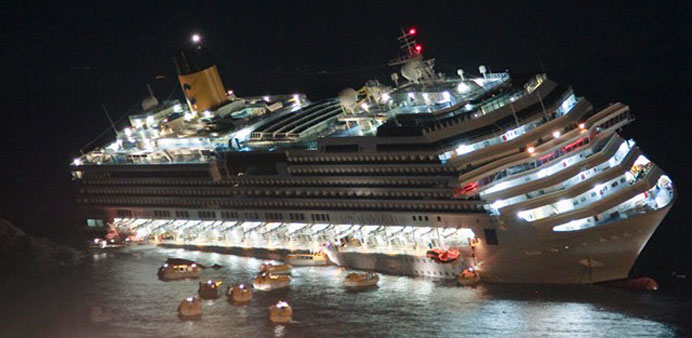
The 290m long Costa Concordia – with a gross tonnage of more than twice that of the Titanic – crashed into Giglio and keeled over with 4,229 people from 70 countries on board on the night of January 13, 2012.
In Giglio, representatives of Costa Crociere told journalists that the operation would cost $400mn, $100mn more than previously budgeted.
On Friday, the outgoing government of Prime Minister Mario Monti extended the “emergency situation” over the Costa Concordia – an administrative act that allows the cutting of red tape – until the end of the year, to speed up salvage operations.
Legambiente, Italy’s leading environmental organisation, said it was “strongly dissatisfied” with progress.
Local residents are keen to get rid of the wrecked hull, regarding it as a grim eyesore and a threat to tourism.
Gabrielli retorted that it was an operation “that does not have any precedent” and stressed how difficult it was.
“(It is not like I could) go there, take the ship, put it in my pocket and take it away,” he quipped.
But he insisted that authorities had been successful in minimising the environmental damage.
“The data I receive every day ... leads me to say that ... the impact has been minimal if not non-existent,” he said.
The Concordia ran aground after its captain, Francesco Schettino, steered it dangerously close to Giglio’s coast, causing it to hit rocks. Two of the victims – an Indian member of the crew and an Italian tourist – are still missing.
Schettino is being investigated for manslaughter and other serious crimes, but Costa’s managers also risk indictment, amid allegations that getting ships to sail close to islands was standard company practice.
“I refute that in the most absolute terms,” Onorato told La Stampa.
He also insisted it had been certified that “the ship was OK, that onboard systems were functioning and that the company respected all the rules”.