


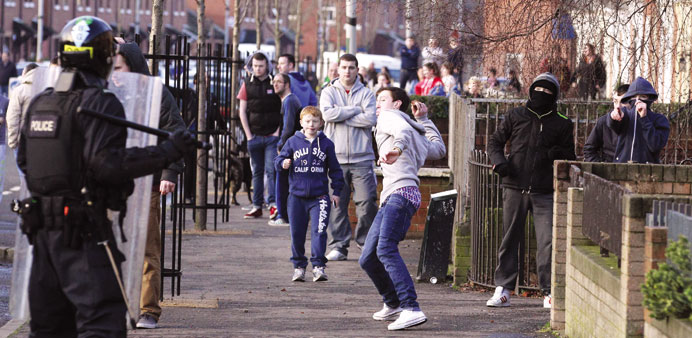
Nationalist youths throw rocks at the police during rioting in East Belfast yesterday.
Reuters/Belfast
Four police officers were injured during clashes between pro-British and Irish nationalist youths in Belfast yesterday following another protest against the decision to remove the British flag from city hall.
Nationalists threw golf balls and stones at a crowd walking home from a rally in the city centre demanding for the return of the flag. Police used water cannon and at least one plastic bullet round in a bid to restore calm.
The unrest over the past five weeks has been some of the most sustained in the British-ruled province since a 1998 peace deal ended 30 years of conflict between Catholic Irish nationalists seeking union with Ireland and Protestant loyalists determined to remain part of the United Kingdom.
Exposing a deep vein of discontent with the peace deal, loyalists have held nightly protests since councillors voted last month to end a century-old tradition of flying the British union flag every day over the city hall.
Loyalist politicians have joined their nationalist rivals in condemning the violence, but they have been unable to prevent groups of young men draped in British flags from clashing with police.
The protesters have complained that the removal of the flag was a step too far in the ebbing of loyalist dominance in the province, saying too many concessions had been given to Irish nationalists in a power-sharing government.
At least 1,000 loyalists, some with British flags and “No Surrender” banners, gathered at City Hall yesterday. Hundreds of police were escorting them back towards east Belfast when the clashes began.
Reinforcements including dozens of jeeps, a helicopter and at least three water cannon trucks were sent in to try to control the crowds.
On Friday pro-British loyalists torched a bus and hurled petrol bombs at officers.
Violence also flared in towns outside the capital Belfast as loyalists—the Protestant community’s working-class hardcore—blocked roads around the province to express their anger.
Most of Friday’s province-wide protests were peaceful, with demonstrators taking the flag onto the streets, but serious disorder broke out in the towns of Newtownabbey and Carrickfergus, just north of Belfast.
Police fired water cannon and five plastic bullets at rioters after they were attacked with a total of 33 petrol bombs, as well as fireworks and masonry.
Four officers were injured, with one requiring hospital treatment, police said, bringing the total number of officers injured since December to around 70.
Two early arrests were made.
In the seaside town of Carrickfergus on Friday, dozens of armoured police vehicles drove in to restore order after around 100 protesters threw bricks, bottles and fireworks and torched plastic trash bins.
In the shadow of Carrickfergus Castle, rubble littered the junction of Irish Gate and West Street. Groups of youths in tracksuits lingered as police in riot gear with plastic shields stood by.
One Carrickfergus man who did not want to be identified blamed the disorder on youths from Belfast who had travelled north on the train.
“I could see them from my house coming out of the station, young guys aged 15 or 16,” he said.
Some youths kept warm standing by burning debris.
Queen Elizabeth II gave her grandson Prince William the subsidiary title Baron Carrickfergus when he married Kate Middleton in 2011.
In nearby Newtownabbey, a double-decker bus was set alight on the Rathcoole housing estate, sending clouds of black smoke into the rainy skies.
Masked youths later threw petrol bombs and missiles when police entered the estate.
The Westlink, which joins Northern Ireland’s M1, M2 and M3 motorways in Belfast, was closed for three hours following a bomb scare.
Army technical officers found a “small, viable pipe bomb-type device” which was removed for further examination, a police spokesman said. A car was also torched in Belfast city centre.
A 1998 peace agreement brought an end to the three decades of sectarian violence between Protestants and Catholics known as the Troubles, but sporadic bomb threats and murders by dissident republicans continue.